

If cognitive behavioural therapy teaches you to catch a troubling thought and question whether it’s true, acceptance and commitment therapy does something that sounds almost like the opposite.
It says: do not fight the thought at all. Let it be there.
Stop wrestling with it, and turn your energy instead toward the life you actually want to lead. It’s a close relative of CBT, grown from the same root, but it reaches for acceptance where CBT reaches for argument.
How to do it
ACT’s most distinctive move is called cognitive defusion: a set of small techniques for loosening a thought’s grip, so you can see it as just a thought rather than a fact you must obey.
You’re not trying to argue with it or make it go away – only to step back far enough that it stops pulling the strings.
Next time a harsh thought has hold of you, try one of these.
- Name it as a thought. Instead of “I am going to fail”, say to yourself: “I am having the thought that I am going to fail.” The small reframe puts a sliver of space between you and the thought – you are the one noticing it, not the thought itself.
- Thank your mind. When the worry arrives, try answering it lightly: “Thanks, mind.” It sounds odd, but it acknowledges the thought without obeying it – treating the anxious mind as a well-meaning but overzealous companion rather than a voice of truth.
- Say it in a silly voice. Repeat the thought in a cartoon voice, or sing it. It feels ridiculous, and that is the point – a thought you can sing cannot frighten you in quite the same way.
- Watch it pass. Picture the thought written on a leaf, floating down a stream, or on a cloud drifting across the sky. You do not push it away – you simply watch it arrive, and watch it go.
None of these makes the thought untrue, or makes it vanish. That’s not the aim.
The aim is to change your relationship to it – from gripped, to merely aware – so the thought can come and go without deciding what you do next.
Where it comes from
ACT – usually said as the word “act”, not spelled out – was developed by the psychologist Steven Hayes from the 1980s onward, as part of what became known as the third wave of cognitive behavioural therapy.
The first wave was behavioural; the second was Beck and Ellis and the challenging of thoughts; the third turned toward mindfulness and acceptance.
Hayes noticed something the challenging approach could miss: the effort of fighting our difficult thoughts and feelings is often a large part of the suffering itself.
The struggle exhausts us, and rarely wins.
So ACT proposes a different deal. Rather than trying to control or correct your inner experience, you learn to make room for it, and to commit your actions to what genuinely matters to you even while the discomfort is present.
Acceptance, and commitment. The name is the whole method.
Worth knowing
The insight at its heart is that much of our pain comes not from the difficult feeling itself, but from the second struggle we pile on top of it: the fighting, the avoiding, the desperate wish for it to be gone.
It teaches you to unhook from your thoughts, hold your feelings more lightly, and keep walking toward what you care about regardless – on the understanding that a meaningful life isn’t one without discomfort, but one where discomfort no longer makes the decisions.
The aim is not to feel better, but to get better at feeling. The evidence is solid and still growing.
ACT is well-supported for anxiety, depression, chronic pain, and stress – and it shines particularly where the struggle itself is the problem, where someone has been fighting their own experience for years.
Two caveats are worth naming, though. It’s newer than classic CBT, with fewer trials behind it, so the evidence base, while good, isn’t as deep – and some researchers argue that, for all its different philosophy, its results aren’t clearly better than standard CBT.
So it’s best thought of not as a replacement, but as a different lens – one that suits some people, and some problems, far better than argument ever could.
The defusion exercises above are genuinely usable on their own, and offer a fair feel for how ACT thinks – its lightness, its refusal to wrestle.
But ACT in full is a richer course of work, weaving together acceptance, defusion, mindfulness, and a careful working-out of your own values, usually with a trained therapist.
Recommended reading
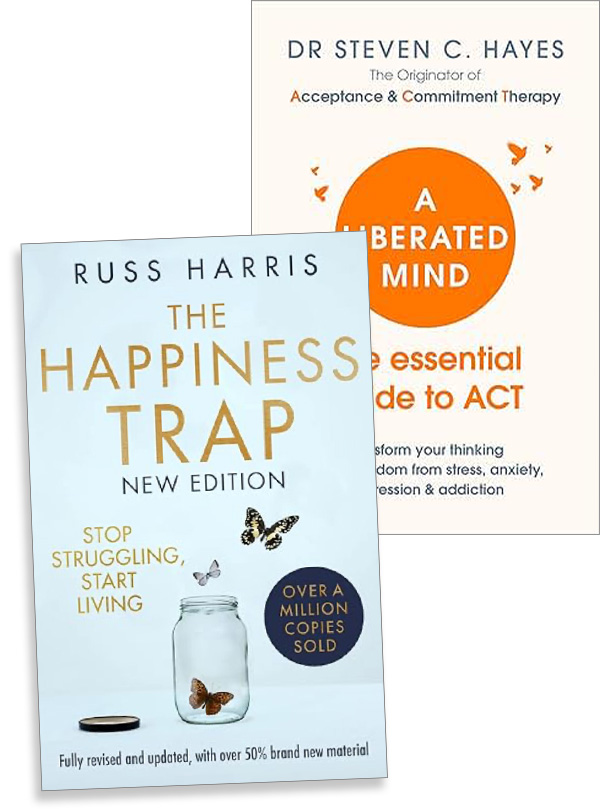
Russ Harris’s The Happiness Trap is the natural starting point – by far the most popular introduction to ACT, warm and practical.
For something more detailed, Steven Hayes’s own A Liberated Mind is a fuller account from the psychologist who developed the method.