

Most effort assumes the thing being pushed against will eventually give. Acceptance starts from the opposite assumption – that it won’t, not this time, not from this. And asks what’s left to do once that’s actually been taken on board.
It sounds like giving up, and that’s precisely why people resist it for as long as they can. Nobody wants to mistake acceptance for defeat. So the fight continues well past the point where it was doing any good, out of a fear of what stopping might mean.
But the fight itself has a cost, separate from whatever it’s fighting. Energy spent resisting an unchangeable fact is energy not spent on anything that could actually help.
None of this asks you to approve of what’s happened, or to pretend it doesn’t hurt.
It’s closer to putting a heavy bag down than to deciding you never wanted to carry it – the weight was real, and so is the relief of no longer holding it up.
How to do it
None of it happens in one sitting, either. A short list of ways toward it, taken slowly.
- Separate what can still be changed from what genuinely can’t. Stop spending effort on the second pile.
- Notice the specific sentence being repeated. “This shouldn’t have happened” – ask what it’s actually accomplishing.
- Let the feeling be there. You don’t need it gone by a particular day.
- Say what happened plainly, at least once. Without the softening or the story built around it.
- Ask what accepting this would free up. Notice the energy it would leave for something else.
None of it needs to look like peace from the outside to count, either. Acceptance can sit right alongside grief, anger, or sadness. It isn’t the removal of the feeling, just the end of the argument with the fact underneath it.
It’s the stopping of the fight, more than any comfort that follows it, that seems to matter. The relief tends to arrive afterward, once the resisting has actually stopped – not as a reward for accepting, more as what was left once the struggle wasn’t using up the room any more.
Where it comes from
The through-line connecting Stoicism, Buddhism, and modern acceptance-based therapy is essentially the same insight, arrived at independently by very different traditions across very different centuries: the goal isn’t the elimination of difficulty, but a changed relationship to it.
The case for letting go over resisting has more recent, empirical backing too. In 1987 the psychologist Daniel Wegner ran what became known as the “white bear” experiments, asking people to speak their thoughts aloud for five minutes while trying not to think about a white bear – and, almost without exception, they couldn’t.
Worse, when the same people were then told they could think about a white bear freely, it came to mind even more often than for people who’d never been told to suppress it in the first place. That finding has been replicated many times since, and it’s the empirical backbone behind the case for acceptance over suppression.
Worth knowing
Approaches built around acceptance rather than suppression consistently outperform pure avoidance strategies, across a range of difficult emotional states.
“Just let it go” has become one of the most repeated pieces of advice going, often delivered as though acceptance were a switch that could be flipped through willpower or a single decisive moment.
Genuine acceptance of something painful is rarely instant, and treating it as a simple decision can leave people feeling like a personal failure when the fight doesn’t stop on command.
The reality is a slow, uneven process rather than a single moment of letting go.
What survives that correction is still worth having: acceptance remains one of the most consistently supported psychological tools available, even though the popular shorthand for it promises a speed and simplicity the actual process rarely delivers.
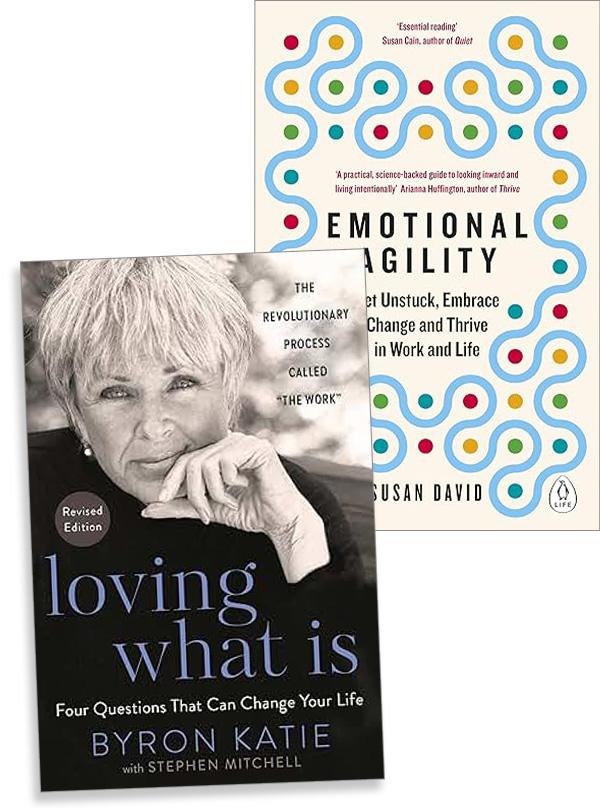
Recommended reading
Byron Katie’s Loving What Is is the natural starting point – a simple, practical method for questioning the thoughts that keep a struggle going.
For something more contemporary, Susan David’s Emotional Agility takes a more research-grounded approach to the same territory.