
Most of what unsettles a mind has an object – a deadline, an argument, a diagnosis. This one doesn’t, quite.
It sits underneath the others, rarely named directly, and a great deal of ordinary busyness turns out to be a fairly effective way of not looking at it.
Modern approaches to anxiety often build an enormous amount of material around managing the feeling, while carefully avoiding what a great deal of that anxiety is actually about.
None of this needs to be morbid to be worth doing. The intention isn’t to dwell, or to frighten yourself into gratitude.
It’s closer to the plain, steadying effect of finally naming a thing that’s been circling unnamed for years.
How to do it
None of it needs a special occasion, either. A short list of ways to bring it in gently.
- Notice when a worry is really about mortality wearing a smaller costume. Rather than treating it as a separate problem.
- Read a few lines of Marcus Aurelius or Seneca. You don’t need to agree with all of it.
- Say the word plainly to yourself occasionally. Rather than reaching automatically for a softer one.
- Let a funeral or a health scare prompt a plain thought. Rather than rushing straight past it back to normal.
- Ask what would actually matter if time were shorter than assumed. Notice whether today reflects the answer.
None of it needs to be resolved to be worth sitting with, either. This isn’t a problem with a solution waiting at the end of it – more a fact that becomes easier to carry once it’s been looked at plainly.
What seems to matter most is the plain act of looking, more than any particular comfort drawn from it. Looking at it squarely tends to produce something closer to clarity than despair, though only once the initial discomfort of looking has been allowed to pass.
Where it comes from
The Stoics didn’t try to avoid this. Marcus Aurelius wrote to himself about it most mornings, not because he found the subject easy, but because he suspected that most of what disturbs a person is made worse by the refusal to look at it directly.
He wasn’t alone in reaching that conclusion. Philosophers across very different traditions arrived at a similar practical idea independently – memento mori in Rome, impermanence in Buddhist teaching, the medieval Ars Moriendi’s guidance on dying well.
All converge on the same idea: that a clear-eyed relationship with mortality tends to produce calmer engagement with life, not less of it.
Worth knowing
A body of psychological research going back decades has found that unexamined fear of death appears to drive a surprising amount of ordinary behaviour – status-seeking, tribal loyalty, harsh judgement of outsiders, an unconscious way of buying a sense of permanence through group or belief.
Bringing the fear into conscious view, rather than leaving it to operate unnoticed, appears to loosen its grip on decisions made in its shadow.
This isn’t an area with tidy statistics or a marketable technique attached, which is itself worth noting – there’s no app, no percentage, no six-week programme promising to resolve a person’s relationship with their own mortality.
This remains genuinely unresolved territory rather than a settled finding, though. Philosophers and researchers broadly agree that facing mortality tends to help, but there’s no consensus on exactly why, or on what “facing it well” should actually look like in practice.
What can be said with more confidence is narrower but still real: assiduously avoiding the subject altogether appears to leave its influence unexamined and unmanaged.
Which is reason enough to give it some undramatic, unhurried attention rather than reason to fear the exercise itself.
Recommended reading
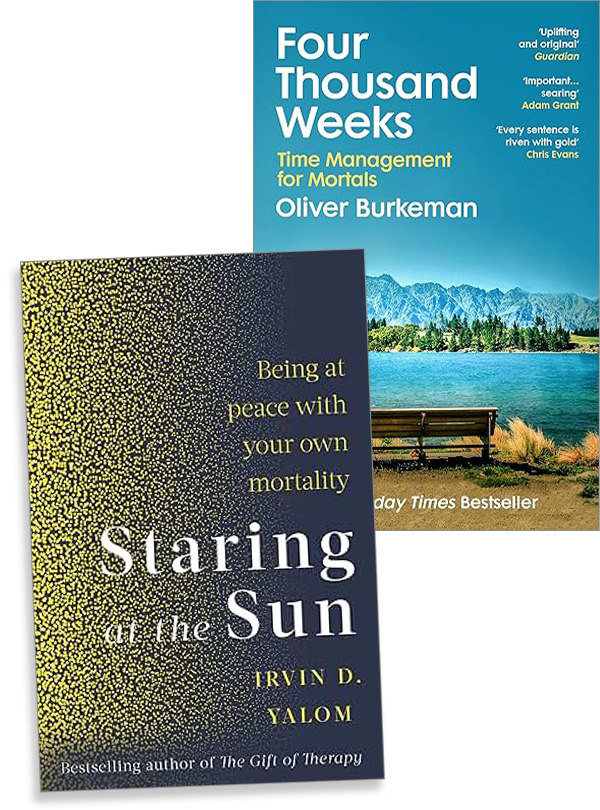
Irvin Yalom’s Staring at the Sun is the natural starting point – a psychiatrist’s compassionate, direct engagement with exactly this territory.
For something more contemporary, Oliver Burkeman’s Four Thousand Weeks takes mortality as its starting point for rethinking how time is actually spent.