

Doing nothing sounds easy, but most of us find it strangely difficult. Left with nothing to do, we reach for a phone within seconds – not because the moment is unpleasant, but because empty time makes us uncomfortable.
That discomfort turns out to be worth exploring. The mind isn’t actually idle during this kind of stillness. Which is probably why a solution so often arrives in the shower rather than at the desk.
How to do it
Doing nothing well seems to take a surprising amount of structure. A few habits make it easier to sit with.
- Set a fixed, short time limit before you start. Five or ten minutes is plenty at first. Open-ended stretches tend to end in reaching for a phone.
- Remove the phone from reach entirely, not just from view. Proximity alone seems to be enough to pull attention back.
- Let boredom arrive rather than heading it off. The discomfort tends to pass within a couple of minutes if you let it, rather than filling it.
- Notice the urge to be productive with the time, and let it go unanswered. That urge is the thing this pathway is practising against.
- Afterwards, notice whether anything surfaced unprompted. An idea, a decision, a memory. That’s usually the sign the time did something.
- And if the itch to reach for something wins anyway, that’s alright too. The point is noticing the pull, not defeating it every single time.
Where it comes from
The mind’s activity during rest wasn’t taken seriously until fairly recently. In the late 1990s, the neurologist Marcus Raichle, at Washington University in St. Louis, kept noticing that a specific set of brain regions grew more active during the “resting” control periods of his scanning studies, not less.
He named the pattern the default mode network in a 2001 paper. The discovery overturned a basic assumption: the brain at rest isn’t idle, it’s doing something – memory consolidation, problem-solving, the loose associative thinking this pathway draws on.
Worth knowing
Modern life offers very little practice at this. A phone in the pocket means unstructured time rarely goes unfilled for more than a few seconds, and doing nothing is culturally coded as unproductive, even indulgent.
One study found that many people, left alone with their thoughts for fifteen minutes, would rather give themselves a mild shock than sit with the silence – which says less about how bad boredom is, and more about how little practice most of us get at tolerating it.
Psychologists studying boredom suggest the discomfort isn’t really about the emptiness itself, but about what surfaces once the usual distractions are removed. Doing nothing may simply help the mind in ways it dislikes while it’s happening.
The Dutch word “niksen” – doing nothing for its own sake – had something of a media moment a few years ago, presented as a distinct wellness technique with its own research base.
Recommended reading
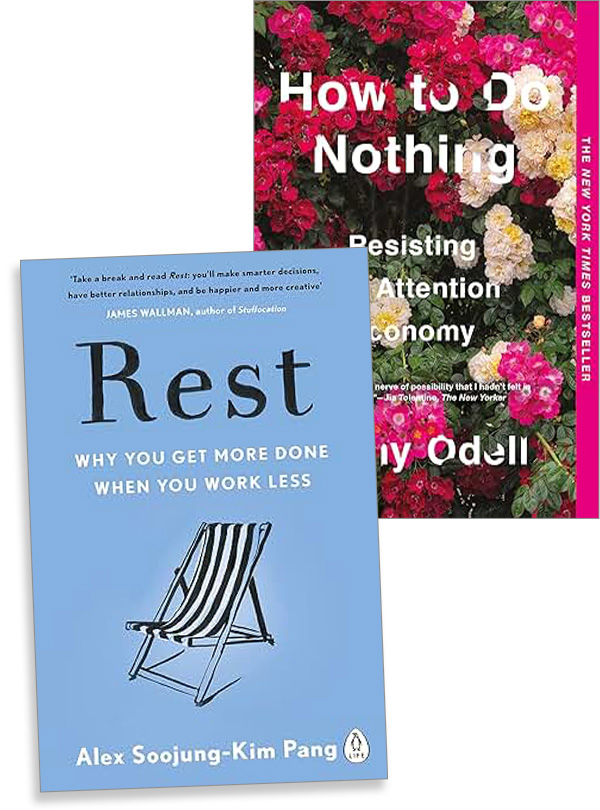
Alex Soojung-Kim Pang’s Rest is the natural starting point – an accessible, well-researched case for why deliberate rest makes us more productive, not less.
For something more contemporary, Jenny Odell’s How to Do Nothing takes on this exact idea directly, as a form of resistance to the attention economy.