
There’s something different about gardening compared with sitting quietly or breathing deliberately – it actually asks you to do something.
Digging, watering, weeding: small physical tasks that seem to settle the mind at least as well as stillness does, and quite possibly better.
This isn’t just a nice idea. Gardening offered deliberately as a form of care – often in groups, sometimes through NHS social prescribing – has been tried everywhere from prisons to dementia wards to ordinary allotments, with results that hold up wherever it happens.
How to do it
You don’t need land, or even much time, to draw on this. A few habits seem to make the difference between gardening as chore and gardening as something closer to therapy.
- Choose a small, repeatable task over a big one-off project. Watering, deadheading, weeding a single bed. Repetition seems to matter more than scale.
- Let your hands do the noticing. Soil texture, leaf shape, the give of a weed coming free – these small physical details are where the settling effect seems to live.
- Work to no deadline if you can help it. Trials report weaker benefits when gardening is rushed or treated as another item to clear.
- If you have the option, garden alongside someone else, even in comfortable silence. The social element appears to add to the effect rather than dilute it.
- Notice the result, however small. A cleared patch, a watered pot. The sense of visible progress is doing real work here.
None of this needs doing perfectly. A few pulled weeds count for as much as a full afternoon in the beds.
Where it comes from
The therapeutic use of gardening has real institutional roots. In the 19th century, the American physician Benjamin Rush – now considered the father of American psychiatry – was among the first to document its calming effect on patients with mental illness.
Asylums on both sides of the Atlantic began offering garden work as part of care not long after.
Horticultural therapy became a formal profession in the 1970s. More recently, the UK’s NHS has folded gardening into social prescribing – referring patients to community activities, gardening among them, alongside or instead of medication.
Worth knowing
Studies of gardening as a deliberate practice report steady drops in stress and low mood after sessions, comparable to other outdoor activity and sometimes stronger than exercise done indoors.
The effect seems strongest when it’s repeated – a regular visit to the same patch, rather than a single afternoon spent potting plants.
Dementia care has produced some of the more striking findings, with gardening linked to calmer, brighter mood even among people for whom talking therapies are no longer reachable.
Unlike walking or simply sitting near water, gardening asks something of you, and that may be exactly the point. Occupational therapists sometimes describe it as offering a rare combination: gentle physical activity, a task absorbing enough to crowd out rumination, and a visible, growing result that rewards patience rather than urgency.
You may have come across claims that soil contains a bacterium, Mycobacterium vaccae, that acts as a “natural antidepressant” by boosting serotonin – a finding that traces back to a single mouse study from the mid-2000s.
It’s been repeated widely enough to sound established, but it’s never been convincingly replicated in humans, and no gardening trial has shown the effect is actually driving the benefits people report.
The calming effect of gardening is real and reasonably well evidenced. The soil-bacteria mechanism, specifically, is not – it’s a good story that has outrun its evidence.
None of this requires a garden of your own. Community gardens, allotment volunteering, and even a few pots on a windowsill draw on much the same effect.
Recommended reading
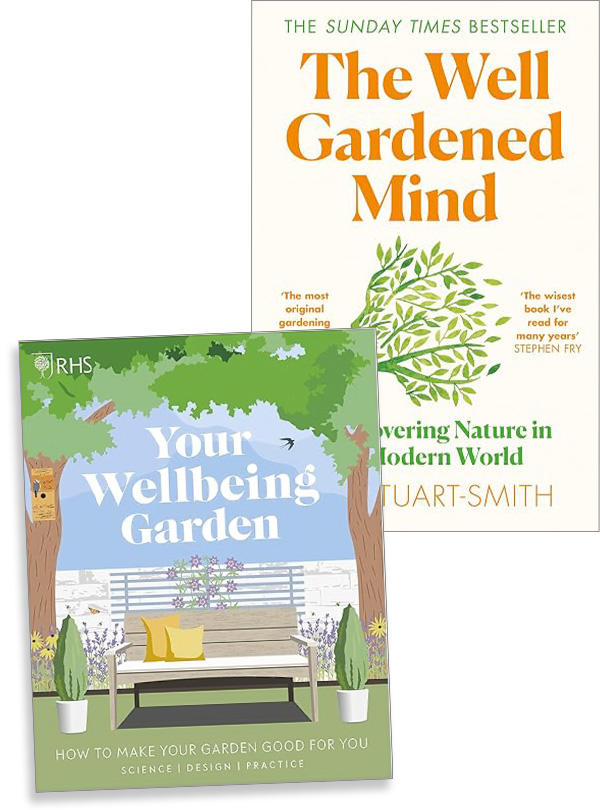
Alistair Griffiths and Matthew Keightley’s RHS Your Wellbeing Garden is the natural starting point – practical, science-backed, and aimed squarely at any size of outdoor space.
For something more contemporary, Sue Stuart-Smith’s The Well-Gardened Mind is a psychiatrist’s deeper, more personal exploration of why gardening helps.