
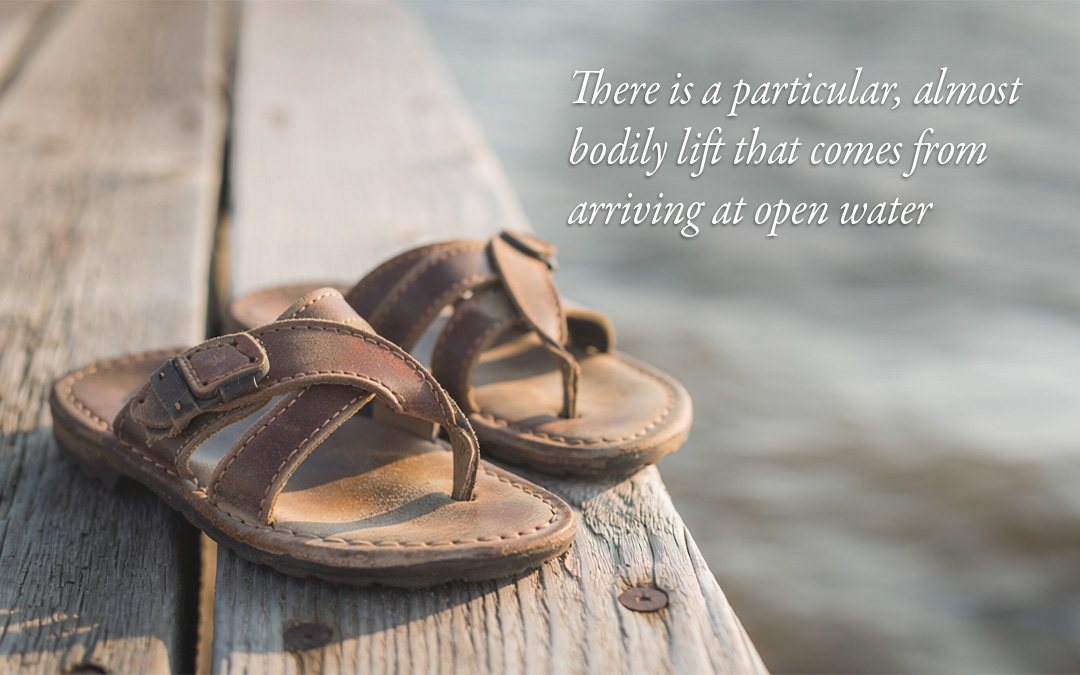
There is a particular, almost bodily lift that comes from arriving at open water – a river bending out of view, or the sea meeting the sky.
Researchers are only lately catching up to what walkers and swimmers have long taken for granted: proximity to water tracks with lower stress, better mood, and a felt sense of space that solid ground rarely offers.
The field is younger than the research into woodland and parks, and the mechanisms are still debated – but the pattern, so far, keeps holding up.
How to do it
None of this needs a plan. But if you want to make the most of time near water, a few small habits seem to help.
- Choose moving water over still, if you have the choice. A river, a stream, or the tideline. The shifting light and sound seem to matter more than the view alone.
- Sit rather than pass through. Ten minutes still, facing the water, appears to do more than the same ten minutes walking past it.
- Leave the phone in your pocket. Reaching for it to capture the view tends to interrupt the very attention it’s trying to hold onto.
- Let your eyes go loose across the surface. Follow no single ripple in particular; let the whole of it hold your attention lightly.
- Notice the sound before you notice yourself noticing it. That’s usually a fair sign it’s working.
Where it comes from
Work coming out of Exeter University’s environment and human health research, alongside the wider “blue space” literature, has found that people living nearer the coast tend to report better general health and wellbeing than those further away.
Even after accounting for income and deprivation.
Mood-tracking studies, where people log how they feel at different moments through the day, consistently rate time spent near water higher than time spent in urban settings, and sometimes higher than green space too.
None of this proves water itself is doing the work rather than everything that tends to come with it – space, quiet, a reason to stop walking. But the association is real and it keeps turning up.
Worth knowing
One plausible thread runs through attention restoration theory – the idea that certain environments hold our attention gently, without demanding it, giving the more effortful, directed kind of attention a chance to recover.
Moving water fits this well: a river’s surface is never quite the same from one second to the next, so there’s always something to look at, but nothing that requires tracking or solving.
The sound plays a similar role, filling the ear without asking anything of it. Neither of these needs the sea – a weir, a stream, or the tideline going in and out will do.
The phrase “Blue Mind”, popularised by the marine biologist Wallace J. Nichols, has done a good deal to bring this field wider attention. But it’s a piece of popular science rather than an established one, and some of what circulates under its banner runs ahead of the evidence.
Claims about negative ions near moving water having a measurable calming effect, in particular, remain unproven despite wide repetition.
What the research does support is more modest, and arguably more useful: being near water, looking at it, and listening to it is reliably associated with feeling better.
That’s enough on its own. You don’t need to swim, or even get close. Water seems to work on us largely by being visible – a fact more generous than most calming techniques manage.
If you live nowhere near a coast, this needn’t be out of reach. A local river, a canal towpath, or even a fountain in a town square draws on some of the same effect.
Recommended reading
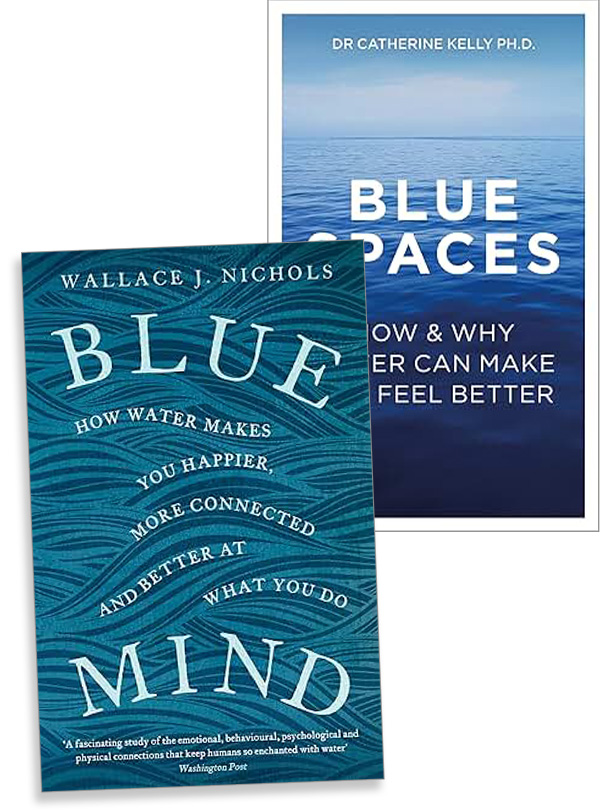
Wallace J. Nichols’s Blue Mind is the natural starting point – the popular-science book named above, and the one that first brought this whole field wider attention.
For something more grounded in the research, Catherine Kelly’s Blue Spaces comes from an academic geographer working directly in the field.