
The average person checks their phone around ninety-six times a day. Most of those checks happen without a real decision behind them at all – a habit that formed so gradually there was never a moment to notice it forming.
The idea of a retreat from ordinary life is ancient. The phone-specific version of it is barely a decade old, which makes this one of the newest pathways on this site, built to answer a problem that didn’t exist for most of human history.
That newness matters. There’s no long tradition to draw on here, no centuries of refinement – just a fairly blunt, practical response to a fairly new and specific kind of noise.
None of this means the phone itself is the enemy, or that using one is a failing. It means near-constant availability has a cost that’s easy to stop noticing, precisely because it arrived so gradually.
How to do it
None of it needs a dramatic week-long retreat to test. A short list of smaller ways in.
- Pick one ordinary block of time. A meal, a walk, the first hour of the day – and keep it phone-free on principle.
- Notice the urge to check it with nothing prompting the urge. That’s the pattern worth becoming aware of.
- Leave the phone in another room sometimes. Rather than merely face-down or on silent nearby.
- Notice what surfaces in the quiet first ten minutes without it. Boredom, restlessness, or something more like relief.
- Treat a lapse back into checking constantly as ordinary and reversible. Not as a failed attempt not worth repeating.
None of it needs to be permanent to be worth doing. A single unplugged evening still counts, even if tomorrow goes back to normal.
It’s the noticing, more than the abstaining itself, that seems to matter most.
Where it comes from
The term “digital detox” only entered common use around 2010, and the first dedicated retreat, Camp Grounded in Northern California, didn’t open until 2013 – founded by Levi Felix, who’d left a high-stress job and gone looking for a way to properly switch off.
It’s a solution built for a problem with almost no history behind it. The smartphone itself is barely two decades old, and constant, always-on connectivity is newer still.
Worth knowing
Frequent phone-checking has been linked in a growing body of research to elevated background anxiety, worse sleep, and a general sense of fragmented attention.
Anecdotal reports of relief during a digital detox are strong and consistent, considerably more so than the harder clinical evidence, which remains comparatively modest.
Part of the difficulty in studying this cleanly is that the relief people describe may reflect the straightforward removal of a genuine stressor, rather than any deeper cultivation of calm – a real and useful benefit, just a narrower one than it’s sometimes described as.
Digital detoxes are sometimes marketed as a profound reset for the mind, implying a lasting transformation from a few days away from a screen.
The difficulty is that whatever relief a detox provides tends to fade quickly once the phone comes back out, precisely because the underlying environment – the notifications, the habits – hasn’t actually changed, only paused.
What survives that correction is still genuinely worth having: a deliberate pause from constant availability provides real, if temporary, relief, and noticing that relief clearly is often the more lasting benefit.
Recommended reading
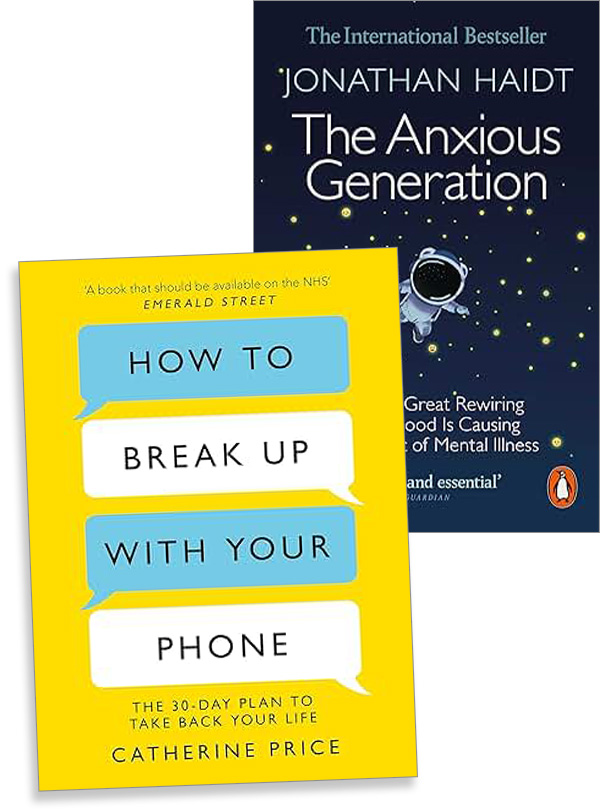
Catherine Price’s How to Break Up with Your Phone is the natural starting point – a practical, evidence-based 30-day plan rather than a vague call to unplug.
For something more contemporary, Jonathan Haidt’s The Anxious Generation lays out the wider evidence for why this has become such a widespread concern.