
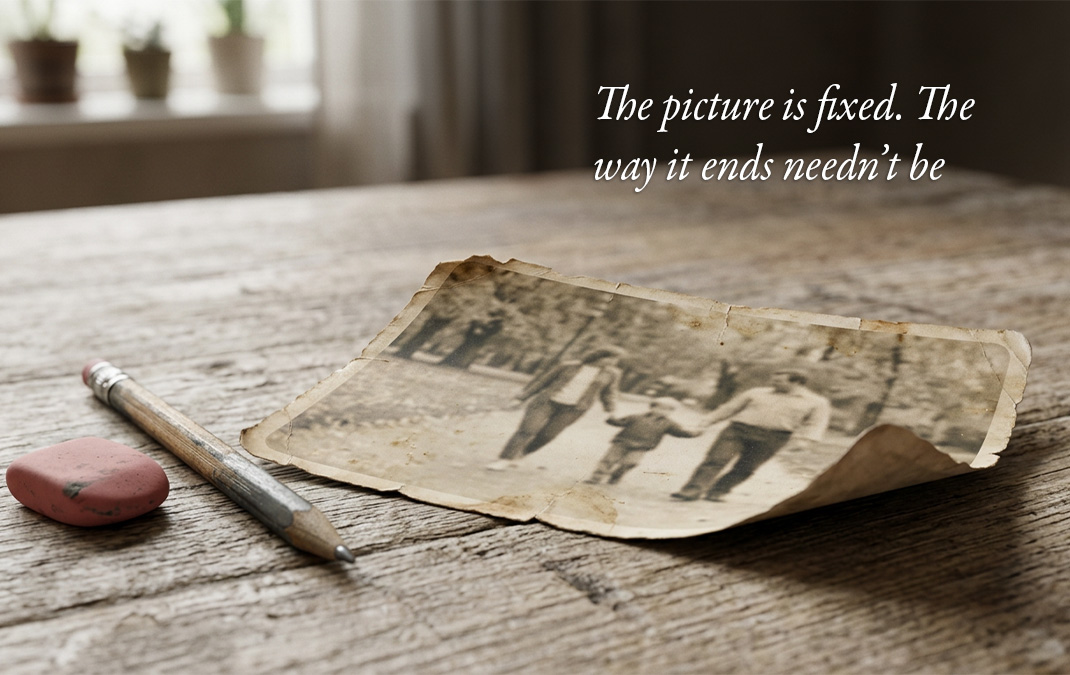
Some images do not fade. A bad memory replays itself, or the same nightmare returns night after night, and each time it lands with the same weight.
Imagery rescripting is a way of going back into that picture – not to relive it, but to change what happens in it. You stay the author. You decide how the scene ends.
How to do it
The clinical research behind imagery rescripting is genuinely good, but it’s about structured work, usually guided by a trained therapist – this isn’t a technique for a moment of everyday stress, and it isn’t a substitute for proper support if you’re carrying something heavy.
What follows is a gentle, self-guided version: enough to understand the idea, and to try cautiously with material that feels manageable.
Choose something manageable to begin with – a mildly uncomfortable memory or a recurring image that troubles you but doesn’t overwhelm you. Leave the heaviest material for work with a professional.
- Settle somewhere quiet and let your breathing slow. Give yourself a minute simply to arrive.
- Bring the image to mind. Let it form, but stay at the edge of it – you are the observer here, not back inside it.
- Notice the moment it turns difficult. This is the point you will change.
- Now rewrite it. Picture what you would have wanted to happen instead. Perhaps someone steps in to help. Perhaps your calm present self walks into the scene and stands beside the younger you. Perhaps the ending simply turns kind.
- Let the new version play through slowly, in its own detail – what is said, what is felt, how it resolves.
- When you are ready, let the image go and return your attention to the room around you.
If at any point the feeling grows too strong, stop. Open your eyes, feel your feet on the floor, and come back to the present. There’s no obligation to push through – this is a technique that rewards patience and a light touch, not force.
Where it comes from
The technique grew out of cognitive behavioural therapy, where therapists noticed that distressing memories and recurring images aren’t fixed recordings – they can be revisited and, with care, reshaped.
Imagery rescripting was refined through the 1990s and 2000s as a treatment for post-traumatic stress, persistent nightmares, and the intrusive mental pictures that come with anxiety and depression. It’s now one of the better-evidenced tools in the therapeutic repertoire, used both on its own and woven into wider treatment.
Worth knowing
The mind doesn’t store memories like files in a cabinet. Each time you recall something, the memory becomes briefly malleable before it settles again, and the feeling it carries can shift in the process. Imagery rescripting uses that window on purpose.
By picturing the troubling scene and then steering it somewhere new – a different ending, a protective figure stepping in, your present self comforting your past self – you give the brain an alternative version to hold alongside the original. Over time the new image can soften the old one’s hold.
Used gently, with everyday images, this can be a quietly reassuring practice. Used on deep wounds without support, it can open more than it closes – know the difference, and be kind to yourself about which side of it you’re on.

Recommended reading
Mary Beth Williams and Soili Poijula’s The PTSD Workbook is the natural starting point – a practical, accessible guide that includes imagery-based techniques for trauma and nightmares within its wider toolkit.
For something more detailed, The Nightmare and Sleep Disorder Toolkit is a current, evidence-based workbook built specifically around imagery rehearsal therapy, from a board-certified sleep psychologist and co-authors.