
Visualisation asks you to do something the mind does anyway, but on purpose. Left alone, imagination tends to rehearse what might go wrong – the difficult conversation, the worst outcome, the thing you dread.
Safe-place work turns that same machinery the other way: you build, in careful detail, an interior place where nothing is required of you, and you learn to go there on cue.
It’s one of the gentlest entries in this whole library, and one of the most genuinely useful when distress has a grip on you.
How to do it
The instinct is to rush to the picture. The better approach is to build it deliberately, one sense at a time, and to keep it entirely your own.
- Choose somewhere that asks nothing of you. Real or imagined, indoors or out – a beach, a quiet room, a hillside you know. Avoid anywhere tied to a person, since people complicate things; the place should be reliably, simply safe.
- Furnish it through the senses, slowly. Start with what you see, then add sound, then temperature and texture, then any scent. The detail is the whole point – “a beach” does little, but warm sand under your hands and the particular rhythm of the waves does a great deal.
- Find the feeling, and give it an anchor. Notice the calm that comes with the scene, then attach a simple cue to it – a word you say quietly, or a hand resting on your chest. With practice, the cue alone begins to call up the place.
- Practise it when you are already calm. This is the step most people skip. A safe place built only in a crisis is hard to reach; one rehearsed in ordinary, settled moments is there when you need it.
If an image ever brings discomfort rather than calm, let it go and choose another – there’s no single correct place, and the right one is simply the one that works for you.
Where it comes from
The deliberate use of mental imagery to calm the body is old – it runs through religious contemplation and much older meditative traditions – but its modern, structured form grew out of clinical psychology in the second half of the twentieth century.
Behavioural therapists in the 1970s used imagined scenes as part of systematic desensitisation, gradually pairing a feared situation with a state of deep relaxation.
From there the “safe place” emerged as a technique in its own right, becoming a standard preparatory step in trauma therapies – notably in EMDR (eye-movement desensitisation and reprocessing, a structured therapy for working through traumatic memories), where a person establishes a reliable internal refuge before any harder material is approached.
What started as a specialist clinical tool has since spread into ordinary guided relaxation and self-help – blurring the edges enough that “imagine a safe place” can sound like a cliché. Done properly, it’s a precise piece of work, and the precision is what makes it function.
Worth knowing
The body doesn’t draw a sharp line between a vividly imagined experience and a real one. Picture a place in enough sensory detail – the temperature of the air, a particular quality of light, a sound in the distance – and the nervous system begins to respond to the imagined scene rather than to your actual surroundings.
Breathing slows, muscles loosen, the alarm quietens. This isn’t wishful thinking – it’s the same mechanism that lets a worrying thought raise your heart rate, simply put to better use. There’s reasonable evidence behind it too: guided imagery has been studied for anxiety, pain and pre-procedure distress, and reviews generally find a modest but real calming effect.
The limits matter too. Safe-place work is a way to manage and interrupt distress, not a treatment for its causes – it won’t resolve trauma on its own. And for some people, particularly those with significant trauma histories, a poorly chosen image can backfire and surface the very feelings it was meant to soothe, which is precisely why, in clinical settings, it’s built slowly and with care.
Recommended reading
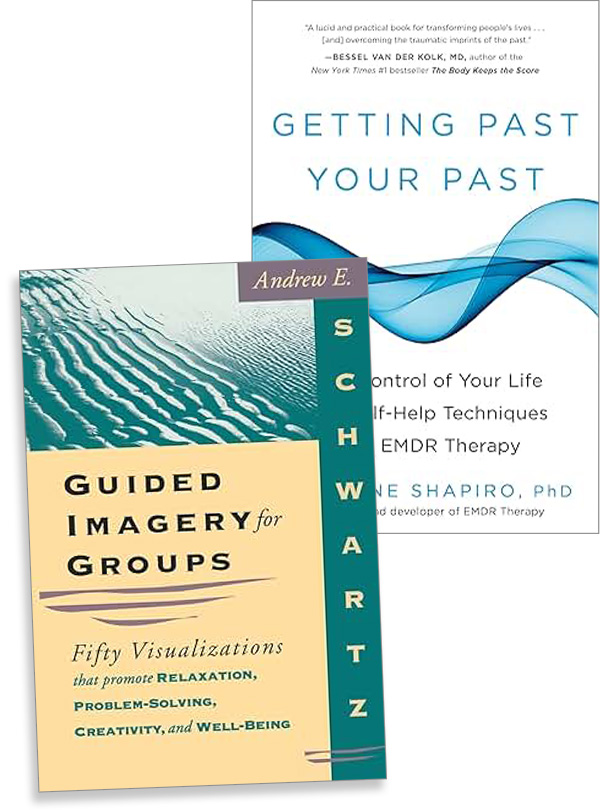
Andrew E. Schwartz’s Guided Imagery for Groups is the natural starting point – a practical, script-based collection from a widely used figure in therapeutic visualisation work.
For something more contemporary, Francine Shapiro’s Getting Past Your Past is an accessible account of EMDR from the therapy’s own founder, including the safe-place work described above.