
Of all the calming pathways on this site, breathing is the one you can always reach. It needs no equipment, no quiet room and no spare half-hour – only a few slow breaths, available to you in a meeting, a queue or the middle of the night.
That’s worth dwelling on, because breathing practices are a case where a genuine physiological effect has attracted a fair amount of overstated claims alongside it – the task here is to separate the two: the technique that works from the mythology that’s grown around it.
How to do it
The simplest effective practice needs no name and no counting app. Here it is.
- Breathe in gently through the nose, for a slow count of about four. Let the belly rise rather than the shoulders.
- Breathe out, more slowly, for a count of about six. The longer exhalation is the part that calms you, so let it be unhurried and complete.
- Pause briefly at the bottom, without straining for air.
- Repeat for a minute or two. Six breaths a minute is roughly the rhythm the body settles into; you don’t need to be precise, only slow.
- Stop when you feel steadier. A minute is often enough. This is a technique you can use in seconds, many times a day, rather than something you set aside time for.
That is the whole of it. Box breathing and the rest are refinements, but a longer out-breath than in-breath is the entire principle, and you now have it.
Where it comes from
Deliberate breath control is ancient. Pranayama – the regulation of breath as a spiritual and physical discipline – appears in the Indian tradition from around 1500 BC, and has been practised continuously ever since.
The instinct that how you breathe changes how you feel is one humanity arrived at very early and never let go of.
The modern era has produced its own versions. Box breathing – in for four, hold for four, out for four, hold for four – is used by the US Navy SEALs to stay steady under pressure, which is a fair endorsement of its practicality.
Wim Hof’s method, popularised in the 2010s, takes the opposite approach with bouts of rapid hyperventilation. The traditions differ wildly; the underlying truth they all draw on is the same.
Worth knowing
The physiological case is solid, and pleasingly simple. A slow, extended exhalation activates the parasympathetic nervous system – the branch responsible for “rest and digest,” the bodily state opposite to fight-or-flight.
In plain terms, breathing out slowly tells your body, at a level beneath conscious thought, that the danger has passed and it’s safe to stand down. This is why the out-breath matters more than the in-breath, and why nearly every effective technique makes the exhalation longer than the inhalation.
You’re not relaxing despite the breathing; the breathing is doing the relaxing. It’s one of the few places where you have a direct, physical handle on a system that otherwise runs without you.
The easiest way to start is to let something else keep the rhythm for you: the breathing circle on this site expands and contracts to guide your in-breath and out-breath, so you can simply follow rather than count.
Recommended reading
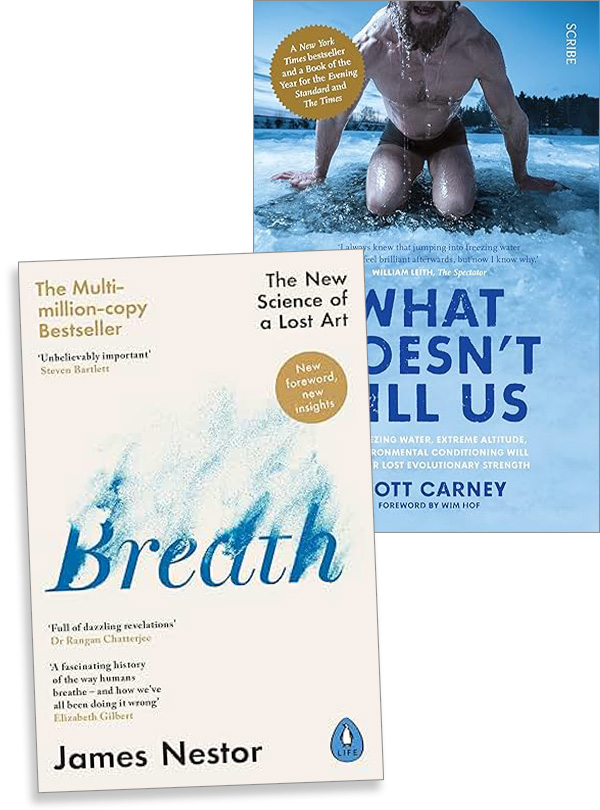
James Nestor’s Breath: The New Science of a Lost Art is the natural starting point – a highly readable tour through the history and science of how we breathe, and how much of it we’ve got wrong.
For something more contemporary, Scott Carney’s What Doesn’t Kill Us follows the author’s own sceptical investigation into the Wim Hof method, mentioned above – part memoir, part science journalism.