
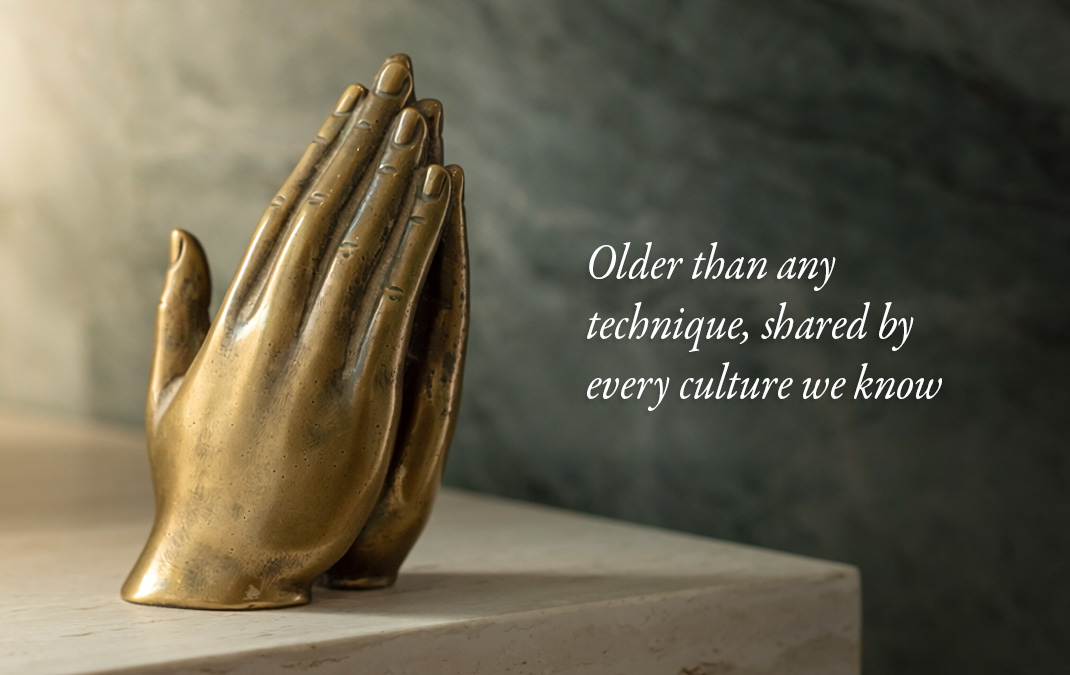
Prayer is the oldest contemplative practice we have, and the most widely shared. Long before anyone named a breathing technique or a school of meditation, people were speaking – aloud or silently – to something they took to be listening.
The question isn’t whether any particular faith is true – it’s what does the act of prayer do for those who practice it? On this question there’s something real, and some overstatement to set aside.
How to do it
You don’t need to hold any particular belief to draw on the structure of the practice. Here’s a simple, secular-friendly starting point.
- Choose a fixed time. The strength of prayer as a practice is its regularity, not its intensity. Pick a moment that recurs – waking, a meal, the end of the day.
- Begin by settling. A few slow breaths to mark the shift from doing to attending.
- Turn attention outward. Bring to mind something beyond your own immediate concerns – a person, a situation, a gratitude, a hope. Hold it without rushing to fix it.
- Let go of the outcome. Whether or not you address the words to anyone, the practice is the releasing of the grip, not the demanding of a result.
- Close simply. A word, a silence, a return to the day.
Where it comes from
Prayer has no founder and no single tradition. It appears, in some form, in every culture we have records of – petition, thanksgiving, confession, the repeated phrase worn smooth by use.
The forms differ enormously: the fixed hours of monastic life, the five daily prayers of Islam, the silent waiting of a Quaker meeting, the improvised conversation of a believer at the end of a hard day. What they share is a turning of attention away from the self, toward something held to be larger.
Worth knowing
Intercessory prayer – the idea that prayer changes outcomes in the world, healing the sick from a distance – has been tested directly in large trials. The results aren’t encouraging.
The steadier finding is different: regular prayer and religious participation are linked to better wellbeing and lower rates of depression. Prayer rarely comes alone, though – it arrives bundled with community and routine, and untangling the two is genuinely hard.
What can be said with more confidence is mechanistic. Contemplative, repetitive prayer – the rosary, a repeated phrase, the rhythm of liturgy – slows the breath and settles the body, much as other contemplative practices do.
And a daily handing-over of what you cannot control has an obvious kinship with both Stoic practice and modern acceptance-based therapies.
Recommended reading
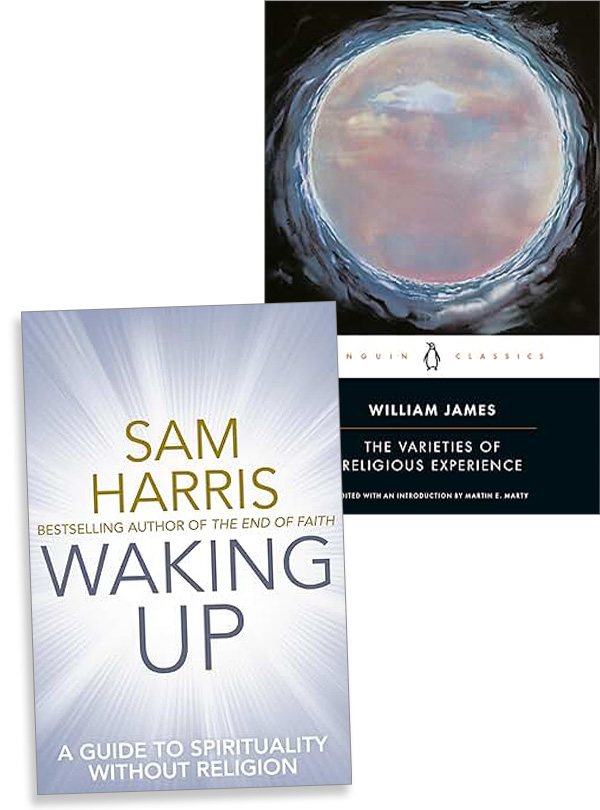
William James’s The Varieties of Religious Experience is the natural starting point – the 1902 classic that first treated religious experience as psychology rather than theology, and still holds up remarkably well.
For something more contemporary, Sam Harris’s Waking Up: A Guide to Spirituality Without Religion makes a secular case for contemplative practice, stripped of doctrine – a good next step if the philosophy interests you more than the faith.