

A quiet, good spell of life can feel less like a relief than a warning – here’s why that happens, and what to do when it does.
For some people, calm doesn’t feel like calm. A steady relationship, a settled job, a run of ordinary good weeks – instead of enjoying it, some part of the mind starts scanning for what’s about to go wrong.
A quiet Sunday brings unease rather than rest. There’s a nagging sense that things are going too well, and that a worry-free stretch is really just the run-up to something worse.
It’s a strange, common complaint: worrying about not having anything to worry about – and it has a name. Psychologists call it catastrophising, and it’s less a flaw in the thinking than a brain doing exactly what it once learned to do.
- It’s a prediction, not a fact. Brains are prediction machines – if yours has been caught out before, by a loss, a shock, a period where things fell apart without warning, it updates its model of the world accordingly: good things don’t last, so don’t be fooled by this one.
- It’s an overcorrection, not a flaw. Treating ordinary contentment with suspicion is a system trying to protect you – not evidence that something is broken.
- It has a real cost. A brain skilled at spotting danger becomes correspondingly poor at recognising safety – so the moments meant to be restorative get quietly contaminated by dread instead.
- Questioning works better than arguing. Asking whether a worry is responding to what’s happening now, or to what happened once, tends to loosen its grip more effectively than trying to dismiss it outright.
- It can tip into something more. Disrupted sleep, constant reassurance-seeking, or avoiding things once enjoyed are signs worth raising with a GP.
Why calm can feel like a threat
The pattern usually starts after being caught out once – and the brain, quite reasonably, updates its expectations.
Brains are prediction machines. If yours has been caught out before – by a loss, a shock, a period where things fell apart without warning – it updates its model of the world accordingly: good things don’t last, so don’t be fooled by this one. From then on, it treats ordinary contentment with suspicion, scanning for the catch.
The trouble is what this costs day to day. A brain skilled at spotting danger becomes correspondingly poor at recognising safety. So the very moments meant to be restorative – a quiet weekend, a good year, a relationship that’s simply working – get quietly contaminated by dread instead.
What actually helps
Arguing with the worry rarely works – questioning where it’s coming from tends to work better.
The instinct is to argue yourself out of the worry, or to feel foolish for having it. Neither tends to work, because the worry isn’t irrational – it’s a habit doing its job too well.
What helps more is questioning the thought itself rather than the feeling: when the unease shows up, pause and ask whether it’s responding to something happening now, or to something that happened once. That small distinction is often enough to loosen the thought’s grip.
Over time, this also makes it possible to notice what a hypervigilant brain otherwise filters out – the sheer number of unremarkable, nothing-went-wrong days that make up most of a life. That evidence accumulates slowly, but it does accumulate.
Worth knowing
There’s a deeper irony in all this, worth naming gently.
The more we care about something, the more there is to lose – which is precisely why the fear turns up around the good things, not the neutral ones.
The answer isn’t to love things more cautiously. It’s to recognise that uncertainty is simply the cost of caring, and to stop letting it tax the ordinary good moments in advance.
Recommended reading
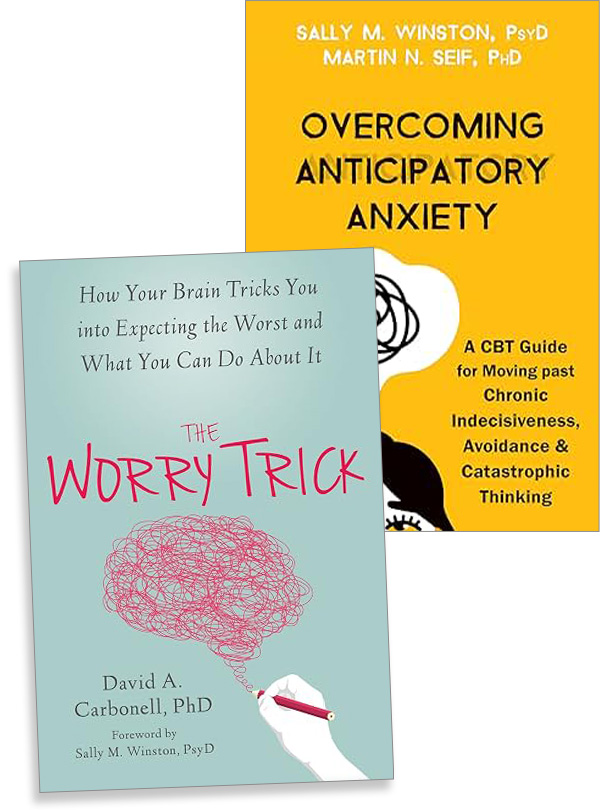
David Carbonell’s The Worry Trick is the standard starting point – it names the exact mechanism this page describes, showing how the brain tricks itself into expecting danger where there isn’t any.
For something more contemporary and detailed, Sally M. Winston and Martin N. Seif’s Overcoming Anticipatory Anxiety goes further into catastrophic thinking specifically, alongside the avoidance and indecision that tend to travel with it.