
Writing things down to feel better is one of the oldest pieces of folk wisdom there is – and, unusually for folk wisdom, a good deal of it turns out to be true. But not all of it, and not in the way most people assume.
The evidence isn’t really for journalling in general – the vague habit of pouring out your feelings onto a page.
It’s for particular kinds of writing, done in particular ways. Get the distinction right, and writing becomes one of the simplest and best-evidenced things you can do for yourself.
How to do it
This is Pennebaker’s method, and you can follow it exactly as the research does.
Set aside a few consecutive days, and about twenty minutes each time. You need nothing but paper and privacy.
- Pick something that matters. Choose an experience that is weighing on you – something difficult, unresolved, or that you have not fully talked through. It does not have to be a trauma; anything genuinely on your mind will do.
- Write for twenty minutes, without stopping. Explore both what happened and how you feel about it – then and now. Do not worry about spelling, grammar, or whether it reads well. If you run dry, simply repeat what you have written until more comes.
- Write about the same thing for three or four days. Return to it each day. You may find the story shifts as you go – new angles, connections you had not seen, a change in how it feels.
- Look for meaning, not just release. As the days pass, let the writing reach toward understanding – why it happened, what it has meant, how it connects to the rest of your life.
- Afterwards, let it go. You do not need to keep what you have written, or read it back, or show it to anyone. The good is done in the writing, not the archive.
It’s normal to feel a little worse immediately after writing – stirring difficult material does that – but the lift tends to come in the days that follow.
If a subject feels too raw to approach, that’s worth respecting; some experiences are better first explored with another person, or a therapist, than alone on a page.
Where it comes from
The landmark work belongs to the psychologist James Pennebaker, who in the 1980s began asking people to write about their most difficult experiences.
Fifteen or twenty minutes a day, for a handful of days, digging into both what happened and how they felt about it. The results were striking, and have been replicated many times since.
This is expressive writing, and it’s the strongest thing on this page.
Worth knowing
People who wrote this way showed improved mood and lower stress in the weeks that followed – and, remarkably, measurable improvements in physical health, from immune function to fewer visits to the doctor.
Gratitude journalling – regularly noting things you’re thankful for – has decent evidence too, lifting mood and wellbeing, though the effects are more modest and can fade if it becomes a chore.
Not all writing helps, though, and some can quietly make things worse.
Unstructured venting – returning again and again to the same grievance or fear, rehearsing it on the page without ever moving through it – can deepen the groove rather than ease it. Psychologists call this rumination, and a journal can become a machine for it.
Expressive writing works because it asks you to make meaning, rather than just record the raw feeling over and over. If you notice your journalling circling the same painful spot without ever moving, that’s the signal to change how you’re writing, or to close the book for now.
Beyond the structured protocol, writing has quieter everyday uses that ask less of you – a gratitude list at day’s end, a few lines to untangle a worry before sleep.
Kept light, and reaching for sense rather than circling the same pain, it’s a companion you always have to hand.
Recommended reading
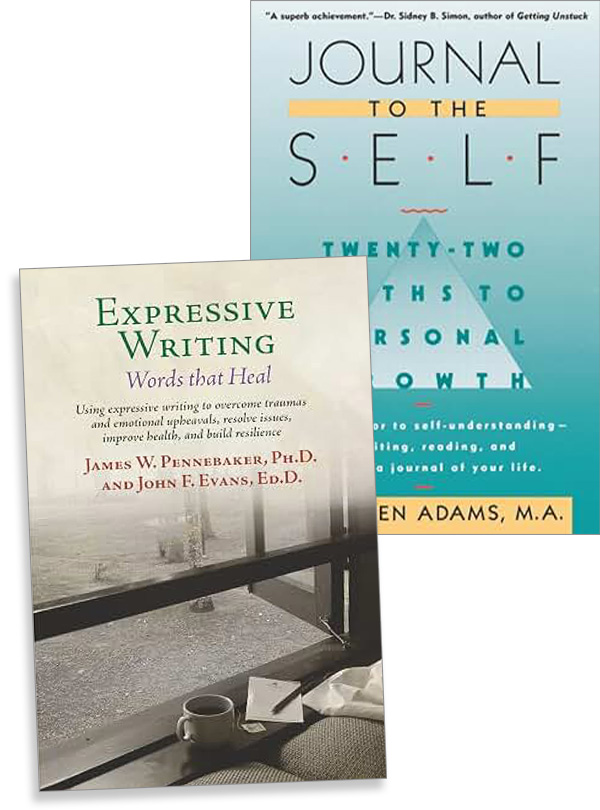
James Pennebaker and John Evans’s Expressive Writing: Words That Heal is the natural starting point – the method above, in full, from the psychologist who developed it.
For something more detailed, Kathleen Adams’s Journal to the Self explores a wider range of journalling techniques beyond the structured protocol.