
Financial insecurity doesn’t just affect your bank balance – it keeps the future feeling unsafe to think about.
Financial insecurity is usually treated as a maths problem: not enough coming in, too much going out, a gap to close. That’s true as far as it goes, but it misses why money worry can dominate a mind so completely – it’s not really about the numbers on the page, it’s about what those numbers threaten.
A bank balance is rarely just a bank balance. It’s a proxy for whether the roof is safe, whether the next unexpected bill is survivable, whether the future can be planned for at all – so when it’s precarious, it’s reasonable for a lot of your attention to go there too, even when you’d rather it didn’t.
None of this means the practical side isn’t real. It means that, for most people, the fear runs well ahead of the actual figures – and closing the gap on paper doesn’t always close it in the mind at the same speed.
- It’s a felt state as much as a financial one. You can have savings and still feel unsafe, or manage fine month to month and still brace for it all to collapse – the feeling and the figures don’t always move together.
- Hypervigilance becomes the default setting. Checking balances, running worst-case numbers, re-checking again – this isn’t catastrophising so much as a reasonable response to real unpredictability, even though it’s exhausting to sustain.
- Shame attaches easily, even when nothing was mismanaged. Most financial insecurity has causes well outside any one person’s control, but the mind rarely files it that way – it tends to read as a personal failing instead.
- It narrows the future, not just the present. Longer-term thinking – a home, a family, retirement – gets crowded out by the nearer arithmetic of getting through this month.
- It can tip into something more. Persistent anxiety, disrupted sleep, or avoiding your own finances altogether are worth raising with a GP rather than pushing through alone.
Why the fear runs ahead of the figures
Money is rarely just money – it stands in for safety, and safety is what the mind actually reacts to.
Humans are wired to treat resource scarcity as a survival-level threat, not an abstract inconvenience – which is why financial insecurity can trigger a genuine stress response, not just worry in the ordinary sense.
That response doesn’t wait for the worst case to actually arrive. It’s often triggered by the possibility of it, which is why the fear can feel constant even in months where nothing has gone wrong yet.
What actually helps
Separating the practical task from the emotional weight tends to make both more manageable.
It helps to name which parts of the worry are solvable this week, and which parts are really about an underlying sense of safety that no single payment will resolve. Both are legitimate, but they call for different responses.
A fixed, limited check-in – looking at the numbers once, at a set time, rather than returning to them all day – tends to reduce the felt threat more than constant monitoring does, even though monitoring feels like the responsible thing to do.
Worth knowing
Financial insecurity is widespread, even when it doesn’t feel that way from inside it.
It’s easy to assume everyone else has this sorted, largely because so few people talk about it openly. That silence isn’t evidence you’re managing worse than everyone around you – it’s just evidence that this particular worry stays quiet.
It’s fair to take the toll of this seriously, rather than treating it as something to simply push through until the numbers improve.
Recommended reading
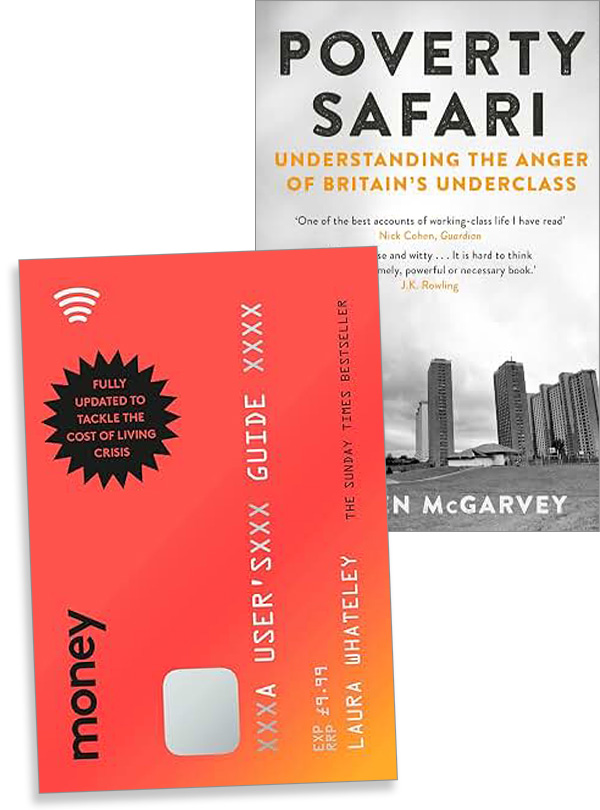
Laura Whateley’s Money: A User’s Guide is the natural starting point – a clear, practical guide to personal finance written by a British journalist, aimed at the everyday anxieties around money rather than investment theory.
For a more personal account, Darren McGarvey’s Poverty Safari is a raw, first-hand account of growing up amid financial insecurity in Scotland, and what that does to a person’s sense of safety and self-worth over time.