
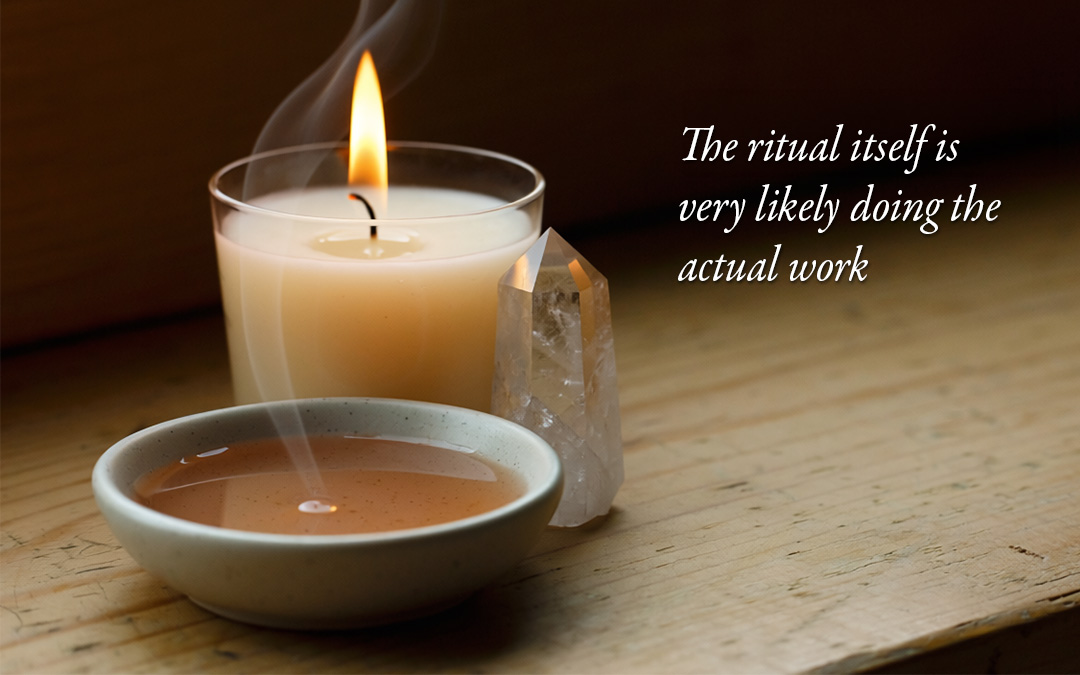
There’s a real, repeatable calm that settles over a room full of people lying still, eyes closed, listening to a singing bowl – something genuinely happens there, whatever is or isn’t happening at the level of sound waves and metal.
Crystals, aromatherapy oils, and sound baths share one thing in common: none of them have a mechanism that survives serious scrutiny, and all of them reliably make some people feel better anyway.
None of this means the calm people feel is fake. It means the calm is coming from somewhere other than the explanation being offered for it – and that somewhere is worth appreciating on its own terms.
How to do it
Getting real value from this category doesn’t require believing the marketing. A short list of ways to use it well.
- Notice that the ritual itself is very likely doing the actual work. The pause, the attention, the deliberate act of self-care.
- Enjoy a scent or a sound for what it is. A genuinely pleasant sensory experience, without needing a healing claim attached to it.
- Treat the story around an object as optional decoration. It doesn’t need to be true for the calm to count.
- Notice if the appeal is really about permission to stop and be still. These practices are often unusually good at providing exactly that.
- Be wary of anything expensive sold on the promise of a physical mechanism. That’s exactly where the evidence is thinnest.
None of it needs the underlying claim to be true for the experience to be worth having. A scented candle and twenty quiet minutes can be genuinely restorative, independent of whatever’s printed on the label.
It’s the permission to stop, more than the object doing the stopping, that seems to matter.
Where it comes from
Aromatherapy has the clearest origin story of the three. The French chemist René-Maurice Gattefossé coined the term in 1937, after burning his hand in a lab accident and reaching for lavender oil, which he became convinced had healed it unusually fast.
Crystals and sound baths have murkier, more recent roots, mostly tracing to the New Age movement of the 1970s and 80s rather than to any single source.
Worth knowing
The placebo response is one of the best-established effects in medicine – capable of producing measurable relief for pain and anxiety even when people are told outright the treatment is inert.
What that suggests here is fairly specific: the ritual of deliberate, attentive self-care appears to be a real active ingredient, regardless of the object or story used to deliver it.
Scent in particular has a genuine, well-documented link to mood and memory through direct neural pathways, which may explain why aromatherapy feels convincing to so many people.
This category is often sold alongside confident claims about energy fields or vibrational frequencies, which don’t line up with what physics and biology currently understand.
The specific mechanisms typically claimed for crystals or sound frequencies haven’t held up under controlled testing so far – worth knowing mainly because leaning on them instead of treatment that’s been shown to work can genuinely delay getting the right kind of help.
What survives is fairly generous: the ritual and the pause are genuinely valuable, whatever’s written on the label. Enjoying that without needing the specific mechanism to be true is a perfectly reasonable way to use this category.
Recommended reading
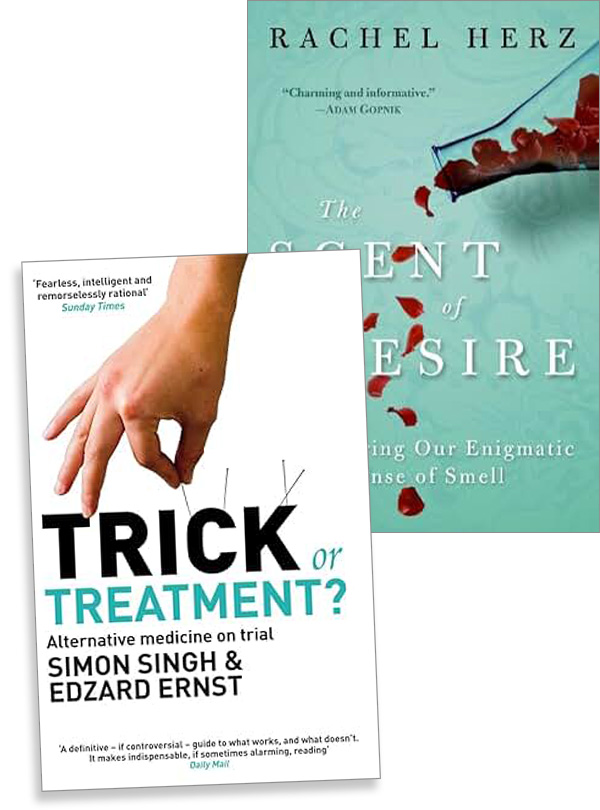
Simon Singh and Edzard Ernst’s Trick or Treatment is the natural starting point – a rigorous, fair-minded look at what does and doesn’t hold up across alternative medicine broadly.
For something more specific, Rachel Herz’s The Scent of Desire goes deep on the real science behind why smell affects mood so directly.