
A single chord can change the temperature of a room before anyone’s said a word. No argument was made, no advice given. Just a sound, arriving directly, and somehow the body responds to it before the mind has time to ask why.
Most calming techniques ask something of you – attention, breath, a change of posture. Music asks for almost nothing.
It works on people who are distracted, upset, or actively resisting the idea of feeling better, in a way that a guided meditation generally can’t manage.
That directness is also its limit. The same track that settles one person can grate on another entirely, and a piece that calmed you last year can do nothing at all today.
None of this needs to be calming music in the conventional sense, either. A furious, thrashing track can do more to settle an agitated mind than anything gentle, if it matches the mood first rather than fighting it.
How to do it
None of it needs a formal listening session to help. A short list of ways to use it more deliberately.
- Match the mood before trying to shift it. Something that mirrors how you actually feel, before reaching for calm.
- Keep a short list of pieces that have worked before. Rather than searching fresh each time a mood needs moving.
- Notice what a piece is doing physically. Shoulders, breath, jaw – rather than just whether you like it.
- Let a familiar piece play in the background. Rather than demanding full attention, if focus is what’s actually needed.
- Turn it off if it starts to grate. Forcing a mismatched track through rarely helps, however good it’s supposed to be.
None of it needs to be sought out fresh each time, either. The same handful of familiar pieces, returned to often, tend to do more work than an ever-changing playlist.
It’s the fit between the piece and the moment, more than the piece itself, that seems to matter – which is why a track that works wonders on one evening can do nothing at all on another, with nothing about the music having changed.
Where it comes from
Music therapy as a formal field grew directly out of the two world wars. Musicians visited military hospitals to play for wounded and shell-shocked soldiers, and staff noticed something they hadn’t expected – patients responded to it, physically and emotionally, in ways other care didn’t quite reach.
That observation led to formal training for hospital musicians, and by 1950 the field had become an organised profession in the United States. The underlying instinct is far older than any of that, though – people have been using rhythm and sound to shift mood for as long as there’s been anything resembling a record of human behaviour.
Worth knowing
Music engages the auditory system so directly that measurable physiological changes – heart rate, breathing rate, muscle tension – can shift within moments of a piece starting, well before any conscious appraisal of whether it’s “working”.
Slower tempos in particular are associated with a calming effect on heart rate and blood pressure, likely because the body has some tendency to synchronise its own rhythms toward an external one.
The emotional response also appears to be shared to an unusual degree – large numbers of people report similar emotional reactions to the same piece of music, despite having entirely different personal associations with it, suggesting the effect isn’t purely a matter of individual memory or meaning.
A specific, precisely engineered track is sometimes marketed as “scientifically proven” to reduce anxiety by an exact, memorable percentage, implying a kind of pharmaceutical precision that a piece of music can’t really claim to have.
The research behind those precise anxiety-reduction figures typically comes from a single small study under controlled laboratory conditions, which is a considerably thinner basis than the confident marketing claims built on top of it suggest.
What survives that correction is still worth having: music with a slow, steady tempo reliably nudges the body toward calm for most people, even if no single track can promise the exact effect its marketing implies.
Recommended reading
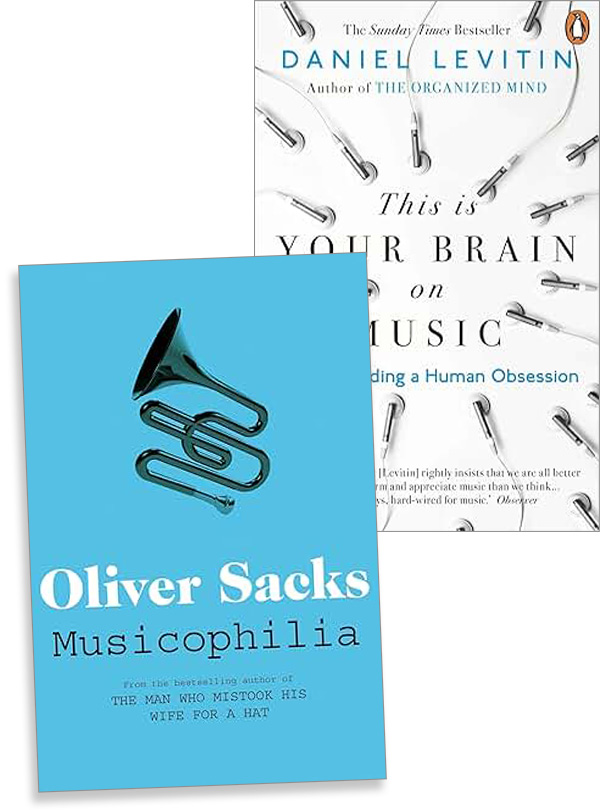
Oliver Sacks’s Musicophilia is the natural starting point – accessible, story-driven, and full of genuinely strange cases of music and the brain.
For something more detailed, Daniel Levitin’s This Is Your Brain on Music goes deeper into the actual neuroscience.