

A good book does something no advice ever quite manages – it doesn’t tell you to stop thinking about your own life, it just gives you somewhere else to be for a while.
The worry doesn’t get solved. It just briefly stops being the only thing in the room. That’s a genuinely different mechanism from most of what’s on this site – meditation asks you to notice the anxious thought and let it pass.
Reading asks you to forget it was ever there, by handing your attention to somebody else’s problem instead.
It’s a borrowed kind of calm, in other words – not resolution, just relocation. And for a mind that’s tired of its own loop, relocation can be exactly what’s needed.
None of this needs to be a demanding book to work, and it rarely is one. The kind of reading that actually settles a racing mind is often the least literary thing on the shelf – familiar, undemanding, and reliably absorbing rather than impressive.
How to do it
None of it needs long, uninterrupted stretches either. A short list of ways to get more calm out of the time available.
- Keep a book that’s easy to fall back into by the bed. Rather than whatever’s currently fashionable.
- Read the same comforting book more than once. Rereading tends to settle a mind faster than anything new.
- Put the phone in another room before starting. The pull to check it undoes most of the effect.
- Give it ten minutes before deciding it isn’t working. The settling effect is often slower to arrive than expected.
- Let a paperback be a paperback. Rest counts as a legitimate reason to read, without needing to learn something too.
None of it needs to be a nightly habit to count, either. A single absorbed chapter on a bad day still does its share of the work.
It’s the depth of the absorption, more than the number of pages, that seems to matter – which is why an anxious mind can sometimes read the same paragraph three times and get nothing from it, while a calmer one loses an entire afternoon without noticing.
Where it comes from
The formal term “bibliotherapy” was coined in 1916 by an American minister and essayist, Samuel McChord Crothers, in an essay describing a fictional “literary clinic” where a character prescribed books to patients the way a doctor might prescribe medicine.
The idea itself is much older – the physician Benjamin Rush was recommending reading for the mentally ill more than a century earlier – and hospital libraries became common through the late 19th and early 20th centuries, expanding rapidly to treat traumatised soldiers after the First World War.
Worth knowing
Even brief reading sessions are associated with measurable drops in heart rate and muscle tension, and the effect appears quickly – often within a matter of minutes rather than requiring a long session to take hold.
The mechanism looks similar to other absorptive states: attention fully occupied elsewhere leaves less spare capacity for rumination to run on.
Fiction in particular seems to do something extra. Following a character’s inner life for an extended stretch appears to exercise some of the same mental machinery used for understanding real people – which may be part of why a good novel can feel like company rather than mere distraction.
A frequently repeated claim holds that a few minutes of reading can cut stress by a dramatic, precisely quoted percentage – tidy enough to make excellent marketing copy for a book, a library, or a wellness app.
The specific statistic behind that claim comes from a single small unpublished study that was never peer reviewed, which means the precise number is far less solid than its constant repetition suggests.
What survives that correction is still worth having: the general direction of the finding – that absorbed reading measurably reduces physiological stress markers – is supported by more rigorous work elsewhere.
Recommended reading
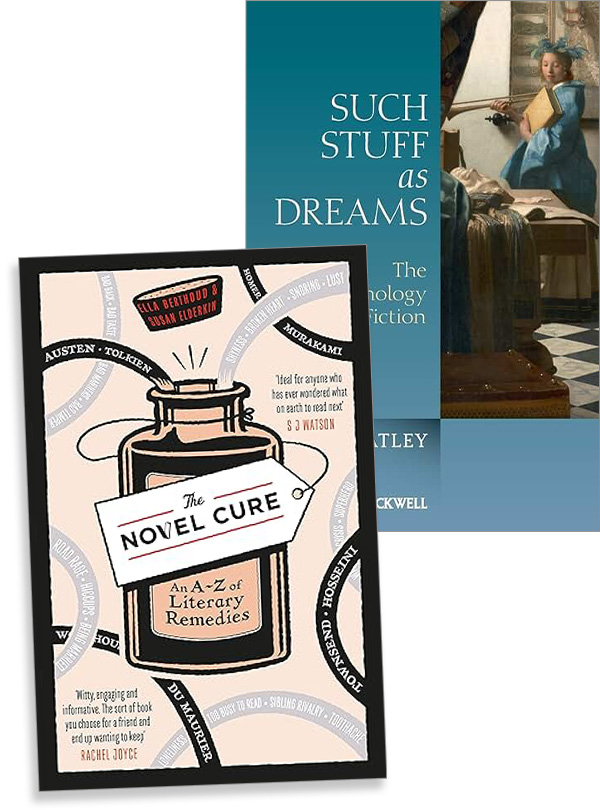
Ella Berthoud and Susan Elderkin’s The Novel Cure is the natural starting point – a playful, A-Z guide to prescribing novels for whatever ails you.
For something more detailed, Keith Oatley’s Such Stuff as Dreams goes deep into the psychology of why fiction affects us the way it does.