
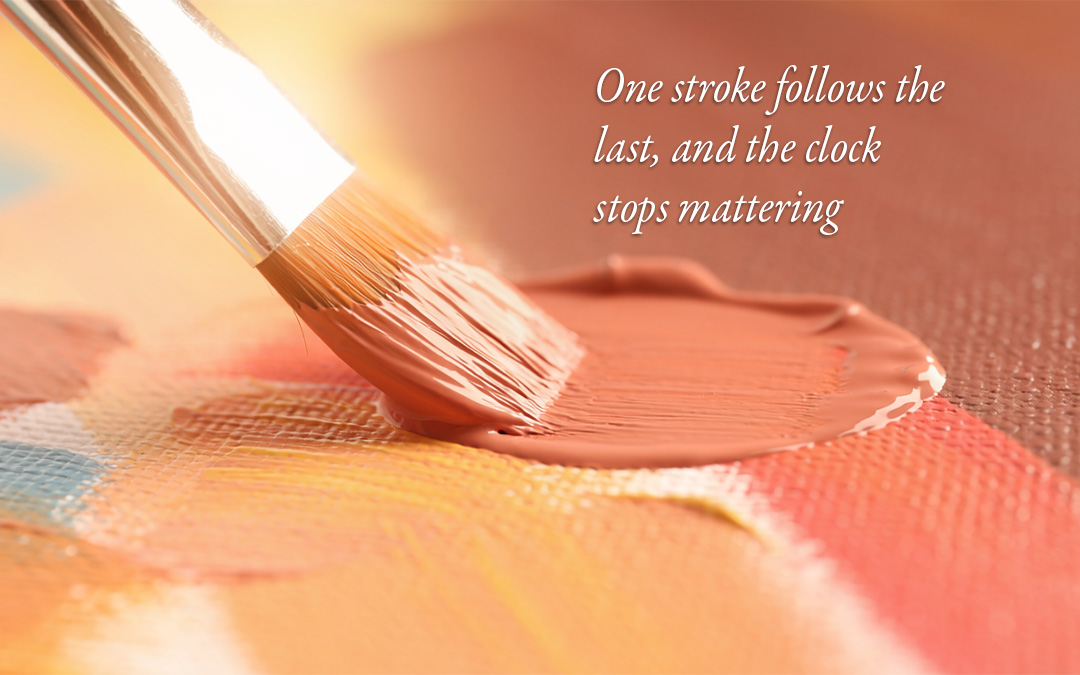
Ask someone deep in a woodworking project or halfway through a difficult piece of music what time it is, and there’s a real chance they won’t know.
Not because they weren’t paying attention – because they were paying so much attention to one thing that everything else, including the clock, briefly stopped registering.
Most of what calms the mind on this site works by slowing things down – a longer breath, a quieter room, a stiller body. Flow does the opposite: it’s fast, demanding, often physically active, and yet people who find it reliably describe something that sounds a great deal like calm on the other side of it.
The paradox is real and worth sitting with rather than explaining away. The state doesn’t arrive through effort at relaxing – it arrives through effort at something else entirely, aimed so precisely that there’s no attention left over for anything but the task.
None of this needs to be a grand creative pursuit to count. The same absorption shows up in a well-organised garage, a properly gripping crossword, or a run where the route’s familiar enough that thinking stops being necessary.
How to do it
None of it can be summoned directly, either – which is most of the difficulty. A short list of conditions that tend to make it more likely, even though none of them guarantee it.
- Pick a task with a clear goal and immediate feedback. You can tell, moment to moment, whether it’s going well.
- Match the challenge to the skill. Too easy and the mind wanders, too hard and it panics rather than absorbs.
- Remove the phone from the room, not just your pocket. Partial attention seems to block the state entirely.
- Let a warm-up period happen without judging it. Flow rarely arrives at the very start of a session.
- Notice which activities have done this before. Treat that list as more reliable than any new idea.
None of it can be forced into arriving on schedule, which is worth accepting rather than fighting.
Some sessions never tip into it at all, for no obvious reason, and that’s a normal feature of the state rather than a sign anything’s being done wrong.
Where it comes from
The concept comes from the Hungarian-American psychologist Mihaly Csikszentmihalyi, who coined the term in the 1970s after studying painters in Chicago who became so absorbed in their work that they’d skip meals and lose track of time entirely, even though the paintings themselves brought them no money or recognition.
He went on to study the same total absorption across wildly different pursuits – chess, surgery, rock climbing, music – using a method that had people record what they were doing and how they felt at random points through the day. The pattern held up everywhere he looked.
Worth knowing
People asked to describe their most satisfying, fully-absorbed experiences reliably describe a similar set of features regardless of the activity – a clear goal, complete concentration, a loss of self-consciousness, and a distorted sense of time passing faster or slower than it actually did.
The self-consciousness dropping away may be doing more work than the activity itself. Rumination and anxious self-monitoring both require spare attention to run on, and flow appears to use up all of it, leaving nothing behind to worry with until the state ends.
Flow gets marketed with a breathless promise in some corners of the productivity world – that it can be switched on reliably with the right playlist or morning routine, turning ordinary work into an endless string of peak states.
The real picture is messier: flow is a description of what sometimes happens during deep engagement, not a lever anyone has found how to pull consistently, and most techniques marketed as flow-inducing simply improve the odds a little rather than guaranteeing the state.
What survives that correction is still worth having: the conditions that make flow more likely – a clear goal, matched challenge, minimal interruption – are worth building into a task regardless of whether the state actually arrives, since most of them make the work itself go better either way.
Recommended reading
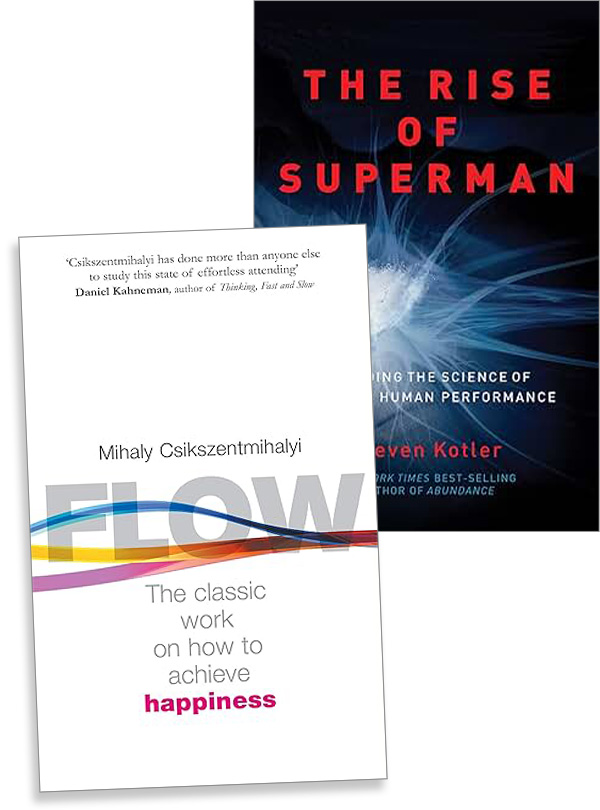
Mihaly Csikszentmihalyi’s own Flow: The Psychology of Optimal Experience is the natural starting point – the definitive account, from the psychologist who named the state.
For something more contemporary, Steven Kotler’s The Rise of Superman looks at flow through the lens of extreme athletes pushing performance to its limits.