
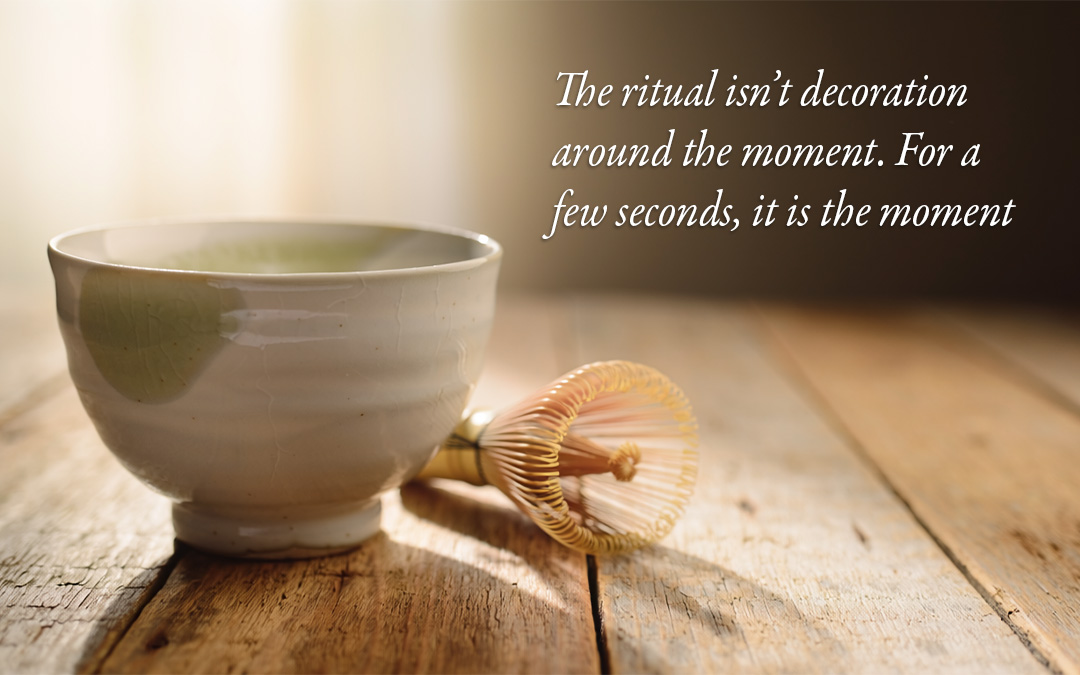
The same cup, made the same way, before the same kind of morning. A phrase said quietly before something difficult.
These small, repeated acts don’t do anything in the ordinary sense – and yet they seem to change how the moment around them feels.
It’s tempting to file this under superstition and move on. But there’s a reasonably solid case that something real is happening.
Not magic, and not really about the object or the words themselves, but about what deliberately marking a moment does to the mind experiencing it.
How to do it
A ritual doesn’t need to mean anything grand. It just needs to be deliberate, and repeated.
- Pick something small and physical. A drink made a particular way, a specific object handled, a few words said aloud. The action matters more than any symbolism behind it.
- Attach it to a moment you already return to often, like starting work or winding down for the night, rather than inventing a new occasion from scratch.
- Do it the same way each time, even in small details. The repetition is doing more of the work than the content.
- Let it stay small enough to actually keep up. A one-line ritual you do daily beats an elaborate one you do twice.
- If it stops feeling meaningful, let it go or change it. A ritual that’s become another chore has lost the thing that made it work.
Where it comes from
Most of us already have a few of these without calling them that – a particular route walked before a hard conversation, a song played before leaving the house, a specific way of settling in before sleep.
Formal religious and cultural rituals work on the same underlying principle, just with more history behind them. None of it requires belief in anything beyond the act itself to have an effect.
Worth knowing
Some of the clearest evidence for this comes from an unlikely place: medicine. Researchers studying placebo treatments have found that even when people know they’re taking an inert pill, they still get real relief.
And the effect seems to come specifically from the ritual of the treatment itself, the care and attention of being given something, rather than any belief that the pill is doing anything.
One researcher in the field put it plainly: the ritual of the encounter appears to change symptoms on its own. That’s a strange and rather hopeful finding, and it applies well beyond medicine.
It suggests that a deliberately marked moment can carry weight independent of whatever it’s actually made of.
Plenty of ritual-adjacent products and practices – crystals, “manifestation” routines, specific candle colours for specific intentions – claim the effect comes from some property of the object or act itself.
The more careful research doesn’t support that. What seems to matter is the attention and intention brought to a deliberately repeated act, not any inherent quality of what’s being repeated.
That’s not a criticism of ritual – if anything, it’s better news: it means the effect is available to anyone, with anything, rather than depending on buying the right object.
None of this needs religious belief, or even a particularly serious tone, to work. A daily ritual can be as small as how you make your coffee, so long as you keep making it the same way, on purpose.
Recommended reading
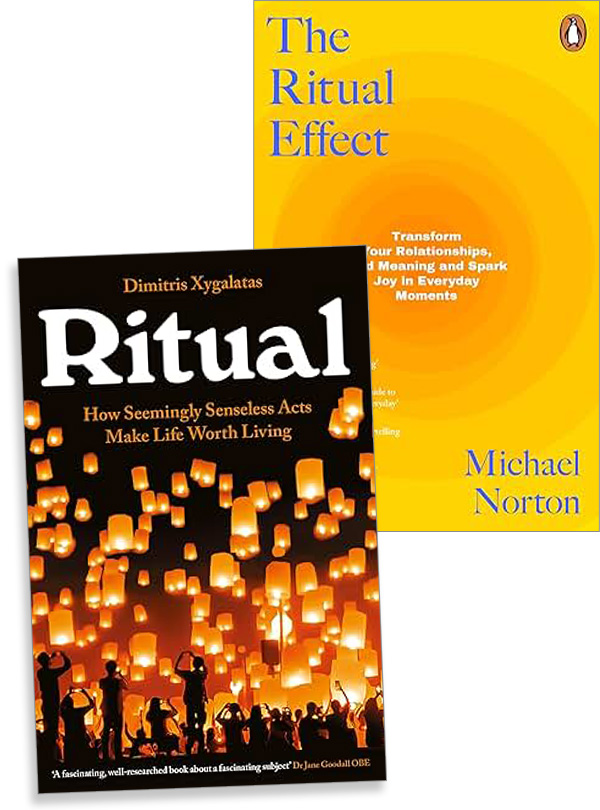
Dimitris Xygalatas’s Ritual is the natural starting point – an anthropologist’s accessible tour through why seemingly senseless acts matter so much to us.
For something more contemporary, Michael Norton’s The Ritual Effect takes a practical, behavioural-science approach to turning ordinary habits into something more.