
The word placebo is usually thrown out to mean nothing happened – it was all in your head. That’s almost the opposite of the truth.
The placebo effect is one of the most reliably measured findings in all of medicine, and what it reveals is genuinely strange: the care around a treatment – the ritual, the attention, the expectation – can do real, physical work of its own, quite apart from the treatment itself.
How to do it
You cannot prescribe yourself a placebo – the moment you try, the trick seems to evaporate. But open-label studies hint at something more useful: it may be the ritual and the care, not the deception, that carry the effect.
And those are things you can bring deliberately to how you look after yourself, and how you look after others.
- Give your own care a little ritual. Rather than rushing through it, make a small ceremony of the cup of tea, the warm bath, the early night – the act of tending yourself, not just the result.
- Pay attention to how you tend yourself. When you’re unwell, attention itself appears to be part of the medicine. Noticing and minding how you care for yourself isn’t indulgence; it seems to be active.
- Mind the expectation you carry. What you expect from something shapes what you get from it, so it’s worth approaching rest and recovery as though they might genuinely help.
- Offer the same to others. Sitting with someone, unhurried and attentive, isn’t a soft extra around the real treatment. Often it is part of the treatment.
Where it comes from
A placebo is a treatment with no active ingredient – the classic sugar pill. For a long time it was treated as an embarrassment, the noise you had to subtract to find a drug’s real effect. But the noise turned out to be the interesting part.
When people take a dummy pill believing it might help, measurable things happen in the body: the brain releases its own endorphins and dopamine, pain signalling quietens, and physiological responses shift in ways that can be tracked on a scan.
Nothing is imagined – the body is responding, not to a chemical, but to a context. And the context is the active ingredient.
Much of what we call the placebo effect isn’t really about the pill at all – it’s about everything around it: the ritual of being treated, the attention of someone who seems to care, the expectation that things may improve.
Researchers have teased these apart and found that the care surrounding a treatment can carry as much weight as the treatment itself.
Worth knowing
Two things seem to drive it. The first is expectation: believing relief is coming primes the brain’s own pain and reward systems to deliver some of it.
The second is conditioning: the body learns, over a lifetime of being treated, to associate the whole ritual of care – the setting, the white coat, the act of taking something – with feeling better, and begins to produce that response on cue, the way a familiar smell can summon a mood.
The most striking evidence comes from the work of Ted Kaptchuk and colleagues at Harvard, who ran trials of open-label placebos – sugar pills handed to people who were told plainly that they were sugar pills, with no deception at all. People still improved.
The ritual worked even when everyone knew it was a ritual, which quietly demolishes the idea that placebo depends on being fooled.
The effect has firm limits, though. Placebo is powerful for symptoms with a felt, subjective component – pain, nausea, fatigue, anxiety, low mood, the discomfort of conditions like irritable bowel syndrome – but it does very little to the underlying disease itself. It will not shrink a tumour, clear an infection, or mend a broken bone.
It changes how you feel, and sometimes that’s a great deal – but feeling better and being cured aren’t the same thing. None of this is a reason to turn away from medicine that works; it’s a reason to take the ritual and relationship around it seriously.
Bring that attention to how you look after yourself, and you’re not fooling yourself with a sugar pill – you’re using something real.
Recommended reading
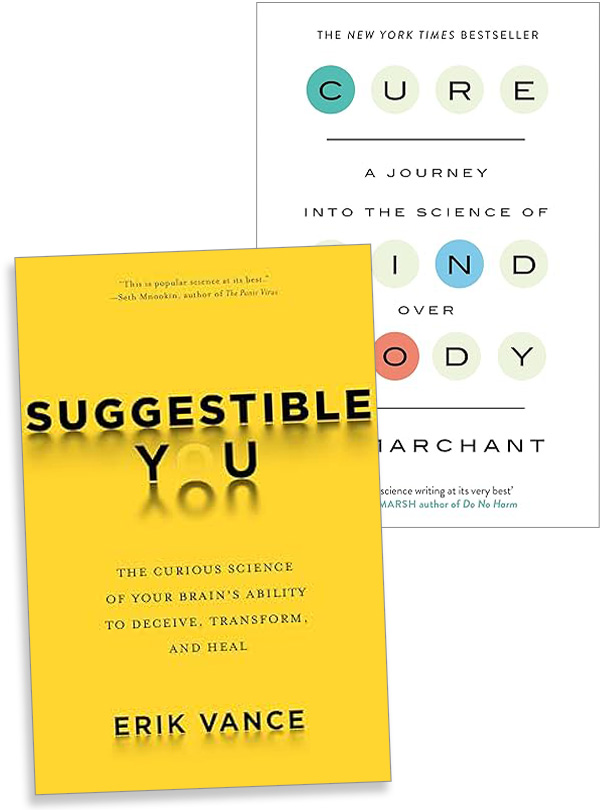
Erik Vance’s Suggestible You is the natural starting point – an accessible, engaging tour through the science of the placebo effect and the mind’s ability to shape the body.
For something more detailed, Jo Marchant’s Cure goes deeper into the research behind mind-body medicine, including the Kaptchuk work described above.