
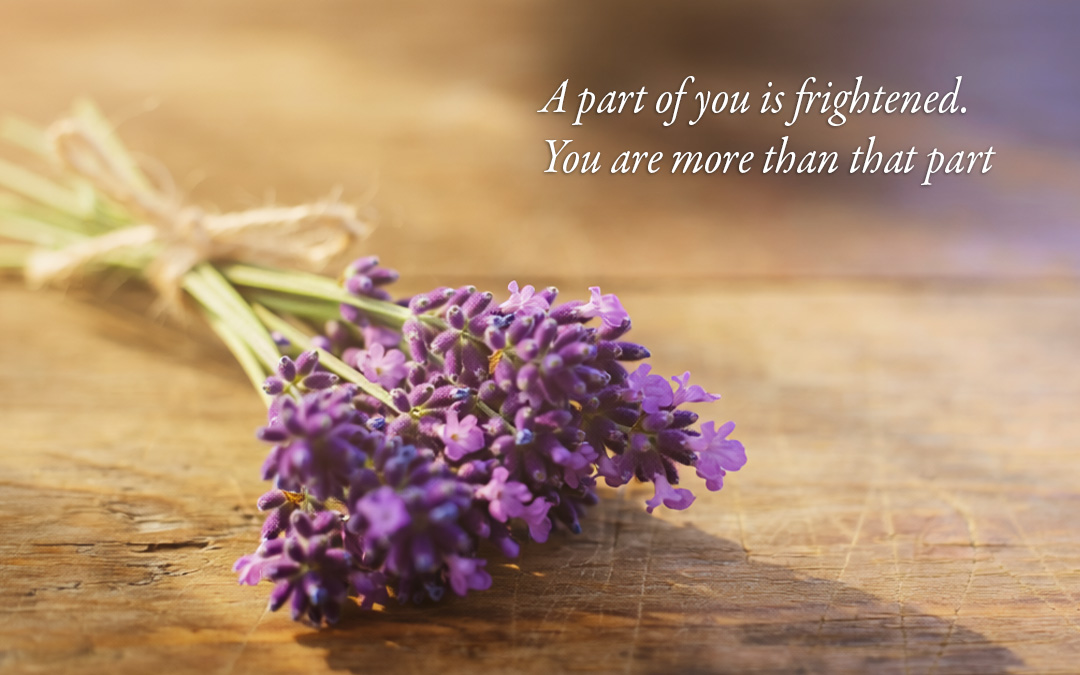
Most of us talk to ourselves as though we were a single person, but it rarely feels that way from the inside. One part of you wants to rest; another calls you lazy for it. One part is frightened; another is impatient with the fear.
Working with your parts – the everyday name for an approach called Internal Family Systems, or IFS – starts by taking that inner crowd seriously, and learning to be on speaking terms with all of it rather than at war.
How to do it
This is a simple way to meet a part, rather than be run by it – a gentle way of relating to difficult feelings that replaces self-attack with curiosity. A few quiet minutes is enough.
Parts work can open onto deep material, especially where there’s trauma in the background, and the full method is meant to be done with a trained IFS therapist – what follows is a way of getting to know the approach, not a substitute for it.
If turning towards a part brings up more than feels manageable, ease off, return to your feet and your breath, and consider trying this with a therapist rather than alone.
- Find the feeling. Bring to mind something that is troubling you – mild rather than overwhelming, the first time. Notice the feeling it brings, and where you sense it in the body.
- Name the part. Instead of “I am anxious”, try “a part of me is anxious”. This small change in wording creates the gap that lets you turn towards it rather than be it.
- Get curious, not critical. Ask the part, gently, what it is worried about – what it is trying to protect you from. You are not arguing with it. You are listening, the way you might listen to a frightened child.
- Notice the intention. Almost always, underneath, the part is trying to keep you safe. See if you can feel the care buried inside even the harshest voice. This is the turn from enemy to ally.
- Let it know it’s heard. You don’t have to fix anything. Simply acknowledging the part – “I understand why you do this” – often softens it. A part that feels heard rarely needs to shout.
- Come back to the centre. Take a breath and notice the steadier place you are watching from. That calm, curious vantage point is always there to return to, however loud the parts become.
Where it comes from
IFS, developed by the psychologist Richard Schwartz from the 1980s, proposes that the mind is naturally made up of many parts – sub-personalities, each with its own feelings and intentions: the anxious part, the critic, the part that wants to please, the part that goes quiet and withdraws.
None of them is the enemy. Even the harshest inner voice is, in this view, trying to protect you in the only way it knows. The trouble comes not from having parts, but from being so merged with one of them that it takes over the whole show.
Worth knowing
Underneath all the parts, IFS holds, there’s a Self – a steadier centre that’s curious, calm and not frightened of any of them. You reach it not by silencing the parts but by stepping back from them, so that you’re with the anxious part rather than swallowed by it.
The shift is small but distinct: from “I am terrified” to “a part of me is terrified, and I can sit with it.” That little gap is where the calm lives – the difference between being the storm and being the sky the storm moves through.
The aim of this work isn’t to win an inner argument or banish the difficult parts – they don’t leave, and trying to evict them only makes them louder. The aim is a better relationship with yourself: less merged with any single feeling, more able to hold the whole noisy committee with some warmth.
Over time, the harsh critic eases, the frightened part settles, because both have stopped having to fight for your attention. You become, more often, the calm one in the room – the one who can listen to all of it without being overrun by any of it.

Recommended reading
Richard Schwartz’s own No Bad Parts is the natural starting point – the clearest account of IFS from the person who developed it.
For something more detailed, Jay Earley’s Self-Therapy is a practical, step-by-step workbook for going further with the method than the short practice above.