
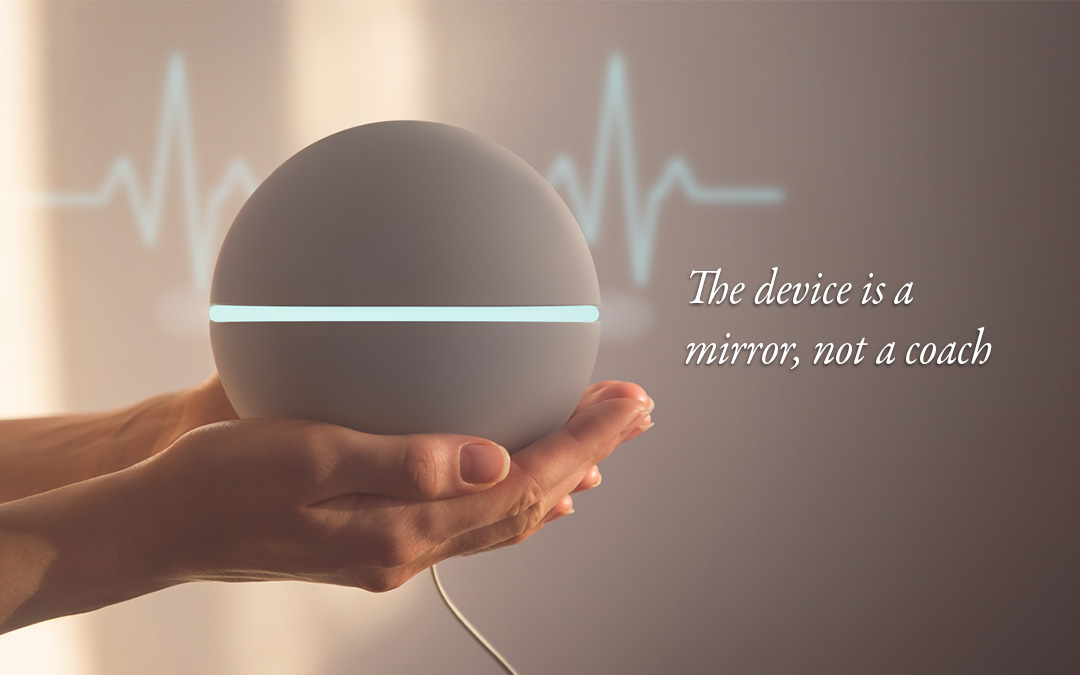
A slow, deliberate breath used to be taken on faith – there was no way to know, in the moment, whether it was actually doing anything. Now a growing range of devices, worn on the wrist or simply held in the hand, can show a heart rate settling in real time.
That’s a genuinely useful correction for anyone who’s ever wondered whether a breathing exercise was actually working or just felt like it should be.
Seeing a heart rate variability score shift during a session gives the practice something to aim at, and something to confirm it landed – but it’s also a new kind of pressure that didn’t used to exist. A breath taken to see a number improve is doing something subtly different from a breath taken simply to feel calmer.
None of this means the data is meaningless, or that these devices are a mistake. It means the device is a mirror, not a coach – useful for checking a practice is landing, less useful as something to obsess over between sessions.
How to do it
None of it needs constant checking to be worthwhile, either. A short list of ways to use the data well.
- Check the reading after a technique, to confirm it’s doing something. Checking during it tends to interfere with the technique itself.
- Notice trends over weeks rather than obsessing over a single day’s number. A single reading is affected by dozens of things beyond stress.
- Turn off notifications tied to the metric. Check it deliberately instead, on your own terms, not the device’s.
- Use a low reading as information, not a verdict on the day. It’s a data point, not a judgement.
- Notice if checking the score has become its own source of anxiety. Step back from the device if so.
None of it needs to be worn constantly to be useful, either. Occasional, deliberate checking during a specific practice tends to give more useful information than a number glanced at forty times a day out of habit.
It’s the use the data gets put to, more than the data itself, that seems to matter – the same heart rate variability score can be genuinely reassuring to one person and a fresh source of worry to another, depending entirely on what they do with the number once they’ve seen it.
Where it comes from
The field traces back to the 1960s, when the Yale psychologist Neal Miller showed, through animal experiments, that the autonomic nervous system – heart rate, blood pressure, and the rest of what runs automatically – wasn’t as fixed and involuntary as had long been assumed. It could, with the right feedback, be nudged under conscious control.
Clinical work at the Menninger Foundation by Elmer and Alyce Green developed the idea further, and the term “biofeedback” itself was coined around 1969, the same year researchers in the field organised into what became the Biofeedback Research Society.
What’s changed since isn’t the underlying principle – it’s that the sensors needed to do it now fit on a wrist.
Worth knowing
The underlying measurement most calming wearables rely on – heart rate variability – has decades of clinical grounding as a marker of nervous system state, and consumer devices have made genuinely useful versions of it available outside a lab for the first time.
Being able to see a technique working in real time appears to reinforce the habit of practising it – a real behavioural benefit distinct from the accuracy of the number itself.
The countervailing finding is just as consistent: a subset of wearable users develop a heightened, anxious relationship with their own metrics, sometimes described informally as health anxiety by proxy – checking the device becomes a compulsive stress response rather than a helpful check-in.
Wearables are often marketed as giving an objective, near-medical readout of stress itself, implying a precision the underlying sensors don’t fully support outside controlled conditions.
Consumer-grade sensors are considerably less accurate than the clinical equipment the research was actually validated on, and day-to-day fluctuations owe as much to sleep, hydration, alcohol, and measurement noise as to anything resembling stress.
What survives that correction is still worth having: used loosely, as a rough trend indicator rather than a precise daily verdict, a wearable can genuinely help someone notice patterns and stick with a calming practice.
Recommended reading
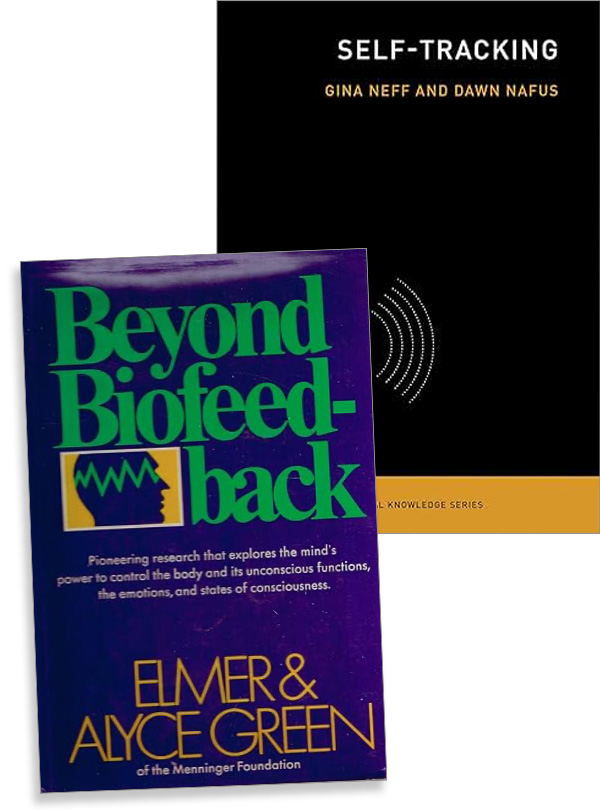
Elmer and Alyce Green’s Beyond Biofeedback is the natural starting point – a foundational account from the researchers behind the field’s original clinical work.
For something more contemporary, Gina Neff and Dawn Nafus’s Self-Tracking looks at the wider culture of wearables and personal data, including where it helps and where it doesn’t.