

Total silence sounds like it should be restful. For a lot of anxious minds it’s the opposite – nothing to listen to except the thoughts, which is exactly the wrong kind of quiet at exactly the wrong time of day.
The app version of this is a fairly modest idea, and doesn’t pretend to be anything more.
It isn’t rewiring anxiety or resolving a difficult day. It’s removing one small, specific obstacle – a mind left with nothing to listen to but itself. And that’s a fair description of most of what actually helps at bedtime.
None of this needs to be complicated sound design to work. A single, unchanging tone tends to do more good than an elaborate soundscape that keeps introducing something new for the mind to notice.
How to do it
None of it needs trial and error every night, either. A short list of ways to use it well.
- Pick one sound and stay with it for weeks. The brain seems to settle faster with a familiar sound than a novel one.
- Favour a genuinely flat, unchanging sound. One with rising and falling swells can do the opposite of settling attention.
- Set a sleep timer rather than letting it run all night. Continuous sound through deep sleep may interfere with sleep quality rather than help it.
- Keep the volume low enough to sit just underneath awareness. Not loud enough to actively listen to.
- Notice if the sound has become something you can’t sleep without. Allow the occasional silent night to check.
None of it needs to be used every night to remain useful, either. Keeping it for the nights that actually need it preserves the effect better than reaching for it automatically regardless of how the day’s gone.
It’s the consistency and flatness of the sound, more than its particular character, that seems to do the work – which is why the same white noise recording can help for years, while a constantly refreshed playlist of “relaxing sounds” often does less good despite far more effort going into it.
Where it comes from
Rain, static, waves – people have used unbroken sound to settle a restless mind for as long as there’s been anything to say about it, long before anyone called it a technique.
The term “white noise” itself is borrowed from physics, by analogy with white light, which contains every visible wavelength at once. Commercial sound machines built for sleep first appeared in the mid-20th century, and the research checking whether steady sound genuinely helps against a quiet baseline has grown since, though it remains a smaller, less-funded field than most of what’s covered elsewhere on this site.
Worth knowing
Consistent background sound appears to work by masking the sudden, small noises – a passing car, a creaking pipe, a partner shifting in bed – that are far more likely than silence itself to trigger a brief awakening.
The evidence for reduced sleep-onset time in noisy or unpredictable environments is reasonably solid, and the mechanism is a plausible, modest one rather than anything mysterious.
For sound to help rather than simply distract, it needs to stay genuinely unchanging – research on “pink noise” and similar steady sounds shows more consistent benefit than sounds with sudden shifts or melodic structure, which the brain tends to keep half-tracking even during sleep.
Sleep and ambient sound apps are sometimes marketed alongside dramatic claims about deep-sleep enhancement, memory consolidation, or specially engineered frequencies with almost medicinal-sounding effects.
Most of those more elaborate claims rest on thin or non-existent evidence – the actual, well-supported mechanism is the far more mundane one of masking disruptive noise, not any special property of a particular frequency or engineered soundscape.
What survives that correction is still worth having: a consistent, low, unchanging sound reliably helps many people fall asleep faster in noisy or unpredictable environments, even without any of the more elaborate benefits sometimes claimed on top of it.
Recommended reading
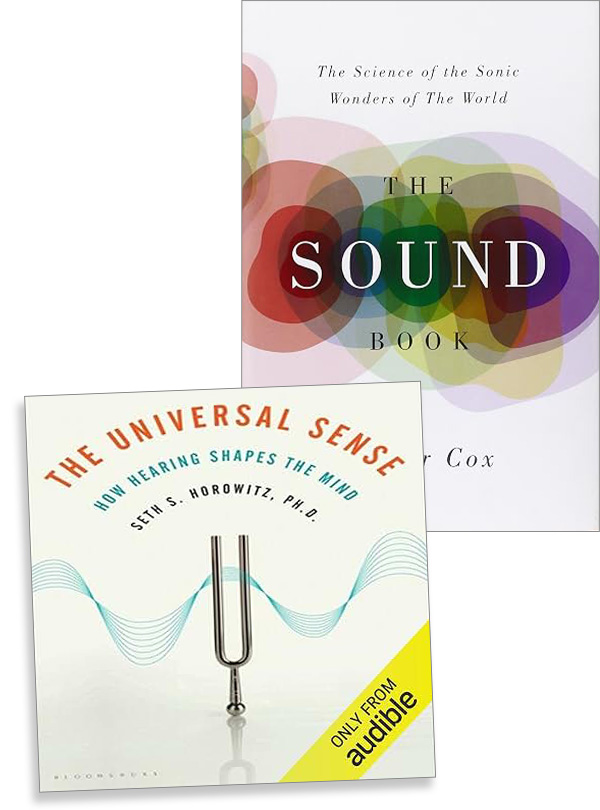
Seth Horowitz’s The Universal Sense is the natural starting point – a neuroscientist’s exploration of hearing, including why it’s the one sense that stays switched on through sleep.
For something more contemporary, Trevor Cox’s The Sound Book is an engaging tour of the science of sound more broadly, from a UK acoustic engineer.