
There’s a particular quiet that arrives after you’ve worked your body hard – climbing a steep hill until your legs burn, swimming until your arms are heavy, lifting until you have nothing left.
The chattering mind goes still, not because you talked it down, but because you ran it out of fuel. This pathway is about using deliberate physical effort to reach that stillness.
There’s a caveat to come, because the popular instinct – that if a brisk walk helps, a brutal session must help more – isn’t one the evidence supports. But the core observation is sound, old, and worth taking seriously: hard physical effort settles the mind.
How to do it
You don’t need to be fit, or to enjoy exercise, to use this. The point isn’t performance – it’s reaching the state on the other side of real effort. Here’s a simple way in.
- Pick something genuinely effortful, but within your limits. A steep hill walk, a hard swim, resistance work, a fast cycle. The aim is real exertion, not punishment.
- Work until the effort takes your full attention. The point where you can’t comfortably hold a conversation is roughly where the mind stops wandering. Stay there for a stretch.
- Don’t skip the come-down. Ease off gradually rather than stopping dead – walk it out, slow the breath, let the heart rate fall. The calm lives in this phase.
- Notice what your body tells you afterward. Settled and tired is the target. Wired and jittery means the dose was too high, too late, or stacked on too much else.
- Save the hardest efforts for earlier in the day if evening sessions leave you restless at bedtime.
Where it comes from
This one has no founder and needs no theory. Hard physical labour, long walks, and a day of manual work have always left people calmer at the end of it – tired in the body and quiet in the head.
The deliberate use of effort to settle the mind is a folk observation older than any gym, later picked up and tested by exercise science.
What the different forms share – the hill walk, the hard swim, the session of lifting – is a turning of attention away from the circling thoughts and into the body’s plain demands. When the effort is real enough, there’s no spare attention left for worry.
Worth knowing
A hard effort doesn’t soothe you while you’re doing it – the calm is a recovery state. During exertion the sympathetic nervous system, the “fight or flight” branch, is fully engaged: heart rate up, adrenaline and cortisol mobilised.
When you stop, the system swings back the other way, and that downswing is where the settled feeling lives. A single session reliably lowers anxiety for at least half an hour afterward.
There’s a second mechanism that builds over time. Exertion forces you to tolerate uncomfortable sensations – a pounding heart, breathlessness, aching muscles – that overlap with the sensations of anxiety itself. Choosing to endure them, on purpose, in a safe context, slowly teaches the nervous system that a racing heart isn’t an emergency.
The instinct that harder must be better is wrong, though: several trials find moderate effort reduces anxiety as well as, or better than, vigorous effort. And for some people – especially after training very hard, very late, or on caffeine – the activation lingers and reads as anxiety rather than calm.
If hard sessions leave you wired rather than settled, that’s information, not a failure of willpower. Dial it down, train earlier, and let the come-down do its work.
Recommended reading
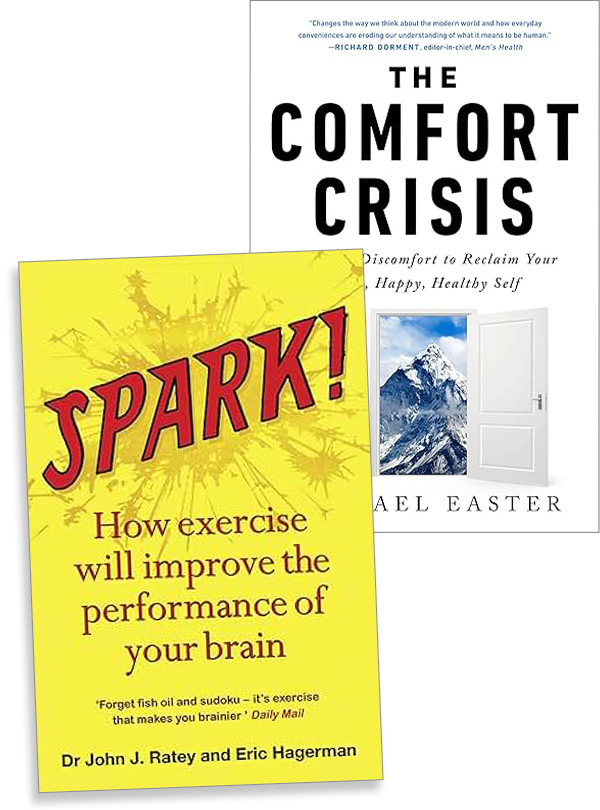
John Ratey’s Spark: The Revolutionary New Science of Exercise and the Brain is the natural starting point – a psychiatrist’s accessible case for exercise as one of the most powerful tools we have for mental health.
For something more contemporary, Michael Easter’s The Comfort Crisis digs into exactly the discomfort-tolerance mechanism described above – what deliberately seeking out hardship does for a nervous system too used to ease.