
Most of the trouble we cause ourselves happens in the half-second between a trigger and our response – the sharp reply fired off before we’ve thought, the spiral entered before we’ve noticed we’re in it.
The STOP technique is a small, memorable tool for putting a gap in that half-second. The name is the method: Stop, Take a breath, Observe, Proceed.
Four steps, a few seconds, and the point of all of them is simply to turn an automatic reaction back into a choice.
How to do it
The whole value of STOP is that it’s easy to recall under pressure. Each letter is one move.
- S – Stop. Whatever you are doing, just pause. Don’t act, don’t speak, don’t send. For one moment, do nothing at all. This first beat is the whole technique in miniature; everything else follows from it.
- T – Take a breath. One slow breath, with a longer out-breath than in. This is the part that actually settles the body – the long exhale tells the nervous system the emergency can wait. If you have time for two or three breaths, take them.
- O – Observe. Notice what is happening, without judging it. What are you feeling – in the body, in the mind? What is the situation actually asking of you? You are stepping back far enough to see the moment, rather than being inside it.
- P – Proceed. Now act – but on purpose. Choose your next move with the small bit of space you’ve made. Sometimes that means responding differently; sometimes it means doing exactly what you would have done anyway, but as a decision rather than a reflex.
Where it comes from
STOP comes out of Dialectical Behaviour Therapy, developed by the psychologist Marsha Linehan from the late 1970s onward – it’s one of the distress tolerance skills, the part of DBT built for surviving a crisis without making it worse.
It has since spread well beyond DBT and turns up across mindfulness-based approaches more widely, including MBSR – partly because, unlike a longer meditation practice, it needs no cushion, no app and no spare time. It works anywhere, the instant you need it.
Worth knowing
When something rattles you, the body reacts before the thinking mind catches up – the jaw tightens, the heart quickens, the words are halfway out.
A reaction in full flow is hard to stop. But it can be interrupted, and a surprisingly short interruption is often all it takes – a single conscious breath gives the slower, wiser part of the brain a moment to come back online. STOP is just a way of remembering to take that moment, a handle you can grab in the instant you most need it.
It’s built for the small, sharp moments – the email that makes your chest tighten, the remark that stings – but it works for the larger ones too: anxiety beginning to climb, a craving taking hold, a familiar argument about to repeat.
Anywhere there’s a gap between a trigger and a response, however brief, STOP is a way of widening it.
A tool you only remember after the fact is no use, so the trick is to practise it when you don’t need it – before you open your laptop, when you stop at a red light, as the kettle boils – so the sequence is worn-in before a real trigger arrives.
It’s a small discipline with a large return: over time, you spend a little less of your life reacting, and a little more of it choosing.
Recommended reading
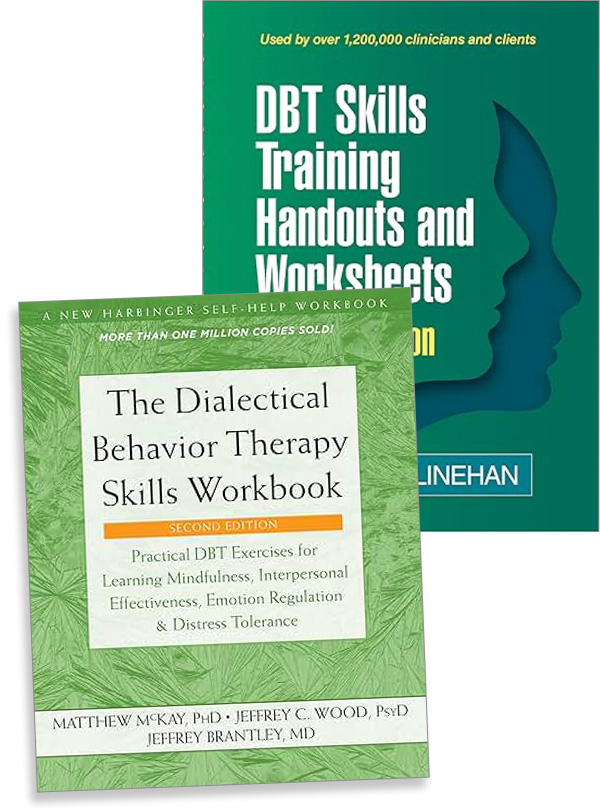
McKay, Wood and Brantley’s The Dialectical Behavior Therapy Skills Workbook is the natural starting point – practical and exercise-based, covering STOP alongside the wider set of DBT skills it belongs to.
For something more detailed, Marsha Linehan’s own DBT Skills Training Manual is the clinical source text – the technique in full, from the person who developed it.