

When someone refuses help
You’ve noticed something’s wrong, you’ve said so, and they’ve said no – or shut the conversation down entirely. It’s one of the hardest positions to be in: watching someone struggle while having no way to make them accept support. Here’s what’s actually within your control, and what isn’t.
Why someone might say no
Refusing help rarely means someone doesn’t want things to be different. More often it’s about something else entirely.
- Shame or fear of judgement – admitting they need help can feel like admitting failure.
- Not recognising how bad things have got – this can happen gradually enough that it’s hard to see from the inside.
- A previous bad experience with a professional, a service, or a past attempt to get help.
- Wanting to keep control of at least one thing, when everything else feels unmanageable.
- Genuinely not being ready yet – readiness isn’t something you can talk someone into on a schedule.
What you can still do…
- Keep the door open, without repeating the pressure. “I’m not going to keep bringing this up, but it still stands if you change your mind” says more than raising it every time you see them.
- Offer something specific, not just “get help.” A name, a number, a link – the support directory or NHS Talking Therapies are concrete enough to act on later, even if not right now.
- Separate the relationship from the rescue mission. Still spend time together doing ordinary things – not everything has to be a conversation about how they’re doing.
- Know what you’d do in a genuine emergency, before you need to. Decide in advance what crossing the line into immediate danger would look like for this specific person, so you’re not deciding it in the moment.
When it stops being their choice to make
Respecting someone’s right to say no has a limit: immediate risk to their life or someone else’s.
If you believe someone is in danger right now, you don’t need their agreement to act – call 999, get them to A&E, or call a crisis line on their behalf.
In a genuine emergency, acting without permission is the right call, not an overreach.
Outside of an emergency, professionals can only assess someone’s care or capacity with their agreement in almost all cases – you can raise concerns with a GP or a crisis team, but they generally can’t act on your say-so alone unless the person consents or an assessment finds they lack capacity to decide for themselves.
It’s worth knowing that boundary exists, rather than assuming either that nothing can be done, or that a phone call from you is enough to trigger one.
Living with not being able to fix it
Watching someone you care about struggle, while they won’t let you help, can feel like a failure on your part. It generally isn’t.
You can do everything right – ask kindly, offer clearly, stay present – and still not be able to make someone ready before they’re ready. That’s not a reflection of how much you tried.
If this is wearing on you, Supporting someone else covers how much of this is genuinely yours to carry, and where your own support might come from while you wait.
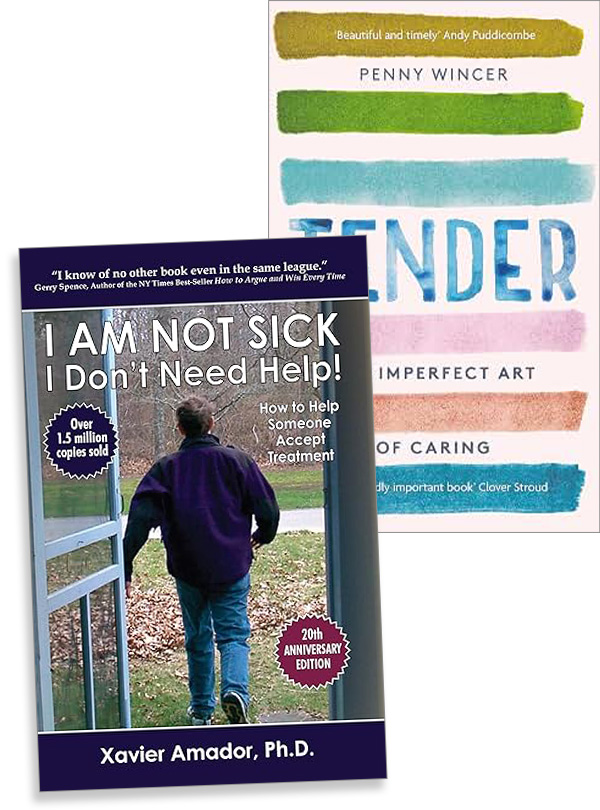
Recommended reading
Xavier Amador’s I Am Not Sick, I Don’t Need Help! is the natural starting point – developed after his own brother refused to accept he had schizophrenia, it teaches a communication method (LEAP) built specifically for when someone won’t acknowledge anything’s wrong.
For something broader than one method, Penny Wincer’s Tender is less clinical and more about the experience of being the person doing the caring – drawing on her own life alongside others’, for the long haul rather than one conversation.
The LEAP method, briefly
Amador’s book goes into far more depth than a page like this can, but the core idea is simple enough to sketch out. LEAP stands for listen, empathize, agree, and partner, and it’s built on the idea that it works by strengthening the relationship rather than winning the argument.
It was originally developed for situations where someone genuinely can’t recognise they’re unwell, but the same four steps hold up for milder refusals too.
- Listen – reflect back what they’ve said, in their own terms, without correcting or arguing yet. The aim is to show you’ve heard them accurately, not to agree or disagree with it.
- Empathize – once they feel heard, name what that experience must feel like for them, so they feel understood rather than managed.
- Agree – find the specific points you genuinely do agree on, and build from there rather than from where you differ.
- Partner – work together toward goals you’ve both actually agreed on, so it feels collaborative rather than something being done to them.
The shift is subtle but real: you stop trying to convince someone they’re wrong, and start listening in a way that lowers defensiveness instead of raising it.
It isn’t fast, and it isn’t a script for a single conversation – it’s a way of showing up over many conversations. For the full method, with worked examples, the book is the better guide than any summary.