
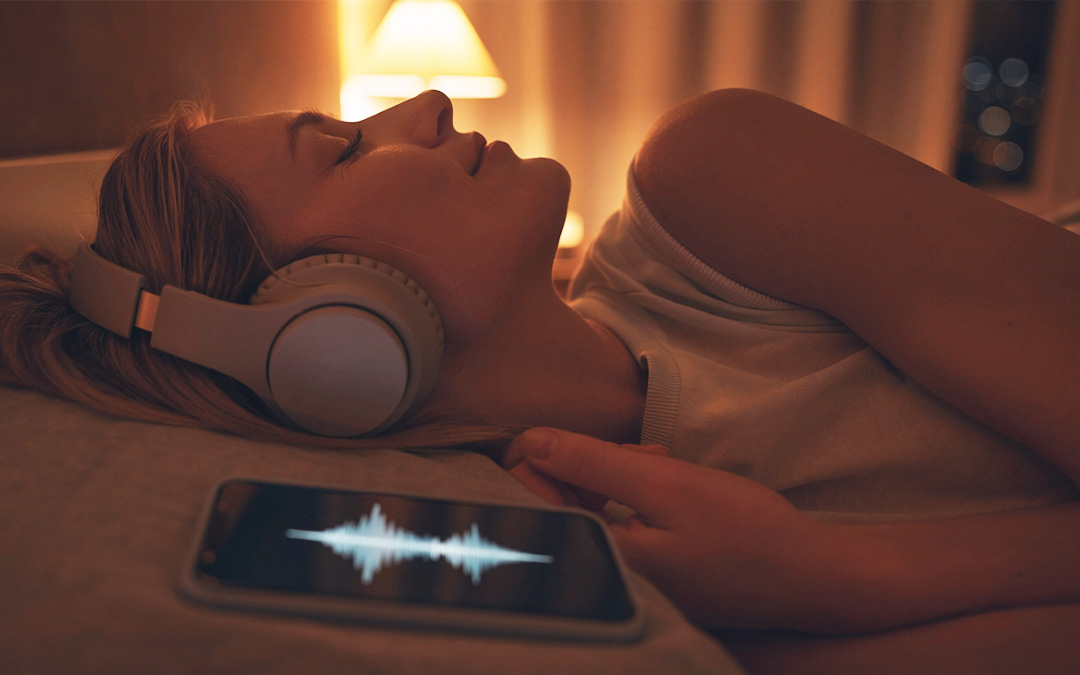
Social feeds have started filling up with ads for “EMDR-inspired bilateral audio” – sound that moves between your left and right ear, promising to calm an overactive mind at the nervous-system level, not just the thought level. It borrows real credibility from a real therapy. Worth separating the two.
What’s genuinely well-evidenced
EMDR – Eye Movement Desensitisation and Reprocessing – is a structured psychotherapy, and the World Health Organization recommends it as a first-line treatment for PTSD.
It works by having a therapist guide a person through recalling a distressing memory while delivering bilateral stimulation – alternating eye movements, taps, or tones – as part of a specific clinical protocol.
That’s the part being borrowed by the marketing. It’s genuine, but it describes a therapist-led process for trauma, not a self-directed audio track for everyday overthinking.
What the audio alone actually shows
The evidence gets considerably thinner once you isolate just the sound.
Even within clinical EMDR research, how much the bilateral stimulation itself contributes – separate from the rest of the therapy – is genuinely debated among researchers.
For bilateral audio specifically, used alone, outside a clinical setting, for general stress rather than trauma: research is early and mostly theoretical.
One proposed mechanism suggests alternating stimulation may trigger the brain’s “orienting response” – interrupting fight-or-flight the way any sudden shift in attention can. It’s a plausible idea, not an established outcome.
- EMDR the therapy and bilateral audio the product aren’t the same claim. One has decades of trial evidence for trauma; the other has a plausible mechanism and little direct testing.
- Even Calm.com’s own blog is more cautious than its ads. Their own site notes bilateral stimulation for trauma processing is best done with a trained therapist, not attempted alone – a different message from “try it tonight.”
- None of this makes it harmful. Calming sound moving between your ears is unlikely to do anything but feel pleasant – the concern is the borrowed authority, not the audio itself.
Worth knowing
If ordinary overthinking or a racing mind at bedtime is the goal, there’s no particular reason this needs to be framed as EMDR-adjacent at all – it’s simply calming audio, in the same broad category as ASMR or ambient sound.
If it’s genuine trauma being processed, the evidence points toward a trained EMDR therapist, not headphones and an app.
Sources: Jongh et al. (2024), Journal of Traumatic Stress – confirms WHO’s 2013 guidelines name EMDR a first-line PTSD treatment, alongside over 30 published trials. Herkt et al., PLOS One – neuroimaging study finding bilateral stimulation increases activity in emotion-processing brain regions during EMDR, and notes the specific contribution of eye movements within EMDR’s evidence base remains debated among researchers.