
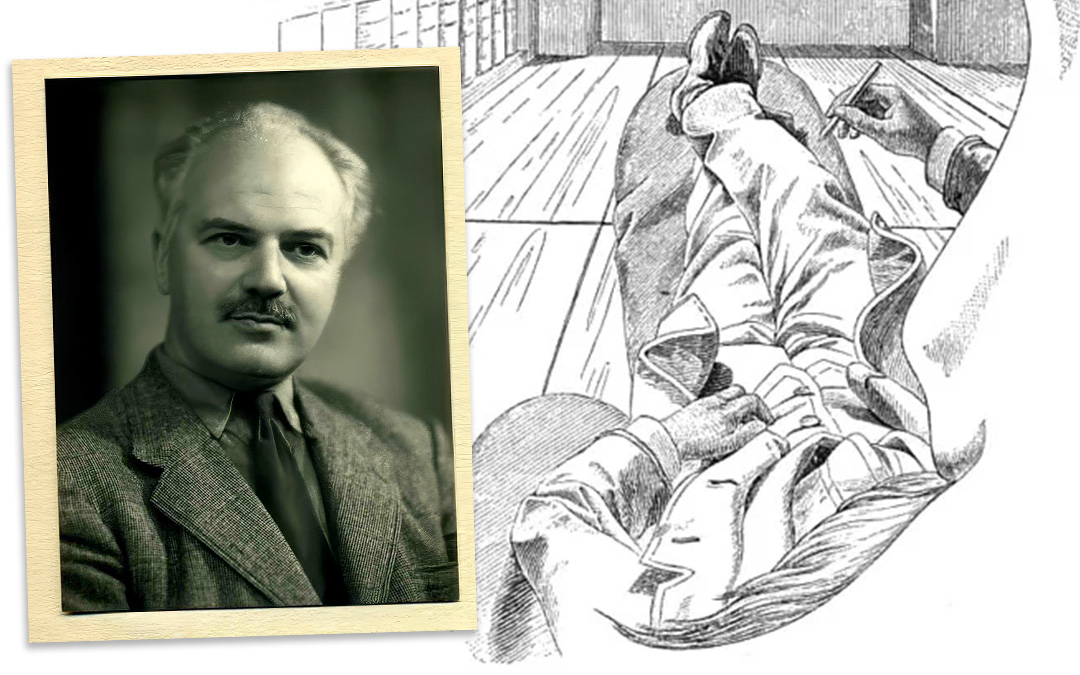
Douglas Harding, photographed in the 1950s – around the decade he first began teaching the exercise built on Ernst Mach’s own headless self-portrait, sketched from Mach’s point of view in 1886.
Photo: Douglas Harding Archive, 1950s. Illustration: Ernst Mach, 1886 (Public Domain Review).
In 1943, an English architect looked down at himself and realised he had no head. He spent the rest of his life teaching other people how to notice the same thing.
Douglas Harding was born in Suffolk in 1909 and raised in the Exclusive Brethren, a strict fundamentalist Christian sect his family belonged to.
He left it at 21, unable to accept its claim to sole possession of the truth – a rupture that seems to have left him permanently suspicious of anyone claiming certainty on his behalf.
He trained and worked as an architect, first in London and then in India, where he moved in the 1930s.
Alongside the day job, he kept returning to one question: if you looked closely enough at what a person actually is – cells, then molecules, then atoms, then further still – where, exactly, would you find the person doing the looking?
The answer arrived while he was out walking in the Himalayan foothills in 1943. He’d recently come across a self-portrait by the physicist Ernst Mach (above), drawn not from a mirror but from Mach’s own point of view – showing a body with no head, because that’s genuinely what your own point of view shows you.
Harding looked down at his own chest, his own shoes, and noticed the same thing: from where he was standing, he had no head at all. Just an open, aware nothing, with the entire world appearing inside it.
Here’s what’s worth knowing about what he did with that moment:
- He spent nine years writing it up properly before publishing anything popular. His 1952 book “The Hierarchy of Heaven and Earth” laid out the full philosophy – dense enough that C.S. Lewis, who wrote its preface, called it “a work of the highest genius.”
- The accessible version came almost a decade later. “On Having No Head,” published in 1961, turned the idea into something anyone could try directly, not just read about.
- He built a simple exercise around it. Point at your feet, your chest, then at the place you’re looking out from, and ask what colour or shape is there. None, is the intended answer – an open awareness, not a bounded self.
- He later discovered Zen Buddhism was already there. He found his own experience described in the writings of D.T. Suzuki and older Zen masters, and reportedly felt he’d “at last found friends” who understood what he meant.
- He kept teaching it until his death in 2007, aged 97. His workshops continue today through the Shollond Trust and a teacher named Richard Lang, still explicitly nonhierarchical – no ordained teachers, no lineage, no membership required.
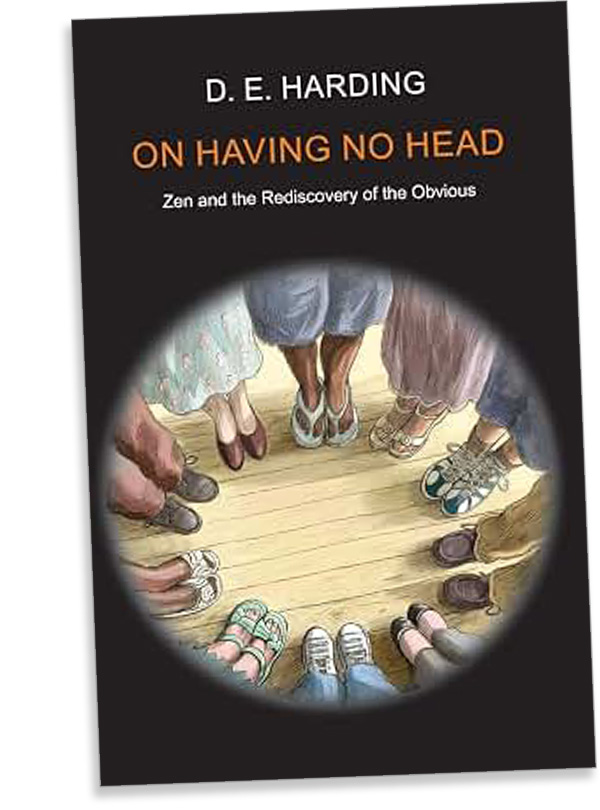
On Having No Head – the book behind the exercise this post is about, and the one Sam Harris cites directly in Waking Up.
An idea without the usual scaffolding
That last point is also where the more considered criticism sits. A Zen vice-abbot, writing about Harding’s method, made a specific and careful distinction: Zen’s own “backward step” toward the same kind of insight comes wrapped in discipline, teacher authentication, and years of sustained community practice.
Harding’s version deliberately strips all of that away – anyone can try it in thirty seconds, with no teacher and no preparation required.
That’s precisely the appeal, and precisely the risk our last two posts have been circling. A technique built to work without scaffolding also removes whatever the scaffolding was there to catch.
Sam Harris built his Waking Up app‘s core teaching around exactly this exercise. He cites Harding directly as offering “an unusually clear description of what it’s like to glimpse the nonduality of consciousness” – and made the pointing exercise part of Waking Up’s introductory course, available to complete beginners from day one.
Cheetah House, the support organisation run by meditation researcher Willoughby Britton – whose own research we covered in The dark side of meditation – has reported people arriving in genuine distress specifically after this material: chronic depersonalisation, anxiety, a particular kind of somatic-existential OCD.
Not because the exercise is a trick or the insight is false, but because removing your sense of being a bounded self is not something everyone’s mind reliably puts back together afterwards. None of which makes Harding a fraud, or his question a bad one.
It’s a genuinely old, genuinely serious question, asked by someone who’d already walked away from one system that claimed a monopoly on truth, and who spent the rest of his life trying to hand people a way to check for themselves rather than take anyone’s word for it. That’s a worthwhile inheritance. It’s just not a free one.
If trying something like this – or reading about it – has left you feeling unsettled, detached, or like your sense of yourself has come loose, that’s worth taking seriously rather than pushing through. NHS Talking Therapies is free, evidence-based, and self-referral in most of England, requiring no GP consutation. If it feels more urgent than that, the Support directory has crisis contacts.