

Working life comes with a promise, spoken or not: keep going, and eventually there’ll be enough. Retirement is when that promise gets tested against the actual numbers – and for a lot of people, the test feels like it never quite ends.
This worry is different from ordinary financial stress. There’s no next pay cheque coming to close the gap, no obvious way to simply earn more if the numbers look short – which makes the maths feel far more final than it did during working life.
It’s also a worry about a future self who isn’t here yet to defend themselves. Underspending now to protect them can feel abstract; running out later, when there’s no more income to call on, doesn’t.
The fear here isn’t really about the size of the pension. It’s about whether the future can still be trusted to hold, now that there’s no more working life left to fix it with.
A few things make this particular worry harder to shake, even for people who’ve genuinely planned for it:
- There’s no more income to fall back on. A bad month in working life can be earned back – a bad decade in retirement can’t, which makes the same uncertainty feel much higher-stakes.
- The end date is unknown. Planning for a fixed amount of time is hard enough; planning for an unknown lifespan, and hoping the money outlasts it, is harder still.
- Distress itself makes the numbers worse. Anxiety about money is linked to actually saving less and drawing down pension savings sooner, not just to feeling worse about the amount that’s there.
- Avoiding the numbers feels safer than it is. Not checking, not getting advice, not opening the statement can feel protective in the moment, while quietly making the underlying problem harder to fix.
- It rarely stays only about money. Underneath it is usually a question about independence, or being a burden, or simply whether the future is still safe to think about.
Why this happens
Retirement planning asks people to make sacrifices now for a future self who can feel almost like a stranger – which is part of why so many people under-save for a future that, when it arrives, feels entirely real and entirely underfunded.
It isn’t simply a knowledge gap. Financial literacy matters, but even well-informed people carry this worry, because the fear is about security, not arithmetic.
The two feed each other in a genuine loop: financial worry makes it harder to plan calmly, and the resulting gaps in planning give the worry more to feed on.
That loop isn’t only psychological, either. A major UCL study that followed the same group of people for nearly seventy years found that chronic financial strain in adulthood was linked to measurably faster brain ageing decades later – not from one hard year, but from money trouble that kept recurring.
What actually helps
Getting specific tends to help more than trying to feel calmer in the abstract. A vague fear of “not having enough” is hard to act on; a concrete number, checked once, is something that can actually be planned around.
It also helps to treat seeking advice as a way of facing the fear, not confirming it. Many people avoid financial advice specifically because of the anxiety it stirs up – which is understandable, but tends to leave the underlying worry unresolved rather than settled.
Separating what’s genuinely still changeable from what’s already decided helps too – some of this worry is about decisions still ahead, and some is about a past that can’t be re-saved for, and they call for different responses.
Worth knowing
This worry is common enough to be closer to normal than exceptional – it isn’t a sign of having failed to plan properly.
People who’ve planned carefully still carry this fear, because it was never purely about the numbers in the first place.
If the worry is disrupting sleep, dominating everyday thinking, or leading to avoiding your own finances altogether, NHS Talking Therapies is worth looking at – free, evidence-based, and self-referral in most of England, no GP needed. If it feels more urgent than that, the Support directory has crisis contacts.
Recommended reading
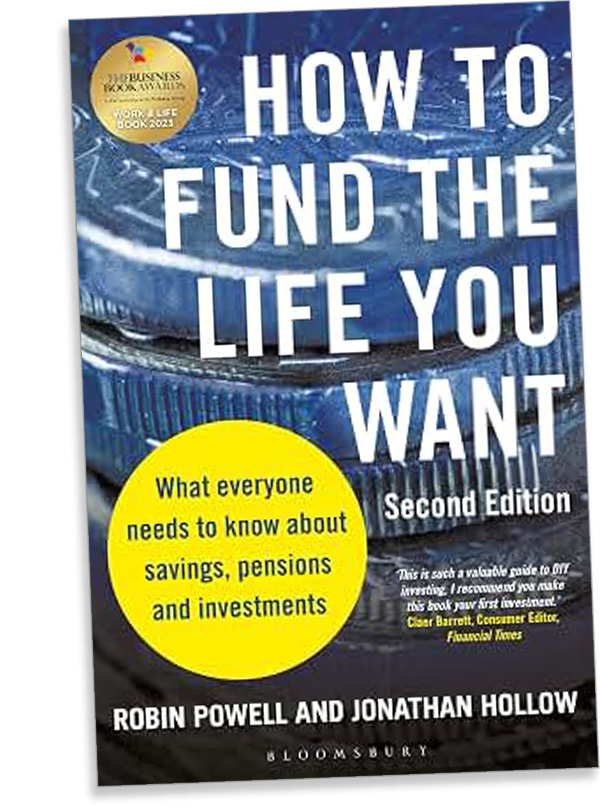
Robin Powell and Jonathan Hollow’s How to Fund the Life You Want is a clear, jargon-free British guide to exactly this problem – written in part by a former UK Money and Pensions Service insider, and built around the same idea of investing in a future self worth taking seriously.