

Feeling like a fraud has almost nothing to do with how capable you actually are – the two turn out to be barely related at all.
It rarely turns up when things are going badly. It tends to arrive right after a promotion, a new job, or some other piece of proof that people rate you – exactly the moment the evidence should be reassuring.
The feeling has a specific shape. Success gets explained away – luck, timing, an easy panel, someone else covering for you. Failure gets taken personally, as confirmation of what you always suspected. Neither reading holds up especially well under scrutiny.
None of this means the feeling isn’t real. It means the feeling and the reality it claims to report on are two separate things – and research suggests only one of them is reliable.
Worth knowing
A few things about imposter syndrome rarely make it into the popular version of the story:
- It has a name and a research history, not just a vibe. Psychologists first described it in 1978, in high-achieving women who couldn’t internalise their own success despite consistent external proof of it – it’s been studied for nearly fifty years, not invented by social media.
- It isn’t confined to any one type of person. Later research found it across genders, occupations and career stages, with reported rates ranging enormously depending on how it’s measured – but consistently common, not rare or unusual.
- It doesn’t track with actual ability. A study that tested people’s real performance directly, rather than just asking how they felt about it, found imposter feelings were essentially unrelated to measured competence – the fraud feeling and the fraud fact don’t travel together.
- New responsibility is often the trigger, not evidence you’re unsuited to it. The feeling tends to spike around transitions – a promotion, a new role, a step up – which is a sign the ground has shifted, not a verdict on whether you belong on it.
- Over-preparation quietly keeps it going. Working twice as hard as necessary “just in case” feels like caution, but it also means success can always be credited to the extra effort rather than to underlying ability – so the underlying doubt never actually gets tested.
Why this is different
The common advice – be more confident, fake it till you make it – treats imposter syndrome as a mindset problem: not enough self-belief. That’s rarely where it actually starts.
It’s better understood as an attribution problem – a habit of explaining outcomes to yourself in a particular, skewed way, rather than a shortage of ability. The skill deficit that the feeling insists is there usually isn’t; the explaining-away habit is.
What actually helps
Naming the pattern out loud, to someone who might recognise it too, tends to loosen its grip more than trying to reason your way out of it alone – it turns a private conviction into a shared, ordinary experience.
Keeping a written record of specific feedback and outcomes – not a vague felt sense, but the actual emails, results, and things people said – gives the explaining-away habit something concrete to argue against.
And separating the feeling from the decision matters: taking the promotion, saying yes to the opportunity, while the doubt is still there, rather than waiting to feel ready first. The feeling is a poor predictor of whether you’re actually prepared.
What it isn’t
Feeling like a fraud is not evidence that you are one. It’s a pattern in how you explain what happens to you – and patterns can be interrupted.
It tends to ease with repetition – doing the thing again, and again, until the evidence outweighs the habit of dismissing it.
If this is disrupting sleep or everyday functioning, NHS Talking Therapies is worth looking at – free, evidence-based, and self-referral in most of England, no GP needed. If it feels more urgent than that, the Support directory has crisis contacts.
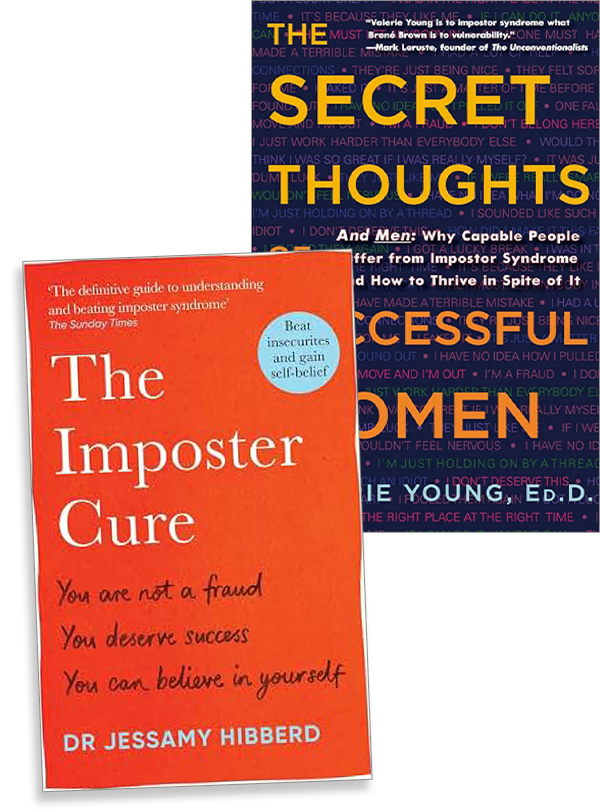
Recommended reading
Clinical psychologist Dr Jessamy Hibberd’s The Imposter Cure is a practical, CBT-grounded guide built specifically around the thought patterns and coping strategies (overworking, avoidance) that keep the feeling going – full of case studies rather than abstract theory, and written to be worked through rather than just read.
Valerie Young’s The Secret Thoughts of Successful Women takes the more foundational, analytical route – her research identifies distinct “competence types” (the perfectionist, the natural genius, the soloist, the expert, the superwoman/superman) that shape how the feeling shows up differently from person to person. Genuinely different from Hibberd’s book rather than covering the same ground twice.