

Self-compassion is often mistaken for self-pity, or for letting yourself off easily. It isn’t either. It’s closer to the way you’d speak to a friend who was struggling – with warmth, and without minimising what’s actually hard.
For a lot of people, that voice is simply missing. The inner default is criticism first, kindness never – as if going easy on yourself were somehow dangerous.
Where it comes from
The practice draws on Buddhist teachings on compassion, which have always treated kindness to oneself as inseparable from kindness to others – not a separate, lesser concern.
Kristin Neff brought it into Western psychological research in 2003, defining it as three connected parts: self-kindness rather than self-judgment, a sense of common humanity rather than isolation, and mindfulness rather than over-identifying with the pain.
Worth knowing
A few things about self-compassion rarely make it into the popular version of the story:
- It isn’t the same as self-esteem. Self-esteem depends on comparing well against others or succeeding at something; self-compassion doesn’t need either – it’s there just as much on a bad day as a good one.
- It’s measurable, not just a feeling. Kristin Neff’s 2003 Self-Compassion Scale is still the standard research tool – part of why the evidence base is as substantial as it is.
- It increases motivation rather than undermining it. In controlled experiments, people who responded to their own mistakes with compassion – rather than a self-esteem boost – ended up more motivated to improve, not less.
- It measurably reduces anxiety and depression. A large review pooling dozens of trials found self-compassion training lowered both, with the improvement holding up over time rather than fading.
- It changes how the brain responds to self-criticism. Brain-imaging studies find self-reassurance and self-criticism activate genuinely different neural pathways – one linked to safety, the other to threat.
Why it can help
The common worry is that self-compassion is really just self-indulgence in disguise – that letting yourself off easily will make you complacent. The research says close to the opposite.
Being kind to yourself after a setback doesn’t remove the sting of it – it just stops the sting from turning into a longer story about what the setback says about you. That’s usually what frees up the energy to actually do something about it.
The self-compassion break
Neff’s own version is short enough to use in the moment, built from the same three parts above: name what’s happening plainly – “this is really hard right now” – rather than pushing past it.
Then remind yourself that other people feel this too, in their own version, so the moment doesn’t turn into isolation; then offer yourself something kind – a hand on the heart, or a phrase that feels genuine rather than performed. All three, run together, usually take under a minute.
Where to go from here
None of this requires believing you’re wonderful, or pretending things are fine. It just means meeting the hard moment as you’d meet it in someone you loved.
It isn’t an instant fix, either – the inner critic tends to be a long-held habit, and unlearning it usually takes repetition rather than a single conversation with yourself.
What the research suggests is that the repetition is worth it: not just for how it feels in the moment, but because it seems to leave people better placed to actually change what needed changing.
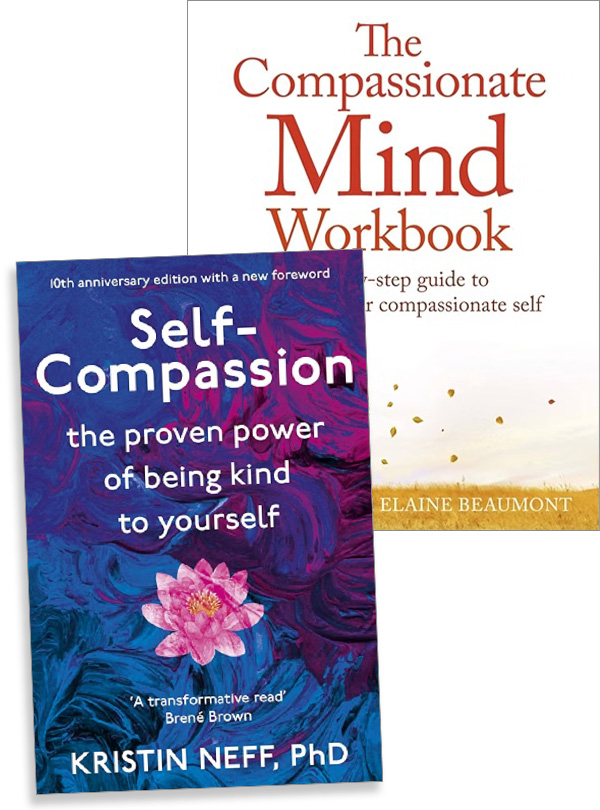
Recommended reading
Kristin Neff’s Self-Compassion: The Proven Power of Being Kind to Yourself is the founding text – the original research, in the words of the psychologist who defined the field.
Chris Irons and Elaine Beaumont’s The Compassionate Mind Workbook takes a more practical route, built from Compassion Focused Therapy, for anyone who wants structured exercises rather than the theory alone.