

Cognitive behavioural therapy (CBT) explores how thoughts, feelings, physical sensations and actions influence one another. It uses practical exercises to understand these patterns and try different responses.
For example, thinking “I’ll embarrass myself” might lead you to avoid a conversation. Avoiding it can bring immediate relief, while leaving you with little chance to find out whether your fear was accurate.
CBT can involve examining a thought, changing a habit or gradually approaching something you have been avoiding. The approach depends on the difficulty you are working on.
It is widely researched and recommended for several conditions, including anxiety disorders and depression. The most suitable treatment depends on your needs, preferences and circumstances.
Trying a thought record
A thought record is one common CBT exercise. You write down a situation, your feelings and the thoughts that came with them, then consider the evidence and possible alternative explanations.
Begin with an everyday difficulty that feels manageable. Use paper or a note on your phone, perhaps once the strongest feeling has eased. The aim is a fairer understanding of the situation; your feelings may take longer to change.
This exercise introduces one part of CBT. A course of therapy includes support, other techniques and opportunities to review what is helping.
- Describe the situation. Write down what happened, where you were and who was involved. Keep this brief and separate what you observed from what you think it meant.
- Name the feeling. Perhaps you felt anxious, sad, angry or embarrassed. If useful, rate its strength from 0 to 100. You can use words such as “mild” or “strong” instead.
- Write down the thought. What went through your mind? For example: “They think I’m a fool” or “I can’t cope.” Use the words you remember. If no thought comes to mind, leave a space and return to it later.
- Consider the evidence. What supports the thought, and what suggests another explanation? For “They think I’m a fool”, ask what the person actually said or did. Include relevant facts on both sides, and acknowledge what you do not know.
- Find a balanced response. Write something that reflects the evidence: “I stumbled over my words, but they continued the conversation. I don’t know what they thought.” Notice how you feel now, and consider whether there is a useful next step. The feeling may stay the same.
With practice, a thought record may help you notice familiar assumptions sooner. You can keep it brief: the aim is to understand a situation, rather than analyse every thought you have.
How CBT developed
CBT brings together approaches that work with thinking and behaviour. Albert Ellis developed Rational Emotive Behaviour Therapy in the 1950s, while Aaron Beck developed cognitive therapy from his work on depression in the 1960s.
Both explored how interpretations and beliefs contribute to distress. Behavioural approaches added ways to learn through experience, such as gradually approaching feared situations or rebuilding activities that have fallen away.
CBT has since developed into a family of treatments adapted for different difficulties. A course for insomnia, for example, uses different methods from one for obsessive compulsive disorder.
More than examining thoughts
CBT also looks at what you do. Avoidance, repeated checking or withdrawing from activities can sometimes keep a difficulty going, even when they bring relief in the short term.
A therapist can help you plan manageable changes and review what happens. This might mean testing a prediction, gradually facing a fear or scheduling an activity you have stopped doing.
Real circumstances matter too. Grief, illness, discrimination or financial pressure cannot be reduced to a mistaken thought. CBT can help with responses to these difficulties while recognising the need for practical support or changes in your situation.
If examining a thought becomes another way to criticise yourself, pause. The approach on the self-compassion page may help you bring a fairer tone to the exercise.
When to seek support
CBT is an established treatment for several mental health conditions, but it does not suit everyone. Treatment involves agreeing goals, choosing appropriate methods and checking progress together.
Support can take different forms, including guided self-help, group sessions and individual therapy. You can ask for exercises to be explained differently or adapted to your needs, and discuss anything that feels unhelpful or too difficult.
If anxiety or low mood persists or affects daily life, speak with a GP or talking therapies service. In England, you can usually refer yourself to NHS Talking Therapies without a GP referral. Access arrangements differ elsewhere in the UK.
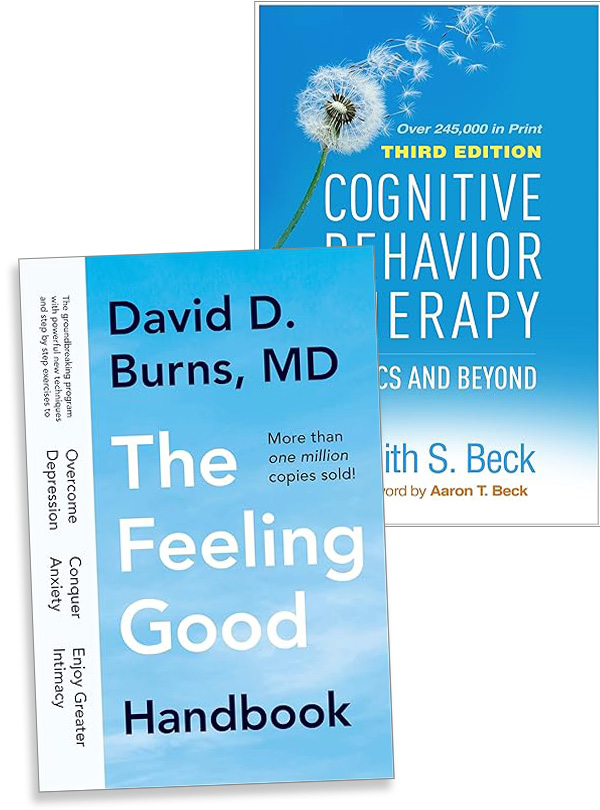
Recommended reading
David Burns’s Feeling Good: The New Mood Therapy introduces cognitive therapy for a general reader, with examples and exercises for examining thoughts associated with low mood. It offers a fuller explanation of the approach behind the thought record.
Judith Beck’s Cognitive Behavior Therapy: Basics and Beyond explains how therapists assess difficulties, plan treatment and use cognitive and behavioural techniques. Written mainly for clinicians and trainees, it suits readers who want a detailed account of how CBT is delivered.