
Stoic practice draws on an ancient philosophy that asks how to live well in circumstances we cannot fully control. Its exercises encourage us to examine our judgements and choose our actions with care.
One useful starting point is to separate what happened from what you think it means. An unanswered message is something you can observe; the belief that someone is angry with you may need checking.
Another is to ask where you can take useful action. You might prepare for a conversation, ask for help or set a boundary, even when you cannot decide how someone else will respond.
Pain, loss and unfair treatment have real effects. These exercises should not become a reason to blame yourself for distress or accept a situation that needs changing.
How to do it
Start with an everyday frustration rather than your most difficult experience. Here are five exercises to try, briefly and without demanding an immediate change in how you feel.
- Identify what you can do. Separate what you can act on from what you cannot decide. Before an appointment, you can prepare questions and arrange support, but cannot guarantee the outcome. Choose one useful next step. Your feelings may take longer to change.
- Check your interpretation. “They haven’t replied” is an observation; “They’re angry with me” is one possible explanation. Ask what evidence you have and whether there are other explanations. Questioning assumptions does not mean excusing someone’s harmful behaviour.
- Choose how you want to act. Ask what honesty, fairness or care would look like in this situation. That might mean acknowledging a mistake, listening before replying or setting a clear boundary. Choose an action you consider worthwhile, even if you cannot ensure it will be well received.
- Prepare for a manageable difficulty. Briefly consider a specific possibility, such as a delayed journey or an awkward conversation. Decide what you could do if it happened, then finish with a practical plan. If this becomes repeated worry or vivid worst-case scenarios, leave the exercise out.
- Review one moment from your day. Take a couple of minutes to ask what happened, how you responded and what you might try next time. Include something you handled well. Keep the review specific; if it turns into self-criticism, stop rather than repeatedly going over the same event.
Where it comes from
Stoicism began in Athens around 300 BC. Zeno of Citium taught at the painted porch, or stoa, that gave the school its name.
Much of the writing available today comes from later thinkers in the Roman world: Seneca, Epictetus and Marcus Aurelius. Their letters, teachings and reflections explore judgement, responsibility and how to respond to difficulties.
Stoicism was a philosophy of how to live, including how to treat other people. The exercises on this page draw on part of that tradition; they do not cover its wider ideas about ethics, logic and nature.
Stoic ideas also influenced the development of cognitive therapies. The connection is real, but practising Stoic exercises is not the same as receiving psychological treatment.
One shared idea is that our interpretation of a situation can affect how we feel and act. Modern CBT explores this alongside behaviour, physical responses and the circumstances of a person’s life.
Worth knowing
Ancient Stoics placed demanding expectations on judgement and emotion. You can explore their practical exercises without treating every feeling as something you should be able to reason away.
Feeling upset does not mean you have failed to think clearly. Grief, fear and anger may need time, support or action, rather than another attempt to change your interpretation.
Distinguishing what you can influence from what you cannot can help you choose a next step. It does not require you to accept mistreatment or give up efforts to change an unfair situation.
If reflection becomes repeated self-criticism or worry, shorten it or leave the exercise out. You might focus instead on a practical task or talk things through with someone you trust.
These exercises are not a treatment for depression, anxiety disorders or trauma. If distress is persistent or affecting daily life, speak to a qualified healthcare professional about support.
Recommended reading
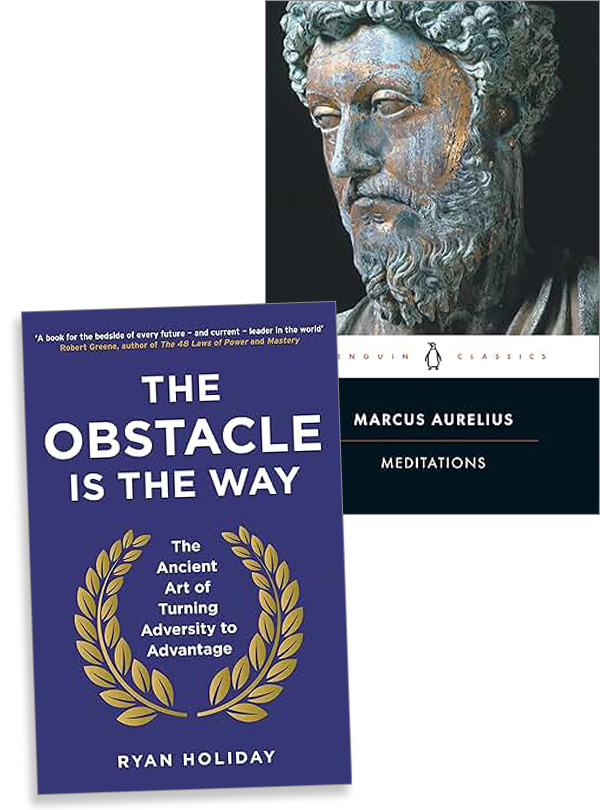
Marcus Aurelius’s Meditations collects a Roman emperor’s reflections on responsibility, judgement, change and mortality. Written for his own use, it shows him repeatedly returning to ideas he wanted to put into practice.
You can read a few passages at a time rather than work through it in order. A translation with an introduction and notes can help explain unfamiliar ideas and historical references.
Ryan Holiday’s The Obstacle Is the Way presents a modern interpretation of Stoic ideas, using historical stories to explore perception, action and perseverance.
It may suit you if you prefer examples to ancient texts. Its emphasis is on responding constructively to setbacks; you don’t need to treat every difficulty as an opportunity or a test of character.