

Some things cannot be undone: a loss, a decision already made or an event you wish had gone differently. Acceptance begins with acknowledging what is here, including how you feel about it.
You can recognise that something happened while still wishing it had not. Sadness, anger and disappointment do not have to disappear before you decide what to do next.
Letting go might mean stepping back from repeatedly replaying an argument, trying to force certainty or waiting to feel better before taking a manageable action.
Acceptance can sit alongside seeking change. You may still need to solve a problem, set a boundary, ask for help or challenge something unfair.
There is no timetable for this, and no requirement to feel peaceful. Begin with a small, everyday difficulty rather than the most painful experience in your life.
Acknowledging what is here
Choose a manageable situation. Notice what has happened, allow for your response and consider one useful next step, without making relief a condition for moving forward.
- Start with a manageable difficulty. Choose something like a disrupted plan or a small disappointment. Describe what happened in a sentence, without needing to explain every part of it.
- Notice your response without judging it. You might name sadness, anger, worry or frustration. You do not need to approve of the situation or make the feeling disappear.
- Recognise when your thoughts are repeating. If you keep returning to “This shouldn’t have happened”, try “I wish this were different, and this is what I’m dealing with now.” Use your own words if that feels more natural.
- Consider what you can influence next. You may be able to change part of the situation, ask for support or set a boundary. If you are unsure what is possible, talk it through rather than deciding too quickly that nothing can change.
- Take one small step that matters to you. Make a practical adjustment, contact someone or return to an everyday activity. The difficult feeling can still be present; you do not have to wait until you feel accepting.
You may acknowledge what has happened and still feel grief, anger or sadness. Acceptance does not require a particular mood, and difficult feelings may return even after a situation feels more settled.
Relief is possible, but it is not a test of whether you are doing this correctly. The practical question is whether you have a little more room to choose your next step.
Acceptance alongside action
Acceptance has a place in several philosophical, religious and therapeutic approaches, though they give it different meanings. In modern acceptance-based therapy, it is usually paired with action towards what matters to the person.
Acceptance and Commitment Therapy (ACT), for example, helps people make room for thoughts and feelings while choosing how to respond. Acceptance is one part of a broader approach that also includes attention, values and behaviour change.
There is evidence for ACT in particular settings. NICE recommends considering ACT or cognitive behavioural therapy for chronic primary pain, delivered by appropriately trained professionals. That does not establish a brief “letting go” exercise as a treatment on its own.
Stoic practice offers another perspective on responding to circumstances and distinguishing what you can influence. You can explore its ideas without treating the philosophy and a psychological therapy as interchangeable.
Making room for thoughts
Trying hard to banish a thought can sometimes make it return more often. Research on thought suppression has found a rebound effect, although its size varies across studies and situations.
The well-known “white bear” experiments explored this by asking people not to think about a white bear. They illustrate a difficulty with controlling thoughts, rather than proving that acceptance is always the best response to every emotion.
You might try noticing “That thought is here again” and returning to what you were doing. The aim is to spend less effort checking whether it has disappeared, rather than to make it go away through a different technique.
Leaving room for support and change
You can acknowledge a situation and still work to change it. Setting boundaries, seeking treatment, challenging unfairness and leaving harm are all compatible with recognising what is happening.
You do not need to forgive someone, minimise what happened or revisit painful memories to practise acceptance. Start small, and pause if paying attention to your feelings becomes overwhelming.
If repetitive thoughts or distress are disrupting daily life, seek support from a GP or mental health professional. Taking a break or turning your attention elsewhere can also be a useful choice; it is not automatically a failure to accept.
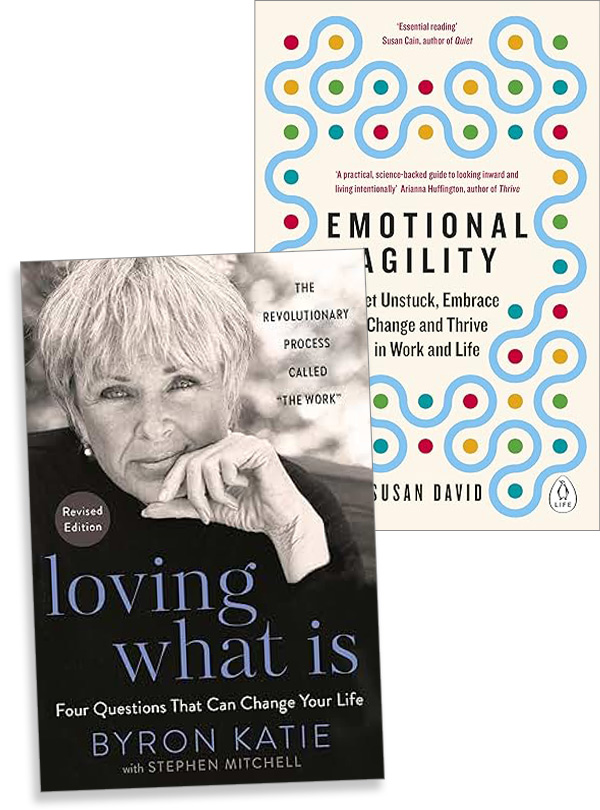
Recommended reading
Byron Katie’s Loving What Is, written with Stephen Mitchell, introduces four questions for examining stressful thoughts. Read it as an approach to self-inquiry, while keeping room for boundaries and practical action.
Susan David’s Emotional Agility offers examples and exercises for acknowledging difficult feelings and choosing actions guided by your values. It may suit you if you want a broader approach to everyday emotional responses.