
Knowing that life is finite can raise difficult questions: how to spend your time, what matters to you and what you would like to say to the people you care about.
Contemplating death means choosing to give those questions some attention. It might involve a brief reflection, reading or a conversation with someone you trust.
You do not need to imagine your death in detail or arrive at a settled belief about what happens afterwards. You might simply ask what you want to make room for in your life now.
People respond differently to the subject. It can feel clarifying, sad, frightening or ordinary, and those responses may change with grief, illness, beliefs and personal experience.
This is an optional practice. If thoughts about death already feel intrusive or overwhelming, leave deliberate contemplation aside and seek support rather than pushing yourself further into them.
Beginning with what matters now
Choose a brief, manageable reflection on how you want to live. Give yourself permission to pause, return to an everyday activity or talk with someone if the subject feels too difficult.
- Choose a time when you feel able to reflect. Begin with a few minutes somewhere comfortable. You can leave this for another day if you are tired, distressed or do not want to explore it.
- Start with a question about living. Ask “What matters to me at this stage of my life?” or “What would I like to give more time to?” There is no need to imagine a deadline or picture your death.
- Use a short reading or conversation if it helps. Choose a passage from a writer or tradition you trust, or speak with someone willing to discuss the subject. You can question the ideas without adopting their beliefs.
- Bring the reflection back to something manageable. You might contact someone you care about, make time for an interest or write down a wish you would like to discuss. A small action is enough; you do not need to reorganise your life.
- Finish by returning to the present. Notice your surroundings and move on to an ordinary activity. If the reflection becomes repetitive or overwhelming, stop and seek support rather than continuing alone.
You do not have to resolve your feelings about death during a reflection. Questions can remain open, and you can return to ordinary life without finding a reassuring answer.
Discomfort is not something you must push through. If the reflection leaves you more distressed or caught in repetitive thoughts, pause rather than assuming that continuing will bring clarity.
A philosophical practice, with different meanings
Reflection on mortality has a long place in philosophy and religious life. In Marcus Aurelius’s writings, reminders of death sit alongside questions about conduct, priorities and how to use the present.
Within Stoic practice, mortality can be a prompt to consider what is within your control and how you want to act. You can explore that perspective without agreeing with every part of the philosophy.
Other traditions approach death through their own beliefs, teachings and ceremonies. These are not interchangeable, and their long histories do not establish that contemplating death will make everyone calmer.
What psychology can tell us
Research has explored how reminders of death affect feelings and behaviour. It does not provide a settled answer about whether brief, self-directed contemplation improves wellbeing.
One influential account, terror management theory, proposes that awareness of mortality can strengthen people’s attachment to beliefs and group identities. Some experiments supported its predictions, but large replication projects have failed to reproduce certain widely cited effects.
Those experiments are also different from choosing a gentle reflection on your priorities. They do not show that bringing fear into awareness reliably loosens its influence, or that ordinary worries are mainly disguised fears of death.
Structured psychological treatments for death anxiety have shown some promise, including approaches based on cognitive behavioural therapy. The research is limited, and treatment involves more than repeatedly thinking about mortality on your own.
Knowing when to leave it aside
This practice is optional. Grief, illness or intrusive thoughts may make the subject especially difficult, and choosing another focus is a reasonable response.
If fear of death is disrupting sleep or daily life, speak with a GP or mental health professional. You can ask for help with the fear without first becoming comfortable discussing every aspect of death.
For a gentler starting point, consider a question about what matters today. An acceptance practice may also offer a way to acknowledge uncertainty without trying to settle it.
Recommended reading
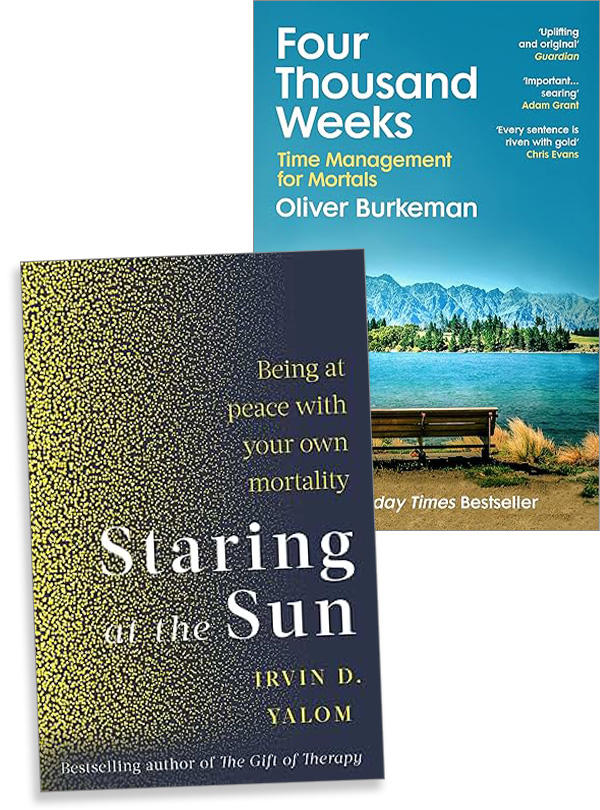
Irvin Yalom’s Staring at the Sun addresses fear of death directly, drawing on his experience as a psychiatrist, stories from therapy and philosophical ideas. He explores how awareness of mortality can shape relationships, regrets and choices about living.
It may suit you if you want a thoughtful discussion of death anxiety rather than a brief exercise. Yalom presents his clinical perspective, which you can consider at your own pace without needing to agree with every interpretation.
Oliver Burkeman’s Four Thousand Weeks approaches mortality through the everyday problem of limited time. It questions the pursuit of getting everything done and explores how accepting limits can inform decisions about work, relationships and attention.
The emphasis is on choosing what deserves your time while recognising that other possibilities will be left aside. It may appeal if you would rather begin with priorities and ordinary life than focus directly on fear of dying.