

Acceptance and commitment therapy (ACT) helps you respond more flexibly to difficult thoughts and feelings, while taking steps towards what matters to you.
For example, you might feel anxious about contacting a friend. ACT asks whether you can acknowledge that anxiety and still make the call, because the friendship matters to you.
Acceptance means making room for an internal experience. It does not mean approving of harmful behaviour, staying in an unsafe situation or giving up on changes you can make.
ACT belongs to the broader family of cognitive and behavioural therapies. Like the CBT method, it works with thoughts and actions, with particular emphasis on how you respond to thoughts.
Trying a different response
One ACT skill is called cognitive defusion: noticing a thought as something your mind is saying, so you can consider your response rather than automatically act on it.
“I’m going to fail” becomes “I’m having the thought that I’m going to fail.” The concern may still deserve attention, but you can decide whether it calls for preparation, support or another useful action.
The exercises below offer different ways to explore this. Choose one and begin with an everyday worry that feels manageable. They introduce one part of ACT, rather than a full course of therapy.
- Name it as a thought. Try adding “I’m having the thought that…” before the worry. For example: “I’m having the thought that I’m going to fail.” Notice whether this changes how you relate to it, even slightly.
- Acknowledge your mind. You could say “Thanks, mind” or simply “There’s that worry again.” Choose words that feel comfortable. You are recognising the thought without having to follow its advice.
- Change how it sounds. With an everyday worry, try saying it slowly, singing it or using a different voice. This is a way to explore the words as sounds. Leave this out if it feels dismissive or makes you more distressed.
- Try an image. If imagery suits you, picture the thought written on a leaf floating along a stream. Let it move at its own pace. If it stays or returns, you do not need to force it away. You can simply notice the thought without picturing anything.
- Choose a useful next step. Bring your attention back to what you are doing. Ask what small action would serve something you care about: begin the task, contact someone or ask for help. The thought does not have to disappear before you act.
These exercises may change how you respond to a thought, even if it remains upsetting. Notice whether they help you choose what to do next, rather than checking whether the thought has disappeared.
How ACT developed
ACT, usually pronounced as the word “act”, developed from the work of Steven Hayes and colleagues, including Kelly Wilson and Kirk Strosahl, from the 1980s onward.
It belongs to a group of cognitive and behavioural approaches that place greater emphasis on acceptance, mindfulness and the context in which thoughts influence behaviour.
One question behind ACT is whether attempts to avoid difficult feelings are narrowing your life. Avoiding every situation that brings anxiety, for example, may also mean missing relationships or activities you care about.
Putting values into practice
In ACT, values are qualities you want to bring to your actions, such as being caring, curious or dependable. They give you a direction when deciding what to do.
If being caring matters to you, a small step might be checking in with a friend. If learning matters, it might be asking a question even while feeling embarrassed.
Choose something manageable within your circumstances. You can adjust the step, ask for support or rest when needed. Acting on your values does not require enduring every discomfort or ignoring your limits.
What the evidence supports
Trials suggest that ACT can help with difficulties including anxiety, depression and chronic pain. Findings vary by condition, study quality and what ACT is compared with.
There is no consistent evidence that ACT is better than established CBT across these difficulties. The choice is worth discussing in terms of your needs, preferences and the treatment available.
NICE recommends considering ACT or CBT for chronic primary pain, delivered by appropriately trained healthcare professionals. This is a specific recommendation, rather than an endorsement for every pain condition.
When an exercise is not enough
A full course of ACT brings together several skills: noticing thoughts, making room for feelings, attending to the present and taking practical steps towards your values. Defusion is one part of that work.
If an exercise feels dismissive or increases distress, leave it out. You might find grounding techniques more manageable when you need to focus on your surroundings.
If difficulties persist or interfere with daily life, speak with a GP or therapist about suitable support. You can ask how ACT would address your particular concerns and how progress would be reviewed.
Recommended reading
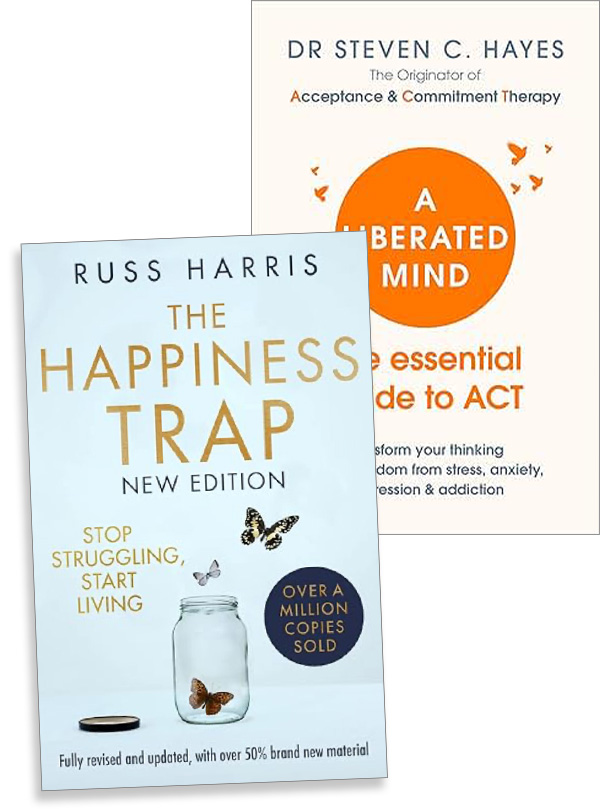
Russ Harris’s The Happiness Trap introduces ACT through everyday examples and practical exercises. It explores ways to respond to difficult thoughts and feelings, clarify what matters to you and take manageable steps in that direction.
Steven Hayes’s A Liberated Mind combines personal experiences, the development of ACT and exercises for building psychological flexibility. It offers a fuller account from one of the approach’s developers.