

Writing can give you space to describe what has happened, notice how you feel and consider what you need next. A few private lines may be enough; you do not need to write well or keep a daily diary.
There are several approaches. You might record an ordinary day, explore a worry or note something you appreciated. Each gives the writing a different focus.
Research has often examined structured exercises rather than diary-keeping in general. One is expressive writing, studied by psychologist James Pennebaker and colleagues from the 1980s.
This involves writing about an experience and your thoughts and feelings about it. Studies have found mixed results, with generally small benefits where improvements occur. It does not help everyone.
Trying expressive writing
Many studies use sessions of around 15 to 20 minutes on three or four days. The steps below introduce that approach, with room to shorten or stop rather than follow a research schedule exactly.
Choose an everyday difficulty that feels manageable, and find somewhere reasonably private. Paper or a secure digital note is fine. Leave time afterwards before returning to anything demanding.
If writing about painful experiences feels overwhelming, choose a neutral subject or leave the exercise aside. You do not need to revisit traumatic memories on your own to try journalling.
- Choose a manageable subject. Begin with an everyday frustration, worry or unresolved experience. Pick something you feel able to explore today. You can change the subject if it feels too upsetting.
- Write about the experience and your feelings. Describe what happened and what it means to you now. Aim for 15 to 20 minutes if that feels comfortable, or begin with five. Spelling and grammar do not matter. You can pause or finish early.
- Explore what you need. You might ask: “What is troubling me most?” or “Is there anything I want to do next?” Leave room for uncertainty. You do not have to find an explanation, a lesson or a positive ending.
- Decide whether to return to it. The research approach often involves three or four sessions. If the first feels manageable, you could write again another day. Notice whether you gain a different perspective or find yourself repeating the same distressing thoughts.
- Finish and return to your surroundings. Put the writing aside, look around and take a little time before your next task. Keep it private, save it or discard it as you prefer. There is no need to reread or share it. If distress persists, leave the exercise aside and seek support.
Writing about something painful can leave you upset afterwards. That is not evidence that the exercise is working, and improvement is not guaranteed. If distress increases or carries into the rest of your day, stop and consider getting support.
Writing in research
James Pennebaker and colleagues began studying expressive writing in the 1980s. Participants wrote about difficult experiences and their feelings for short sessions over several days.
Later studies have tested different prompts, schedules and groups of participants. Some report benefits for wellbeing or symptoms; others find little or no difference compared with another writing task.
The findings do not support broad promises that writing improves immunity or prevents illness. Nor do they establish that one writing method is best for everyone.
Other ways to use the page
You can use writing for a smaller, practical purpose: describe a worry, prepare for a conversation or separate what needs doing from what can wait.
Try two headings: “What is on my mind?” and “What can I do next?” The next step might be asking a question, making a plan or acknowledging that you need more information.
For a recurring harsh thought, the CBT thought record offers a more structured way to consider the evidence. A positive data log focuses on everyday moments that challenge a negative belief about yourself.
Another option is to note something you appreciated: a helpful conversation, a meal or a moment outdoors. Gratitude exercises show modest benefits in some studies, though results vary. There is no need to force gratitude or use it to dismiss what is difficult.
Notice how writing affects you
A useful question is whether writing helps you understand something or decide what you need. You do not have to feel calm afterwards, but repeated distress is a reason to reconsider the approach.
If you keep rehearsing the same worry without gaining anything useful, try a shorter session, a different prompt or a break from writing. Repetition alone does not mean you are making progress.
Writing can accompany professional support, but it is not a substitute for treatment when difficulties are persistent or affecting daily life. Painful memories may be better explored with a therapist than through an exercise on your own.
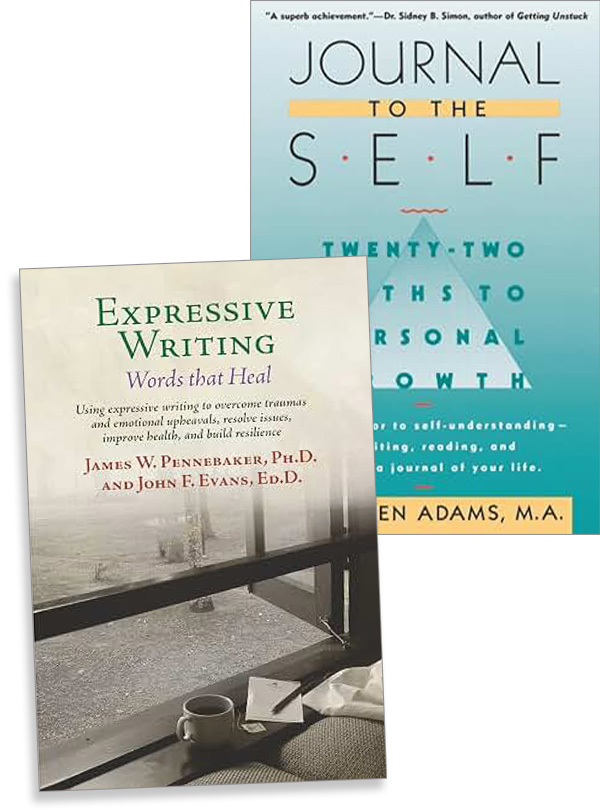
Recommended reading
James Pennebaker and John Evans’s Expressive Writing: Words That Heal explains the research and offers structured writing exercises, including a four-day programme. It provides more detail for readers interested in the approach introduced here.
Kathleen Adams’s Journal to the Self explores a broader range of journalling methods, including lists, unsent letters and written dialogues. It offers different starting points if writing freely about your feelings does not suit you.