


Photo: Sami Timimi
A new interview in The Times profiles Dr Sami Timimi, a former NHS child psychiatrist, and a small but growing group of clinicians asking whether the current age of diagnosis has gone too far. Their proposed answer isn’t a new label. It’s called de-diagnosis.
The scale of the shift is striking. One in five adults in England now has a classified mental health disorder, and one in seven are considered neurodiverse. Timimi says he’s never seen a generation “as pathologised as this one”.
Before his recent retirement, Timimi ran a service in Lincolnshire built around reassessment rather than diagnosis. Patients who’d been told they had ADHD, but felt the label no longer fitted or wasn’t helping them, could come back to be looked at again. Here’s what the case for de-diagnosis actually rests on:
- De-diagnosis is a formal, evidence-based process. A Swedish study led by the universities of Lund and Gothenburg re-evaluated 100 adults seeking to overturn a childhood autism or ADHD diagnosis; 90 per cent no longer met the criteria on re-assessment.
- Losing a label can be a relief, not a loss. One young man, given an ADHD diagnosis at 12, described his future “disappearing” in front of him – and finding it again once the diagnosis was formally removed.
- Symptoms can be transient or situational. Timimi argues that traits fitting a diagnostic checklist can shift with circumstances, and a label taken at one point in life may not still describe the person years later.
- The critique isn’t that distress is fake. It’s that naming distress after a checklist of behaviours – rather than the person’s actual circumstances – doesn’t explain it, in the way Timimi says “the pain in my head is a headache” doesn’t explain a headache.
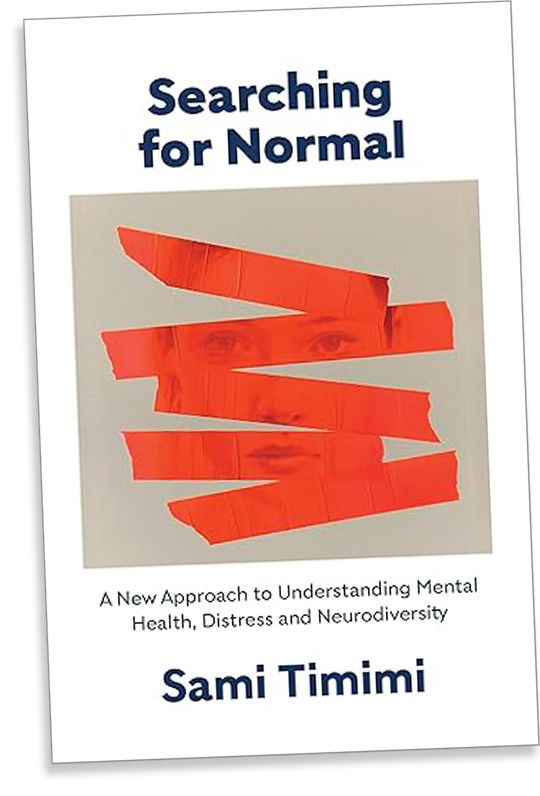
Timimi’s own book, published earlier this year, makes the fuller case for de-diagnosis outlined here. See on the bookshelf →
A label that stops fitting
The strongest part of Timimi’s case is what a diagnosis can quietly become over time, even for people it once helped.
A Swedish follow-up study found that younger participants, in particular, described their diagnosis as having become “restrictive” – shaping career choices, healthcare encounters and their whole sense of identity, in ways that outlasted whatever usefulness it once had.
That’s the case Timimi is making: not that any of this distress is imagined, but that a label can start out as an explanation and end up as a cage.
What the evidence from schools suggests
Timimi’s clinical hunch has some support from a much larger study of how children are taught to understand their own feelings.
A six-year UCL trial involving 32,000 children aged 8 to 13 found that normalising ordinary sadness and stress, rather than labelling them as specific conditions needing urgent attention, led to better wellbeing outcomes than the alternative approaches tested.
A separate Department for Education review of mental health awareness courses in secondary schools found that some were “associated with increased emotional difficulties for young people”.
Timimi goes further than the study itself, arguing that all such courses in schools should be stopped – a stronger position than the evidence alone establishes, though one that shares the same underlying worry: that naming a feeling as a condition can sometimes make it harder to shift.
What this doesn’t mean
De-diagnosis isn’t a case against diagnosis itself, and Timimi isn’t arguing that ADHD or autism aren’t real experiences worth naming.
The process he describes is careful and individual: a reassessment, a professional judgement, a letter to a GP – not a blanket rollback applied to everyone currently diagnosed.
It’s also entangled with a much messier political backdrop. The same week this piece ran, Andy Burnham signalled he’d make it harder to claim disability benefits.
DWP figures show the share of Pip claimants whose main condition is psychiatric has risen from 35 per cent in 2019 to 39 per cent today, and the proportion of claims specifically for ADHD, autism, depression or anxiety has grown from 16 per cent to 23 per cent over the same period.
Timimi is clear that de-diagnosis isn’t a lever for cutting welfare spending – the goal is a diagnosis that actually helps the person holding it, not a smaller bill for the state.
Living with the label either way
Whichever side of this debate turns out to be right for any one person, the more useful question underneath it might be simpler.
Does the diagnosis change what you actually do differently – and does it still feel true, a year or five years on? A label that opens the right support is doing its job. One that’s calcified into an identity you no longer recognise is worth taking back to the person who gave it to you.
Source: “‘When my diagnosis of ADHD was removed, it was a relief'”, Charlotte Lytton, The Times. Sami Timimi is the author of Searching for Normal: A New Approach to Understanding Distress and Neurodiversity, on the bookshelf.