

This isn’t a dedicated therapy app, and it isn’t an AI companion built for emotional connection. It’s something looser and more recent.
People typing out an ordinary worry, decision, or tangled situation into a general-purpose AI chatbot – the same kind used for emails or homework – simply to think it through out loud, with something that can follow along and respond.
That’s not meditation, and it isn’t therapy either. It’s closer to the old habit of talking a problem through out loud to no one in particular – rehearsing an argument in the shower, explaining a decision to an empty room, and finding the answer arrives somewhere in the explaining. Except this time, the room can ask a genuine follow-up question.
None of this needs to replace thinking things through with a person, and it works best when it doesn’t try to. It’s a way of getting a tangled thought into some kind of order before a harder conversation, not a substitute for having the conversation.
How to do it
Using this kind of tool well doesn’t require any special skill. A short list of ways to get more from it.
- Use it to organise a thought before a difficult conversation. Rather than instead of having the conversation.
- Notice if you’re using it to avoid a decision rather than think one through. Be honest with yourself about which.
- Ask it to push back or find holes in your reasoning. Rather than only using it to agree with you.
- Say the actual, unedited version of a worry. The exercise works less well half-honest.
- Notice when you feel ready to say the same thing to a person. Treat that as the point, not the end point.
Staying with it isn’t necessary for the exercise to have worked. A single conversation that untangles one knotted thought still counts, even if it’s never repeated.
It’s the act of putting something into words for another mind to receive, more than the quality of what comes back, that seems to matter – which is why this can help even when the response itself is unremarkable.
Where it comes from
There’s no dedicated app, no single inventor, and no settled name for this yet. It tends to start almost by accident – asking a chatbot to help draft a difficult message, and ending up explaining the whole situation behind it first.
People have always talked to things that couldn’t talk back – a diary, a dog, an empty room. What’s new is something that answers, coherently, in a way that can follow an argument and push back on it, without ever getting bored or needing the story explained twice.
Worth knowing
Articulating a worry out loud, to any responsive listener, appears to engage a different kind of processing than simply turning the same worry over silently in your head – putting language around a feeling seems to organise it in a way that circling it wordlessly doesn’t.
What’s genuinely new here isn’t the mechanism – people have used journals, pets, and empty rooms for the same purpose for centuries – but the responsiveness. Something that can follow a train of thought and ask a real question back appears to sharpen the effect compared with a diary that only listens.
Whether that’s a fundamentally different experience from talking to a person, or simply a well-engineered version of talking to yourself, is one of the genuinely open questions of the moment, worth holding as open rather than settled.
Some coverage treats this behaviour as a breakthrough form of therapy, or dismisses it entirely as a hollow trick – both takes tend to be more confident than the evidence currently allows.
Almost none of this has been formally studied. That articulating a thought helps is well established in psychology generally, but whether talking specifically to an AI carries the same benefit, a lesser one, or a different set of risks over time, genuinely isn’t known.
What can be said plainly is narrower: using it occasionally to think something through, while keeping real people in the loop for the decisions that actually matter, is a reasonable way to use a very new tool without waiting for research that doesn’t exist yet.
Recommended reading
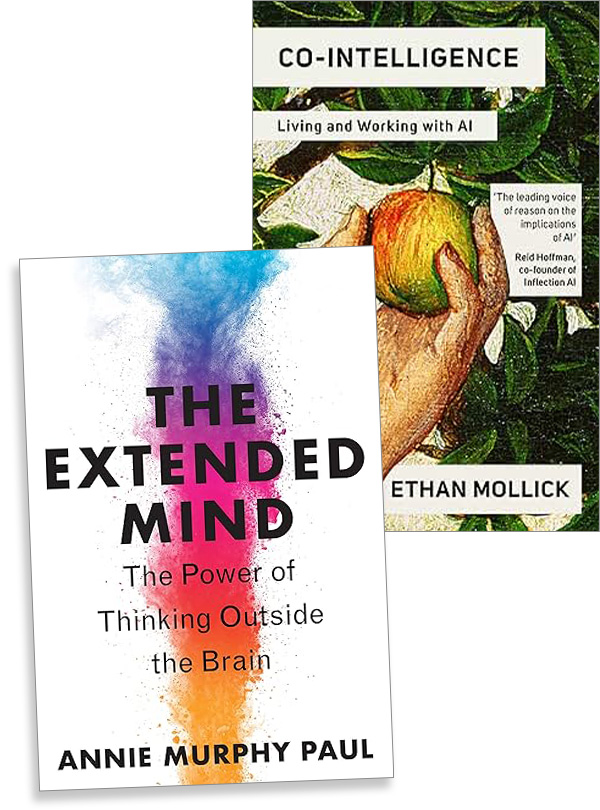
Annie Murphy Paul’s The Extended Mind is the natural starting point – on how thinking has always happened partly outside the brain, long before AI entered the picture.
For something more contemporary, Ethan Mollick’s Co-Intelligence looks directly at using AI as a genuine thinking partner, in work and beyond.