
A dog doesn’t ask how you are and wait for the honest answer. It just wants the lead getting off the hook, same as yesterday, same as it’ll want tomorrow.
And somehow that steadiness does something that a well-meaning question often doesn’t.
Most relationships need tending in ways that take energy: a reply worth sending, a mood worth managing, a version of yourself worth presenting.
An animal doesn’t collect on any of that. It notices if you’re late with dinner, not if you were good company today.
That’s not a lesser kind of relationship – it’s a different one, and on the days a person feels like too much to deal with, it can be the only kind that’s manageable.
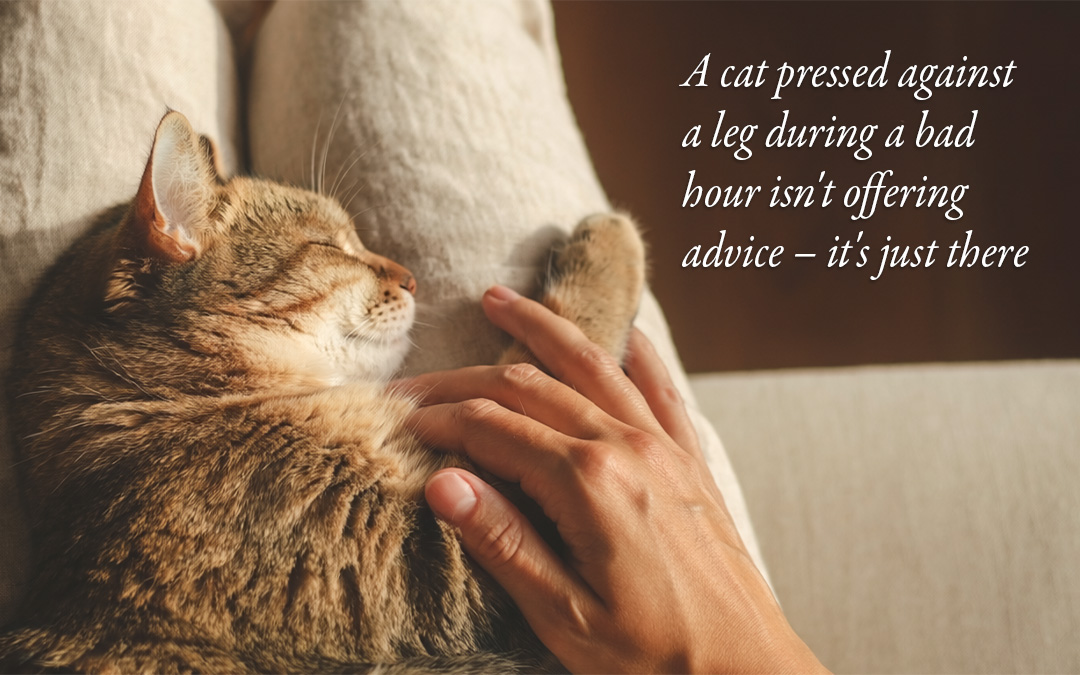
A cat pressed against a leg during a bad hour isn’t offering advice – it’s just there, and being there turns out to carry more weight than it should.
How to do it
None of it needs to be a whole pet to count, either. A short list of ways this tends to help, whether or not there’s an animal in the house already.
- Let a daily walk be the dog’s idea. Not a chore squeezed in around everything else.
- Sit with an animal doing nothing in particular. No training, no walk, just occupying the same room.
- Notice the routine an animal imposes. Feeding times, a regular walk – structure rather than obligation.
- Borrow one, if there isn’t one at home. A friend’s dog, a neighbour’s cat, a local shelter that allows visits.
- Let the greeting at the door be the whole point some days. Rather than something to get past on the way to the sofa.
None of it needs to look like devotion to count. Feeding a cat on time and getting an unbothered blink in return is still a relationship doing its quiet work.
It’s the ordinary repetition that seems to matter most – the same walk, the same feeding time, the same spot on the sofa.
Where it comes from
The formal study of this began almost by accident. In 1961, the child psychologist Boris Levinson noticed that a withdrawn young patient became far more open and communicative whenever Levinson’s own dog, Jingles, happened to be in the room.
Levinson wrote up the observation and coined the term “pet therapy” a few years later, and was initially met with ridicule from colleagues, some joking about whether the dog shared his fees. The resistance didn’t last – animal-assisted approaches are now a well-established part of therapeutic and care settings.
Worth knowing
Dog owners consistently log more daily steps and more regular activity than non-owners, largely because a dog doesn’t accept “not today” as an answer the way a person might.
That difference shows up in measurable markers – lower resting blood pressure and better recovery from stress are both associated with regular contact with a pet.
Some of the effect looks social rather than purely physical: dog walkers report more passing conversation with strangers than people walking without one.
“Pet ownership adds years to your life” is one of the most widely repeated claims in this space, usually attached to a headline statistic about lower mortality in dog owners.
When researchers looked more closely, much of that apparent effect turned out to reflect who tends to get a dog in the first place – people who are already more mobile and more socially connected, rather than something the dog itself was causing.
The more modest, better-supported version holds up fine without the exaggeration: regular contact with an animal reliably nudges people toward more activity and more routine, and both of those things are worth having in their own right.
Recommended reading
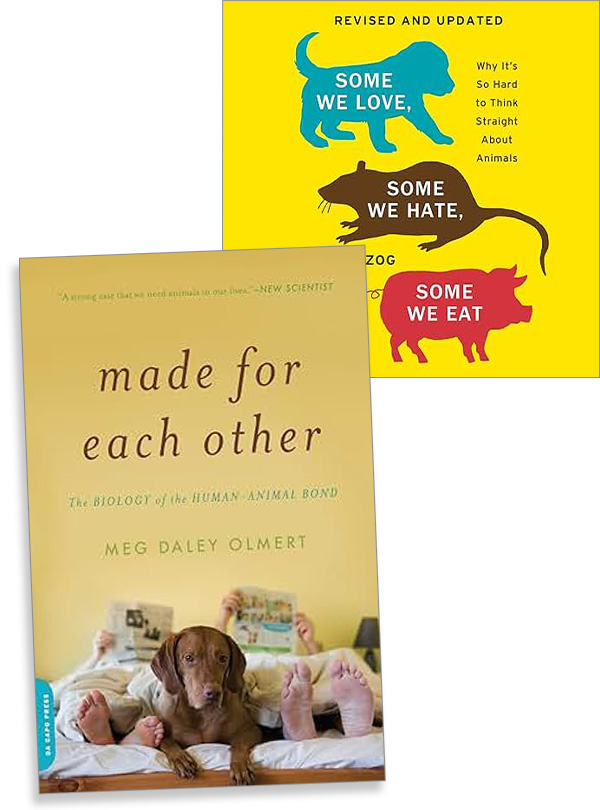
Meg Daley Olmert’s Made for Each Other is the natural starting point – an accessible look at the biology behind the human-animal bond.
For something more contemporary, Hal Herzog’s Some We Love, Some We Hate, Some We Eat takes a wider, more clear-eyed look at our often contradictory relationship with animals generally.