

Of everything on this site, this might be the pathway with the least equipment and the deepest evidence behind it.
Not a technique, not an app, not something to learn – just the ordinary, unglamorous business of staying in touch with the people who matter, in a week that never quite makes room for it.
It rarely arrives as a decision. A friendship thins because neither person sends the text that would restart it, not because anyone chose to let it go.
Nobody plans to drift; it just happens by default, one skipped call at a time, unless something nudges the balance back the other way.
None of this is really about romance, or even about closeness in the deepest sense. It’s about whether there’s someone who’d notice if your week went badly – and whether you’d think to tell them.
How to do it
None of it needs grand gestures to work with. A short list of low-effort starting points, if the habit of reaching out has quietly lapsed.
- Send a text that says something true. Not just “how are you”.
- Ask one question you don’t already know the answer to. And wait for the real one.
- Put a small greeting ritual back in place. Properly looking up when someone comes through the door.
- Protect one unhurried conversation a week. Keep it free from phones and other tasks.
- Let ordinary touch back in. A hand on a shoulder, a hug that lasts a beat longer than habit.
None of it needs to be dramatic to count, either – a single good conversation doesn’t fix a relationship that’s gone quiet any more than a single walk fixes an unfit body.
It’s the return to it, imperfectly and often, that seems to matter. A missed call or a stretch of silence isn’t a verdict on the relationship – just a normal lapse in something that was always going to need picking back up.
Where it comes from
The clearest evidence for this comes from a single, often-cited piece of research: a 2010 meta-analysis by the psychologist Julianne Holt-Lunstad and colleagues, pooling data from 148 separate studies and over 300,000 people.
It found that the strength of a person’s social ties predicted survival about as reliably as whether or not they smoked – one of the most widely repeated findings in behavioural science, and among the best-replicated.
Worth knowing
Which sounds far-fetched until you notice how much of ordinary life the people closest to you actually touch: what you eat, how you sleep, whether stress gets talked through or just carried around alone.
Quality seems to matter more than quantity here – a couple of relationships that feel safe and reciprocal outweigh a wide circle of acquaintances.
The idea of “love languages” – that everyone has one primary way of expressing and receiving affection, and that happy couples share one – has become one of the most widely repeated pieces of relationship advice there is.
When relationship researchers went back and tested its central claims directly, none of the studies they reviewed supported them: people don’t reliably sort into one preferred language, and couples with matching ones aren’t any happier than those without.
The instinct behind the idea is sound – that people show and need affection differently, and that guessing wrong causes real friction – it’s just the tidy five-box framework itself that the evidence doesn’t back up.
Noticing what actually lands with someone tends to work better than assigning them a category. Keeping any of this going asks for frequency more than intensity – closer to keeping a small light on than staging a rescue.
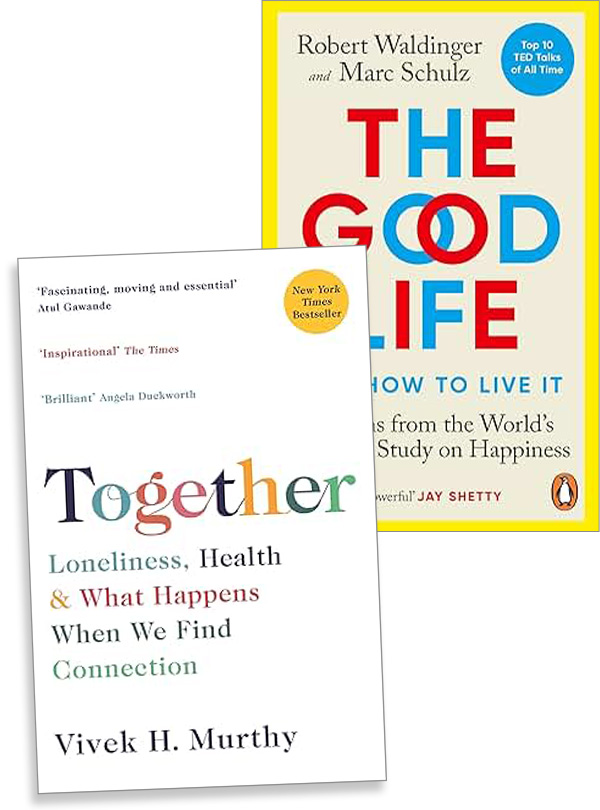
Recommended reading
Vivek Murthy’s Together is the natural starting point – from the former US Surgeon General, on the health cost of loneliness and the case for connection.
For something more contemporary, Robert Waldinger and Marc Schulz’s The Good Life draws on the world’s longest-running study of what actually makes a life go well.