
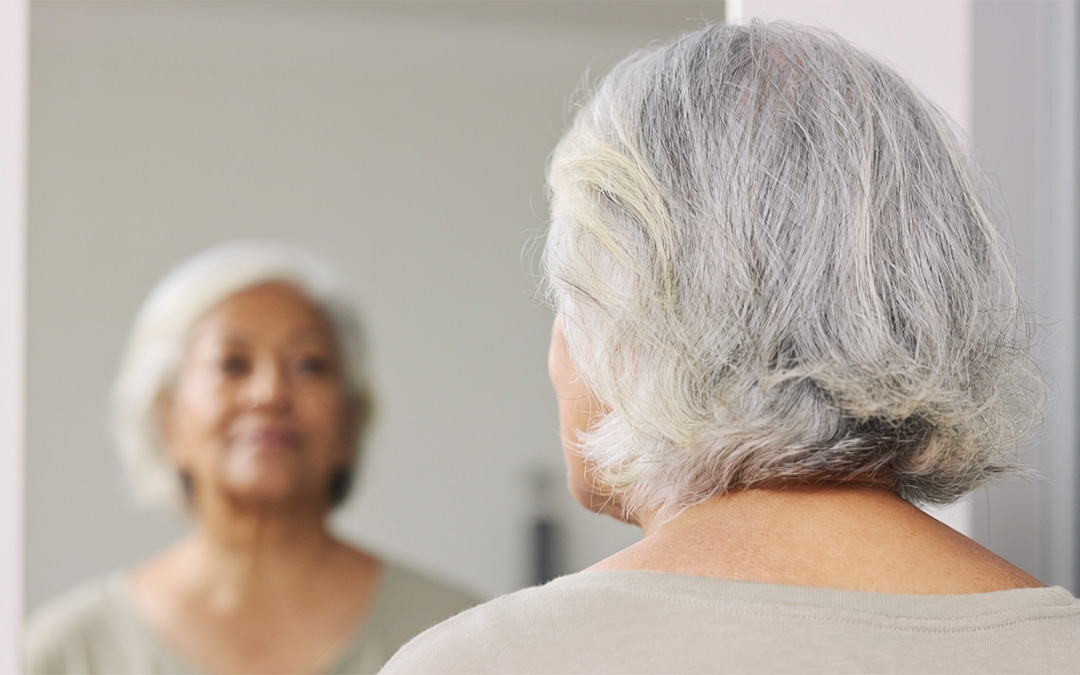
Most people don’t feel like the age on their birth certificate – until a mirror, a flight of stairs, or a stranger’s assumption reminds them that the body has been quietly disagreeing for years.
Nobody announces the change. There’s no single morning where the body visibly becomes older – it happens in a long series of small, easy-to-miss adjustments, until one day the gap between how you feel and what you see is impossible to ignore.
What makes this particular change hard isn’t just the physical reality. It’s the sense of falling out of sync with a version of yourself that, internally, hasn’t gone anywhere.
The person doing the noticing rarely feels as old as the body being noticed. That mismatch is the real experience of an ageing body – not decline on its own, but decline alongside a self that hasn’t caught up to it.
A few things make this harder to talk about, and easier to misread as vanity when it’s really something closer to identity:
- It isn’t really about looks, even when it looks that way. Wrinkles and grey hair are the visible signs, but what’s unsettling is what they represent – a body moving on without permission.
- The inner sense of age barely moves at all. Most people’s sense of their own age stays remarkably stable through adulthood, which is why an ageing body can feel like it belongs to someone else.
- What you believe about ageing shapes how your body copes with it. People who’ve absorbed negative ideas about growing old tend to fare measurably worse physically, not just emotionally.
- Other people’s reactions can hurt more than the changes themselves. Being spoken over or assumed frail says more about cultural attitudes to age than about the body in question.
- It rarely arrives as a single, dramatic shift. It’s cumulative – which makes it easy to dismiss any one moment while the overall picture keeps changing anyway.
Why this happens
Researchers describe this gap with an evocative phrase: the mask of ageing – the idea that the ageing body sits over the self like a mask, concealing a person who, internally, doesn’t feel like it belongs to them.
This isn’t denial. It’s a well-documented, ordinary feature of getting older, not a failure to accept reality.
The belief side of this matters more than it gets credit for. Culture hands people ideas about what ageing looks like long before it happens to them – with real consequences for how the body actually performs decades later, not just how it’s perceived.
What actually helps
Separating the physical facts from the cultural story attached to them helps enormously. A change in stamina is a physical fact. “Getting old is decline” is a story – one specific culture’s story, not a universal truth about bodies.
It also helps to notice, and gently challenge, negative self-talk about age when it shows up – “I’m too old for this” carries real weight, given how directly internalised beliefs connect to physical outcomes.
Where the reaction is coming from other people rather than the body itself, it helps to name that clearly as an attitude problem, not a fact about you.
Worth knowing
The body will keep changing regardless of how it’s felt about. The part that’s actually within reach is the story running alongside it.
Most people report feeling significantly younger than their actual age, and that gap tends to hold fairly steady rather than closing over time – it isn’t a phase to grow out of.
If the disconnect between how you feel and how you’re treated is affecting mood or confidence in a lasting way, NHS Talking Therapies is worth looking at – free, evidence-based, and self-referral in most of England, no GP needed. If it feels more urgent than that, the Support directory has crisis contacts.
Recommended reading
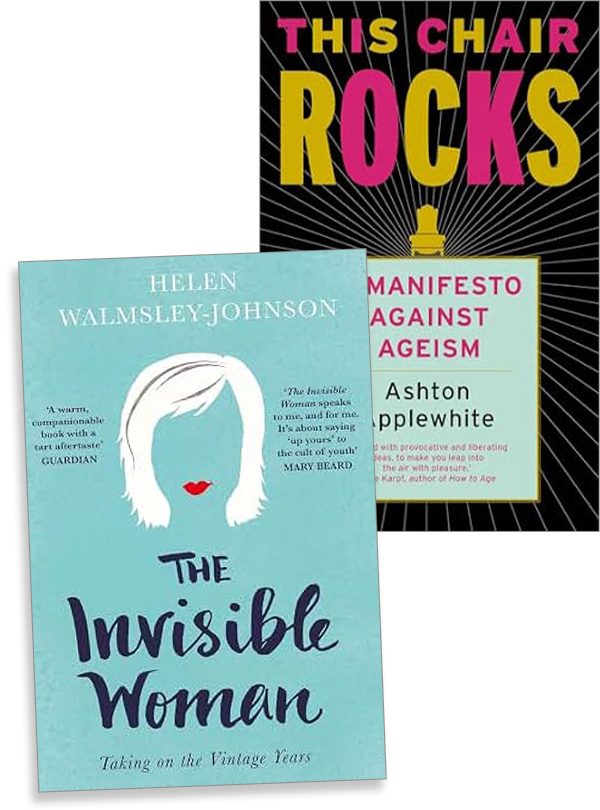
Helen Walmsley-Johnson’s The Invisible Woman is funny, sharp and unmistakably British about exactly this territory – what it actually feels like to be treated as though you’ve quietly disappeared, and what to do about it besides disappear on cue.
Ashton Applewhite’s This Chair Rocks takes the wider, more analytical view – a manifesto against ageism itself, tracing where the negative beliefs actually come from and what they do to the people who absorb them.