

Losing a job can feel like losing yourself – not because work should define us, but because for most people, it quietly does.
Redundancy is usually talked about as a financial problem with a financial solution: find another job, replace the income, move on. That’s true as far as it goes, but it skips over what actually makes job loss disorienting for so many people – not the missing salary, but the missing sense of who you are on a Monday morning.
For a lot of adults, “what do you do?” isn’t really a question about tasks. It’s a stand-in for status, purpose, and daily structure, all bundled into one sentence. When the job goes, the honest answer to that question disappears too, at least for a while – and that’s a bigger loss than it sounds.
None of this means work should carry that much weight. It means that, for most people, it already does – and pretending otherwise doesn’t make the adjustment any easier.
- It’s an identity loss, not just an income loss. Somewhere between “helpful” and “central,” a job becomes part of how you understand yourself – and losing it can genuinely disrupt that, not just your bank balance.
- Shame turns up even when nobody’s at fault. Redundancy is often a business decision with nothing to do with individual performance, but it rarely feels that way from the inside.
- The structure disappears along with the role. A job quietly organises entire days – when you wake, who you talk to, what counts as productive – and all of that has to be rebuilt from nothing.
- There’s no ritual for this kind of ending. Other major losses come with recognised markers – funerals, leaving parties, formal goodbyes. Redundancy often just ends with a laptop being returned.
- It can tip into something more. Prolonged low mood, withdrawal from people, or a persistent sense of worthlessness are worth acting on – NHS Talking Therapies (self-referral, no GP needed) is built for exactly this. If it feels more urgent than that, the Support directory has crisis contacts.
Why this cuts deeper than the practical hit
The financial problem is real, but it’s rarely the whole problem.
Work supplies things well beyond a wage: a reason to get up, a place to belong, a way to measure your own competence, a story to tell about your day. None of that shows up on a payslip, which is exactly why it’s easy to underestimate how much a job was doing until it’s gone.
Redundancy also tends to arrive without warning or ceremony. There’s rarely a chance to say goodbye properly, no shared acknowledgement that something significant has ended – just an abrupt stop, followed by a great deal of silence where a structured day used to be.
What actually helps
Separating “what I do” from “who I am” takes deliberate effort – it rarely happens on its own.
It helps to notice which parts of the loss are actually about identity and structure, rather than assuming it’s only a financial problem that a new job will automatically fix. Naming that distinction doesn’t solve it, but it stops the adjustment from feeling like a personal failure to “just get on with it.”
Rebuilding some kind of daily structure early – even a loose one – tends to help more than waiting until a new role arrives to reintroduce routine. The specific activities matter less than having some.
It also helps to resist the urge to explain or justify the redundancy to everyone who asks. A short, neutral answer is enough; you don’t owe anyone the full story just because they were curious.
Worth knowing
However temporary it turns out to be, this is a genuine transition, not just a gap to be filled quickly.
Most people who go through redundancy do find their footing again, often somewhere they wouldn’t have predicted. That’s genuinely true – but it doesn’t make the in-between period any less real while you’re in it.
It’s fair to give this the same seriousness you’d give any other major life change, rather than rushing to look “fine” for other people’s comfort.
If it would help, here's a short message of encouragement to sit with before moving on.
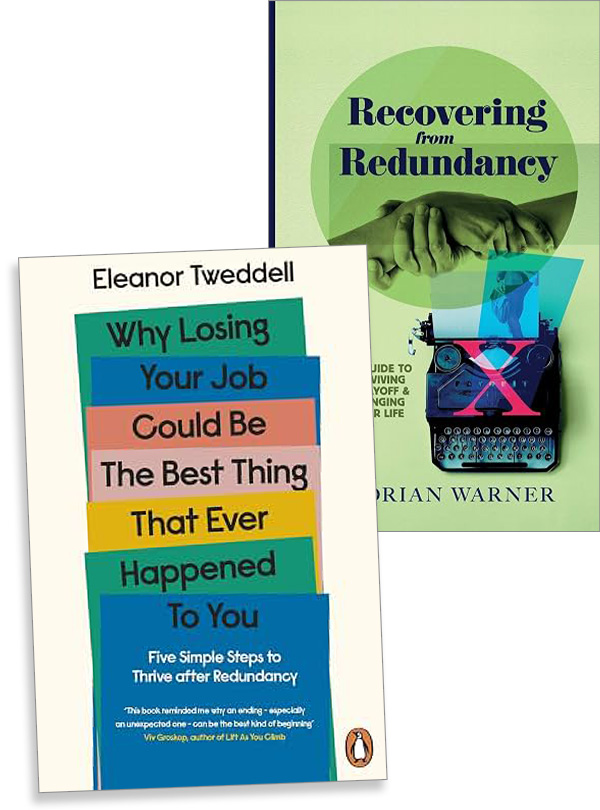
Recommended reading
Eleanor Tweddell’s Why Losing Your Job Could Be the Best Thing That Ever Happened to You: Five Simple Steps to Thrive After Redundancy is the standard starting point – a structured five-step plan that treats the emotional fallout (anger, guilt, shame) as seriously as the practical next steps, rather than rushing past one to get to the other.
For a more personal account, Adrian Warner’s Recovering from Redundancy: A Guide to Surviving a Layoff and Changing Your Life writes candidly about the emotional side of job loss from a male author’s perspective, alongside genuinely practical guidance drawn from having gone through redundancy twice himself.