
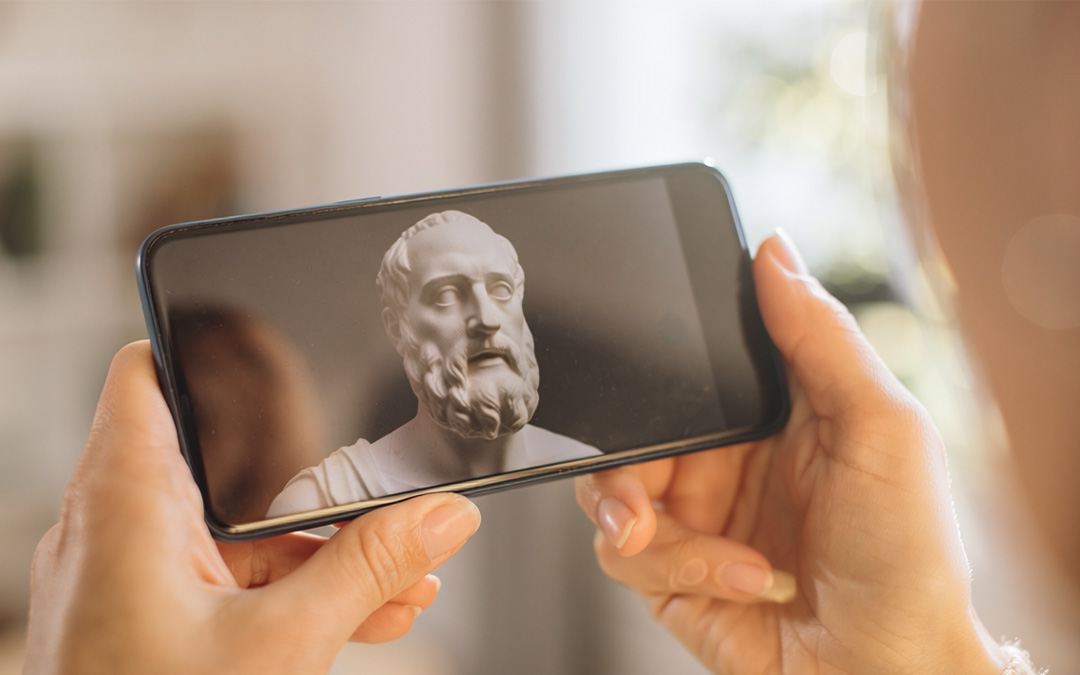
Two thousand years old, held up to modern scrutiny…
A Big Think interview with philosopher Massimo Pigliucci has been doing the rounds, making the case that Stoicism isn’t just an ancient curiosity but a philosophy with real evidence behind it.
The claim is more layered than it first sounds – worth pulling apart.
What Pigliucci actually argues
Massimo Pigliucci is an evolutionary biologist and philosopher of science, co-author of Beyond Stoicism. His case for Stoicism rests on a few core ideas.
The central one, drawn from the ancient Stoic Epictetus: focus your energy on what’s genuinely within your control, and accept the rest with equanimity rather than fighting it.
He also describes “role ethics” – the idea that most of us hold several roles at once (parent, colleague, friend, citizen), and Stoicism is partly a discipline for managing limited time and energy across all of them without any one role quietly draining the others.
Epictetus organised the practice into three disciplines: desire (examining your actual values), action (how you treat other people), and assent (thinking rationally about the first two). Pigliucci maps these onto three classical fields of study – understanding how the world works, how to live well, and how to think clearly.
What the evidence actually shows
This is where the claim needs the most care, because Pigliucci makes both a strong point and a much softer one, back to back.
The strong point: cognitive behavioural therapy has a genuine, documented lineage in Stoic philosophy. Aaron Beck and Albert Ellis, developing CBT in the 1960s, had both read Marcus Aurelius and Epictetus first.
CBT itself is one of the most rigorously evidenced forms of psychotherapy that exists.
The softer points follow immediately after, without much distinction drawn between them. Pigliucci describes modern cognitive science as broadly “compatible with” Stoic ideas about reason and emotion – not the same as evidence for them.
And he cites one specific paper, by psychotherapist Tim Lebon, as offering “preliminary evidence” for Stoic techniques directly – a first study, not an established body of research. Here’s how those threads actually sort by strength:
- CBT’s Stoic roots are real and well documented. Beck and Ellis have both written about drawing directly on Stoic texts when developing the approach.
- That’s evidence for the techniques, not the whole philosophy. Showing a therapy technique works doesn’t validate every claim within the broader worldview it was drawn from.
- “Compatible with” isn’t the same as “supported by.” Cognitive science not contradicting an idea is a much weaker claim than cognitive science demonstrating it.
- Direct research on Stoic techniques specifically is brand new. Pigliucci’s own example is one preliminary study, not a settled evidence base.
Worth knowing
Pigliucci’s practical advice is worth keeping regardless of how the evidence question settles. He recommends reading primary texts in modern translation rather than older ones – pointing to Robin Waterfield’s translations of Marcus Aurelius and Epictetus, and the University of Chicago Press collection of Seneca’s letters.
He’s equally clear that ancient texts alone aren’t enough – modern interpreters like Donald Robertson, William Irvine, and John Sellars help translate 2,000-year-old ideas into something usable today.
His clearest warning is against picking up a philosophy uncritically, or mixing pieces from incompatible ones without noticing the trade-offs – Stoicism prioritises character over pleasure, for instance, in a way that can’t fully coexist with an Epicurean framework built the other way round.
Recommended reading
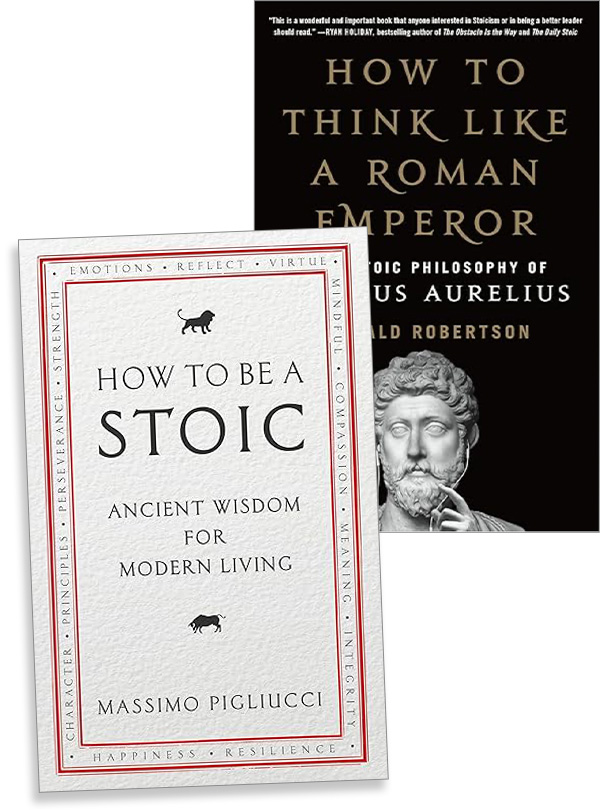
Massimo Pigliucci’s own How to Be a Stoic is the book behind the interview itself – an accessible route into the same ideas, written as an ongoing dialogue with Epictetus rather than a dry summary.
For the CBT connection specifically, Donald Robertson’s How to Think Like a Roman Emperor traces that link through Marcus Aurelius’s own life – written by the cognitive behavioural therapist Pigliucci himself points to.
Recommended reading
Massimo Pigliucci’s own How to Be a Stoic is the book behind the interview itself – an accessible route into the same ideas, written as an ongoing dialogue with Epictetus rather than a dry summary.
For the CBT connection specifically, Donald Robertson’s How to Think Like a Roman Emperor traces that link through Marcus Aurelius’s own life – written by the cognitive behavioural therapist Pigliucci himself points to.
Sources: Massimo Pigliucci, interviewed by Big Think, on Stoicism and his book Beyond Stoicism (with Greg Lopez and Meredith Kunz).