

The more a decision matters, the harder it can become to make it at all – until not deciding starts to feel safer than choosing wrong.
This isn’t indecisiveness as a personality flaw. It’s a specific response that shows up when the stakes feel high, the options feel similar, or the fear of regret outweighs the pull of any one choice.
It can strike over something enormous – a career change, whether to end a relationship – or something almost absurdly small, like which insurance policy to pick.
The size of the decision and the size of the paralysis don’t always match. More options were supposed to make this easier. Often, they make it worse.
Worth knowing
A few patterns make decision paralysis worse, once you can spot them:
- More choice doesn’t reliably mean a better decision. Beyond a certain point, extra options add more anxiety about missing the right one than they add genuine improvement to the outcome.
- It’s rarely really about the decision itself. Underneath, it’s often the fear of what a wrong choice would say about you, or what you’d lose by choosing at all.
- Waiting doesn’t keep every option open. Time passes anyway – not deciding is itself a choice, usually in favour of whatever the default happens to be.
- Perfectionism and paralysis feed each other. Waiting for certainty that a decision is “right” can mean waiting for something that was never going to arrive.
- Small decisions can get swept up in it too. Once the pattern sets in around one big decision, everyday choices – what to eat, what to wear – can start to feel disproportionately hard as well.
Why this happens
Research on choice overload backs up what this feels like from the inside. In one well-known study, shoppers offered a smaller selection of jams were more likely to actually buy one than shoppers offered a much larger selection – more options didn’t help people choose, it made choosing itself harder.
Part of what’s happening is the gap between “good enough” and “the best.”
Herbert Simon, who coined the term satisficing, pointed out decades ago that most decisions don’t need the optimal answer – they need one that clears a reasonable bar.
Holding out for the best option, rather than a good one, is often what turns a five-minute decision into a five-week one.
What actually helps
Setting a deadline, even an arbitrary one, tends to work better than waiting to feel ready. Readiness rarely arrives on its own – a deadline forces the decision to happen instead of waiting for a certainty that isn’t coming.
Lowering the bar from “best” to “good enough” isn’t settling. For most everyday decisions, it’s simply matching the effort to what the decision actually deserves.
It also helps to separate decisions that can be undone from the ones that can’t. A choice that’s easy to reverse – a subscription, a haircut, a restaurant – doesn’t need the same weight as one that closes a door permanently, and treating every decision like the second kind is exhausting.
The cost of not choosing
Not deciding doesn’t pause the decision. It just hands it to time, or to whoever else is waiting on you, instead of making it yourself.
Every choice forecloses other options – that’s not a flaw in decision-making, it’s what a decision actually is. The discomfort of narrowing down doesn’t go away with more thinking. It only goes away once something is chosen.
If decision paralysis is showing up across most areas of life, or sitting alongside a broader pattern of anxiety or perfectionism that’s hard to shift alone, NHS Talking Therapies is worth looking at – free, evidence-based, and self-referral in most of England, no GP needed. If it feels more urgent than that, the Support directory has crisis contacts.
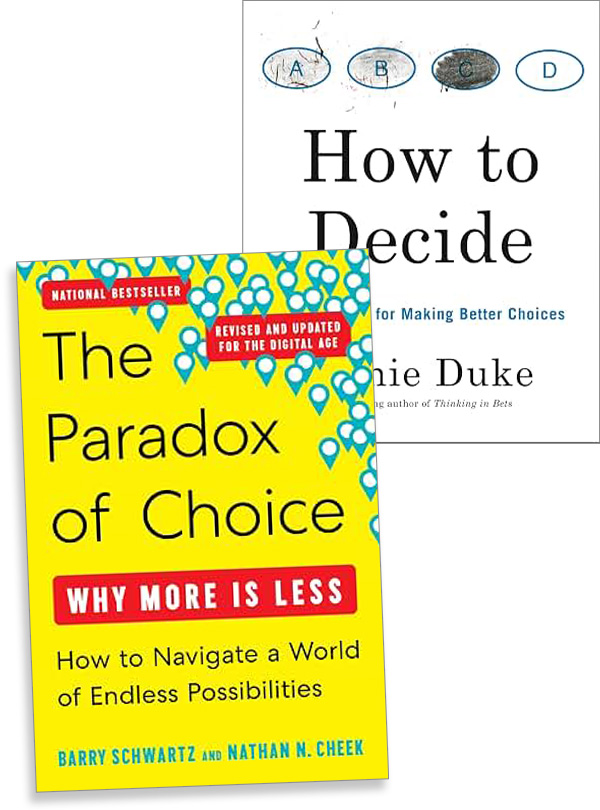
Recommended reading
Barry Schwartz’s The Paradox of Choice is the book that made choice overload a household idea – it lays out, clearly and with real research behind it, why more options so often make a decision harder rather than easier.
Annie Duke’s How to Decide is the practical companion to it – a working poker player’s toolkit for actually making a decision under uncertainty, rather than just understanding why it’s hard.