

“What do you do?” is one of the first questions strangers ask. For decades, most people have a ready answer. Then, in a single week, they don’t.
Retirement is usually framed as a reward – the end of the working years, finally arrived at. What’s rarely mentioned is that the job wasn’t just a way of earning money. For a lot of people, it was the answer to a much bigger question: who am I.
Losing that answer overnight, however welcome the free time, is a real loss – not a logistical adjustment, but something closer to grief.
Nobody warns you that the hardest part of retirement might not be the empty calendar. It might be not knowing who you are once the job stops answering that question for you.
Worth knowing…
A few things make this particular loss harder to anticipate, and harder to talk about once it arrives:
- It’s not really about missing the work itself. Most people don’t grieve the tasks – they grieve the role, the routine, and the sense of mattering that came attached to it.
- It can hit hardest for people who were good at their jobs. The more identity was invested in being excellent at something, the more there is to lose when that something ends.
- Nobody prepares you for the social loss. Colleagues, the daily nod from the same faces, the casual conversations – retirement removes an entire social structure overnight, not just a task list.
- It’s allowed to feel bad even when it was voluntary. Choosing to retire, even wanting it, doesn’t cancel out the identity loss that follows – wanting a change and grieving what it costs aren’t contradictory.
- The timeline is longer than expected. The honeymoon phase of freedom often fades within months, well before a new sense of identity has had time to form.
Why this happens
Retirement researchers describe it as a dual task, not a single event: adjusting to the loss of the work role, and separately building a satisfying life to replace it.
A career isn’t just a role you perform. It becomes part of how you know yourself – which is exactly why losing it can feel like losing a piece of your own identity.
People who adapt best tend to find continuity somewhere – carrying forward a version of the skills, relationships or sense of purpose the job provided, rather than expecting an entirely new identity to appear from nothing.
What actually helps
Treating retirement as a transition to plan for, not just an ending to reach, makes a measurable difference. Finding a version of continuity helps enormously – consulting, mentoring, volunteering, or simply staying connected to the field in some smaller capacity, so the shift feels like a change in form rather than a total loss.
It also helps to expect the adjustment to take longer than the leaving party suggested. This is a real transition, not something that resolves in the first few relaxing weeks.
What this isn’t
Struggling with this doesn’t mean retiring was a mistake. It usually means the identity that got left behind mattered, which was always going to be true of a life spent doing the work well.
It’s also not a sign of failing to “do retirement properly.” There’s no schedule by which a new identity is supposed to arrive, and plenty of people take years, not months, to feel settled in one.
If it’s tipping into something heavier than adjustment – a lasting loss of purpose, or a low mood that isn’t lifting as the months pass – NHS Talking Therapies is worth looking at – free, evidence-based, and self-referral in most of England, no GP needed. If it feels more urgent than that, the Support directory has crisis contacts.
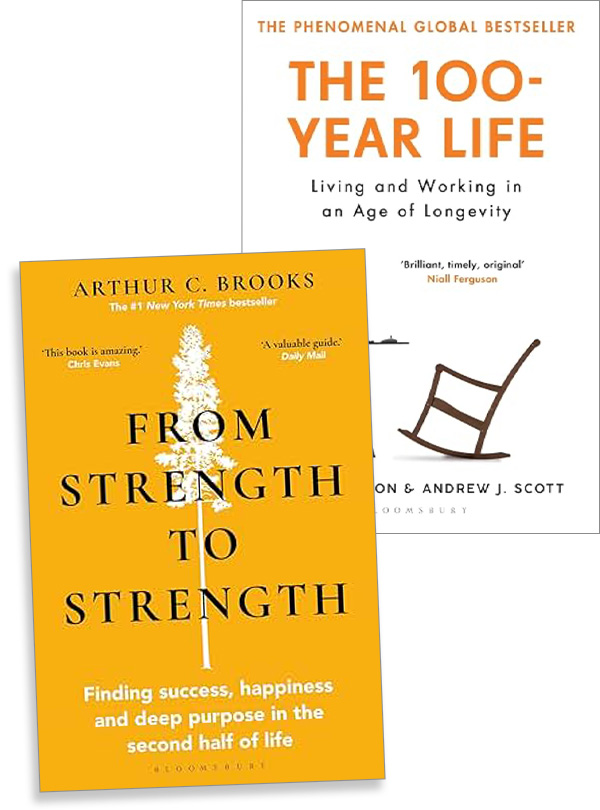
Recommended reading
Arthur Brooks’s From Strength to Strength was written for exactly this transition, though its lens is broader than retirement alone – it’s a genuinely well-evidenced case for building identity and purpose around something other than professional achievement, before that achievement inevitably ends.
Lynda Gratton and Andrew Scott’s The 100-Year Life takes the structural view – the old three-stage life of education, work, then retirement is quietly breaking down, and identity now has to be actively rebuilt more than once, not just at the end.