

A message goes unanswered and you imagine the friendship is over. You make a mistake at work and picture yourself losing your job. Before you’ve had a chance to find out what’s happened, your thoughts have reached the worst possible outcome.
This is often called catastrophising. A possibility starts to feel like a prediction, and you may also feel that you wouldn’t be able to cope if it happened.
Sometimes one worry leads quickly to another: “What if I lose my job? How will I pay the bills? What if I lose my home?” Each thought can make the next feel more convincing, even though you don’t yet know whether your job is at risk.
There may be a real problem to deal with. The difficulty is when the worst outcome takes up so much attention that it becomes hard to judge what’s likely or decide what to do next.
A few things to keep in mind…
- A frightening thought isn’t a prediction. Imagining an outcome vividly can make it feel likely. Before treating it as something that will happen, ask what you know so far and what you’re assuming.
- There may be other explanations. An unanswered message could mean someone is busy; a request to speak with your manager could be routine. You don’t have to choose the most reassuring explanation, but the worst one isn’t the only possibility.
- One problem doesn’t settle everything that follows. A mistake at work may need correcting. It doesn’t, by itself, tell you that you’ll lose your job or be unable to pay your bills. Try to deal with the part that has actually happened.
- You can consider how you’d cope, too. If a difficult outcome is possible, ask what help or options you would have. You may not welcome the situation, but that’s different from having no way to manage it.
- You can ask for help when worry is taking over. If you’re losing sleep, avoiding everyday activities or repeatedly checking for reassurance, speak to your GP or consider NHS Talking Therapies for anxiety. In England, you can refer yourself without going through your GP. The Support directory also lists urgent mental health support.
When one worry leads to another
A worst-case thought can arrive quickly. You might notice your manager seems distracted and think you’ve done something wrong. Soon you’re imagining a difficult meeting, losing your job and struggling to find another one.
By the time you notice how worried you feel, several things that haven’t happened may seem almost settled. It can help to go back to the first thought and check what started it.
You don’t need to work out exactly why you think this way before trying a different response. Start with a recent example rather than your biggest worry.
Things that may help
Write down the prediction. Try to make it specific: “My manager wants to see me because I’m going to be dismissed.” This gives you something to examine, rather than a general feeling that everything is going wrong.
Separate what you know from what you’ve imagined. In this example, you know your manager has asked for a meeting. Unless they’ve told you more, you don’t yet know what it’s about. Ask what evidence supports your prediction and whether anything points to a different outcome.
Consider other possibilities. The meeting could concern a new task, a routine update or a problem you can help solve. You don’t have to convince yourself it will be good news. The aim is to leave room for more than one explanation.
A more balanced thought might be: “I don’t know what the meeting is about. If there’s a concern, I can listen, ask questions and find out what happens next.”
Choose a useful next step. You could ask whether you need to prepare anything for the meeting. If there’s a mistake you already know about, consider how to correct it. Focus on something you can do, rather than trying to plan for every possible consequence.
Think about support if the outcome is difficult. Who could you ask for advice? What options might be available? Keep this brief and practical, so it doesn’t become another exercise in imagining everything that could go wrong.
You don’t have to feel certain
A worry may still feel convincing after you’ve checked it. That doesn’t mean you’ve done the exercise badly. You can acknowledge that you’re worried without treating the thought as a fact.
You’re looking for a fairer view of the situation, rather than a promise that nothing bad will happen.
Once you’ve considered the evidence and chosen any useful action, try returning to what you were doing. If you find yourself checking the same thought again, remind yourself that there may be no new information to consider yet.
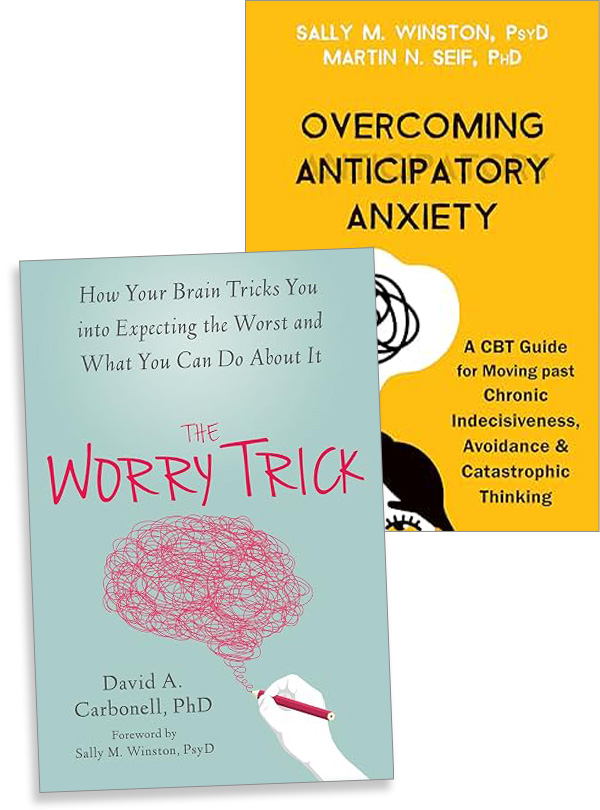
Recommended reading
If you’d like to read more about worry and worst-case thinking, these books offer explanations and practical exercises you can work through in your own time.
David Carbonell’s The Worry Trick looks at how worry can make possible dangers feel urgent. It offers ways to respond to recurring anxious thoughts without spending all your time trying to settle them.
Sally M. Winston and Martin N. Seif’s Overcoming Anticipatory Anxiety focuses on fears about situations that haven’t happened yet. It may interest you if imagining the worst is leading you to put off decisions or avoid things you’d like to do.