

You’ve compared the options, read the reviews and asked for advice, but still can’t choose. Each time you feel close to deciding, another question sends you back through it all again.
This is often called decision paralysis: feeling stuck when you need to make a choice. You may worry about regretting it, letting someone down or missing a better option.
It can happen with a major decision, such as changing jobs, or an everyday choice, such as buying an appliance. Even a smaller decision can feel difficult when money is tight or you’re already tired.
Taking time to decide can be sensible. The difficulty is when more searching leaves you no clearer, while the decision keeps taking up your time and attention.
A few things to keep in mind…
- You may not need to compare every option. Start with what matters most to you, such as cost, location or time. Setting aside options that don’t meet those needs can give you a smaller choice to work with.
- Try to name what makes the choice difficult. Are you missing information, worried about someone’s reaction or afraid of regretting it? Each calls for a different response; another comparison may not answer the question that’s keeping you stuck.
- Check whether there’s a real deadline. Some decisions can wait while you find out more. Others have a closing date or a cost to delaying. Knowing which you’re facing can help you decide how much time to give it.
- A reasonable choice may still involve doubt. You may have enough information to decide without feeling completely certain. Consider whether an option meets your needs, rather than whether you can prove it’s the best possible choice.
- Look at what you can change later. Some choices are easy to revise; others carry lasting costs or commitments. If you can try something before committing, a trial may tell you more than further research.
When more research stops helping
Comparing options is useful when it answers a question that matters. But you may reach a point where you’re reading the same reviews, asking the same people or switching between two options without learning anything new.
Before searching again, ask: “What information am I still missing, and would it change my choice?” If you can’t name it, more research may not be the next useful step.
Sometimes there’s a genuine conflict between things you value. One job offers better pay; another gives you more time at home. No amount of searching can make either option offer everything. You may need to decide which matters more in your circumstances now.
Things that may help
Set a few clear requirements. If you’re buying an appliance, these might be your budget, the space available and the features you’ll actually use. Write them down before comparing models, so an appealing extra doesn’t keep changing what you’re looking for.
Make a short list. Choose two or three options that meet those requirements. Compare them on the same points, rather than collecting every available detail. If none meets an essential need, reconsider the options or what’s realistically available.
For an everyday purchase, the question might be: “Will this do what I need at a price I can afford?” You don’t have to establish that nothing better exists.
Give the decision an appropriate amount of time. You could choose an appliance after one final comparison tomorrow. A major commitment may need longer and advice from someone qualified. Set a time to review what you know, rather than forcing a choice before important questions are answered.
Ask for help with a specific question. Instead of “What should I do?”, try “Have I overlooked any running costs?” or “What would this change mean for my working hours?” This can give you useful information while leaving the decision with you.
Try a smaller step where possible. Before signing up for a course, attend an introductory session. Before making a career change, speak to someone doing the work. Check any trial terms, costs or commitments rather than assuming you can easily undo the choice.
After you’ve chosen
You may still feel doubt or notice something appealing about an option you didn’t choose. That alone doesn’t tell you that you made a mistake.
Give yourself a chance to find out how the choice works in practice. You can review it if important new information appears, rather than reopening it every time you feel uncertain.
If difficulty making decisions is affecting everyday life, or comes with anxiety that feels hard to manage, speak to your GP. NHS Talking Therapies may help with anxiety; in England, you can refer yourself without going through your GP. If you need urgent mental health support, the Support directory has crisis contacts.
Recommended reading
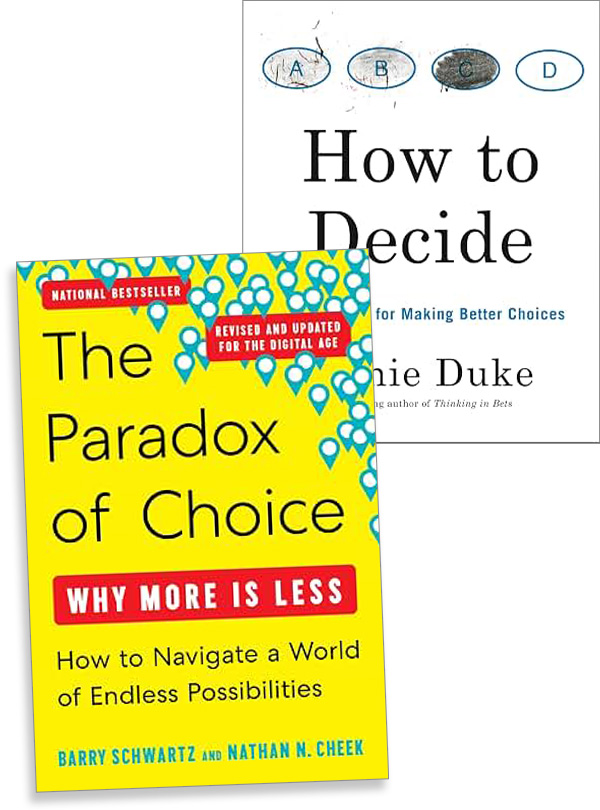
If you’d like to read more about making decisions, these books offer different approaches to comparing options and choosing without complete certainty.
Barry Schwartz’s The Paradox of Choice explores how having many options can contribute to doubt and regret. It may interest you if you find yourself searching for the best choice long after you’ve found one that meets your needs.
Annie Duke’s How to Decide offers exercises and tools for thinking through choices under uncertainty. It considers how to use the information you have, recognise what you don’t know and judge how much time a decision deserves.