
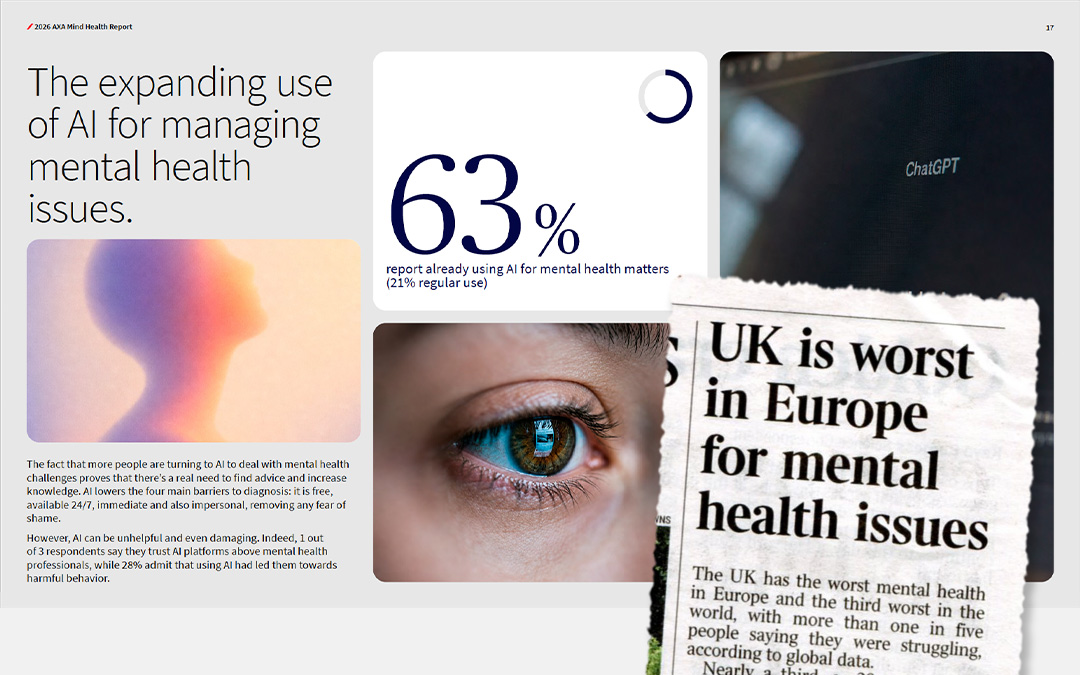
New research has named the UK the worst country in Europe for mental health, and third worst in the world. The headline is stark. What’s underneath it is more useful – and points quietly back to the same small, steady practices this site is about.
The figures come from the sixth annual AXA Mind Health Report, compiled with Ipsos from 19,000 people across 18 countries.
More than one in five people in the UK said they were struggling, and nearly a third of those described their depression, anxiety or stress as severe.
Half of everyone surveyed pointed to the same underlying cause: uncertainty about the future, in a world that keeps changing faster than we can adjust to it.
That’s the UK picture – zoom out to the full global report, and the numbers get starker still:
- Mind health keeps declining. 46% of people worldwide are now languishing or struggling – up six points since 2022, with 10 of the 16 tracked countries recording their lowest scores since the Index began.
- AI has become a genuine double-edged sword. 63% have already used AI for mind health support, but 45% were dissatisfied with the advice, and 28% say it led them towards harmful behaviour.
- Young adults are hit hardest. 59% of 18 to 24-year-olds are struggling or languishing – 13 points above the average – and they’re 2.3 times more likely to receive a severe diagnosis of depression, anxiety or stress.
- Awareness still isn’t the same as understanding. 60% haven’t seen a healthcare professional about their mind health in the past year, and 36% simply don’t believe their situation warrants medical attention.
- Workplaces have room to close the gap. 84% of employees would join a mental health support programme if their employer offered one, yet two-thirds say support at work is absent or unclear.
Where people are turning instead
Sixty per cent of people with a mental health concern hadn’t seen a professional in the past year, and a quarter said fear of being judged was part of why.
Into that gap has come something newer – almost half of Britons said they’d used AI tools for mental health support, lower than the global average of 63 per cent, but still a striking number.
A third used them to self-manage, and over 40 per cent said they trusted an AI tool more than a mental health professional. Opinion on the results was split: just over half found the advice helpful, but more than a quarter said an AI recommendation had, at some point, led them toward something harmful.
AXA UK & Ireland’s chief executive, Tara Foley, put it plainly: these are real lives behind the numbers, not just statistics.
What this doesn’t mean
It’s easy to read a report like this and feel worse, not better – one more piece of evidence that things are bad and getting worse. But there’s a steadier way to read it.
People aren’t short of resolve. They’re short of accessible, trustworthy ways to look after themselves day to day, so they reach for whatever’s nearest, whether or not it’s well suited to the job.
That’s really the gap this site tries to sit inside. Not as a replacement for a GP, a therapist, or a crisis line when one is needed, but as a place to try something small, low-stakes, and grounded in how people have actually managed distress for a long time – well before anyone thought to ask a chatbot.
A few places to start
If uncertainty is the thing sitting heaviest, a practice that brings you back into your body or your day, rather than further into your head, tends to help first.