

It’s possible to share a bed, a home and a life with someone, and still feel completely unseen by them – and that particular loneliness is harder to name than the kind that comes from being on your own.
Being physically alone and feeling alone are not the same thing. Someone can be present every evening and still be somewhere your loneliness can’t reach – because it isn’t about proximity, it’s about not being known.
This is often harder to talk about than solitary loneliness, precisely because it sounds like it shouldn’t be possible. You have a partner. Saying otherwise can feel like an accusation, or an admission that something’s gone wrong you can’t quite point to.
Loneliness was never really about how many people are in the room. It’s about the gap between the closeness you want and the closeness you’re actually getting.
Worth knowing…
A few things make this particular loneliness harder to see, both for the person feeling it and the partner beside them:
- It’s often mistaken for a smaller complaint. “We don’t talk much anymore” sounds minor next to what’s really underneath it – a slow loss of feeling known by the person closest to you.
- It can build gradually enough that neither partner notices. Nobody usually decides to stop being emotionally available. It tends to happen through years of small, unremarked absences.
- One partner reaching harder can push the other further away. A common pattern: one person pursues connection, the other withdraws from the pressure of it, deepening the loneliness that started the pursuing.
- It’s not necessarily a sign the relationship is ending. Plenty of relationships that outwardly look stable have this loneliness running underneath them for years.
- Guilt often stops people naming it. Admitting you feel lonely next to someone you love can feel like a betrayal of them, so it frequently goes unsaid.
Why this happens
Loneliness researchers draw a sharp line between social isolation and emotional isolation – having people around you is not the same as having someone who truly knows you. A long partnership can supply the first without the second, and it’s the second one that determines whether you feel lonely.
Loneliness, at its core, isn’t the absence of people. It’s the gap between the closeness you want and the closeness you’re actually getting.
One well-documented pattern makes this gap worse: one partner pursues connection while the other withdraws from the pressure of being pursued. The more one partner pushes, the more the other pulls back, and the loneliness that started the pushing only deepens.
What actually helps
Naming the loneliness directly, without it being an accusation, tends to work better than raising it as a complaint. “I’ve been feeling far away from you lately” lands differently to “you never talk to me anymore.”
It also helps to get specific about what closeness would actually look like, rather than leaving it as a vague sense that something’s missing.
Where the pursue-withdraw pattern has taken hold, it helps for the withdrawing partner to understand that distance doesn’t feel neutral to the other person – it feels like confirmation of the loneliness driving the pursuit.
What this isn’t
This loneliness is not proof the relationship is over. It’s usually proof that something in it needs attention, which is a very different thing.
It’s also not a verdict on either partner’s character. It’s a pattern that usually built up slowly enough that neither person chose it on purpose.
If the loneliness has sat there a long time, feels impossible to raise without a fight, or is tangled up with a broader disconnection neither of you can shift alone, that’s exactly what couples counselling is built for – not a last resort, but a reasonable next step.
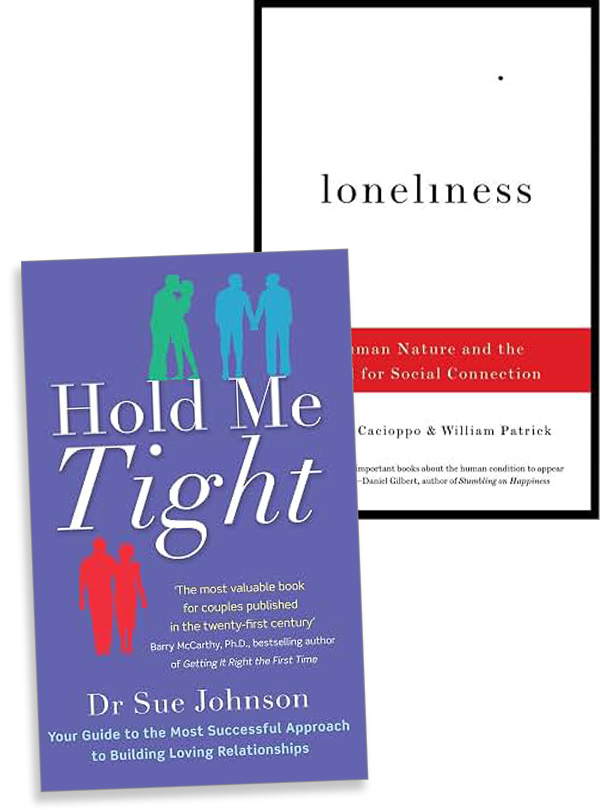
Recommended reading
Sue Johnson’s Hold Me Tight is the clearest practical route back from this distance – built on Emotionally Focused Therapy, it treats emotional disconnection as an attachment problem with a real, teachable way through it.
John Cacioppo’s Loneliness is the wider lens – less about couples specifically, more about what loneliness does to a person, which helps explain why this kind can feel so disproportionately heavy.